Cone
At a Glance
- Frequency: 14 sub-parts across 12 of 13 years (2013, 2014, 2015, 2016, 2018, 2019, 2020, 2021, 2022, 2023, 2024, 2025)
- Priority tier: T1
- Marks (count): 10 (6), 13 (2), 15 (5), 20 (1)
- Average solve time: ~11 min
- Difficulty mix: medium 10, hard 4
- Section: A | Dominant type: proof
Why This Chapter Matters
The cone is the second most-tested T1 topic in Paper 1, appearing in 12 of the last 13 years. Unlike the sphere, which always delivers a calculation question, the cone asks for proofs about as often as computations — and those proofs recycle the same two or three ideas every time. Master the generator-parametrisation method, the perpendicular-generator criterion, and the reciprocal-cone duality, and you own every variant the examiner can construct. That is roughly 15 secure marks per sitting.
Minimum Theory
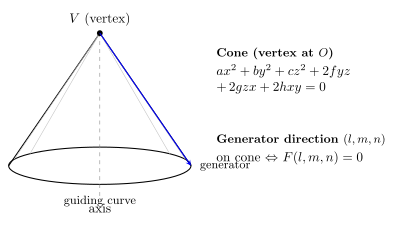
The cone and its equation. A cone is the surface swept by lines (generators) through a fixed point (the vertex) meeting a fixed curve (the guiding curve) in one plane. When is the origin, the cone equation is homogeneous of degree 2: A direction lies on the cone iff . For a general vertex at , the equation is a cone iff completing the square drives the constant to zero: For a general second-degree surface , the vertex is the unique point where ; verify it is a cone by checking .
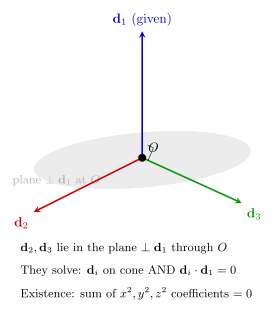
Perpendicular generators. A cone with vertex at admits a triple of mutually perpendicular generators iff . Given one generator , the other two are the intersection of the cone with the plane through perpendicular to (a single quadratic that factors into two real directions, automatically perpendicular to each other). The plane cuts the cone in perpendicular generators iff The set of such planes is tangent to the reciprocal cone .
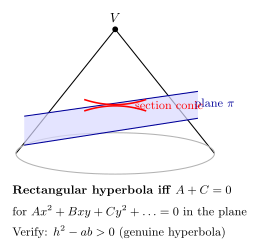
Enveloping cone and plane sections. Lines from an external point tangent to a sphere generate the enveloping cone , where and is the polar of . A conic section is a rectangular hyperbola iff (asymptotes perpendicular); confirm it is a genuine hyperbola via .
Question Archetypes
Seven recurring patterns cover every cone question in the corpus. Classify the question in seconds, then jump to the matching section.
| Archetype | You are seeing this when… |
|---|---|
| cone-from-vertex-curve | ”Find the cone with vertex … and guiding curve …“ |
| perpendicular-generators | one generator is given; find the other two mutually perpendicular generators |
| plane-section-type | show a plane cuts the cone in perpendicular lines or a rectangular hyperbola |
| perp-generator-condition | derive or use the condition ; involve the reciprocal cone |
| cone-equation-condition | prove a second-degree equation is a cone iff |
| cone-from-normals | lines from parallel to conicoid normals at a plane section generate a cone |
| cone-vertex | ”Find the vertex of the cone …“ |
cone-from-vertex-curve (3 question(s); 2018, 2023, 2025)
Recognition Cues
- Question says “find the cone with vertex and guiding curve ” (or guiding circle in another plane).
- Alternatively: “lines from to a circle/curve generate a cone” — still the same parametric construction.
- You have a vertex, a plane, and a curve in that plane. Nothing else.
Solution Template
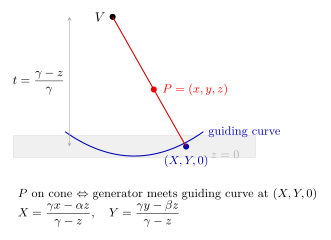
- Parametrise the generator. Let be a general point of the cone. The generator through and meets the guiding plane (say ) at some point .
- Express via . On the parametric line , setting gives (assuming ). Then and .
- Impose the guiding-curve condition . Substitute and multiply through by to clear denominators.
- Simplify to get — the cone equation in .
- Verify: the vertex satisfies the equation, and setting recovers the guiding curve.
Worked Example(s)
2018 Paper 1, 2018-P1-Q4c (13 marks)
Find the equation of the cone with as the vertex and as the guiding curve.
1 — Parametrise. Vertex . Generator through and meets at . Parametrically . From the -component, . Hence
2 — Impose guiding curve. gives
3 — Result.
Verify: at : ✓. At : ✓.
2023 Paper 1, 2023-P1-Q2c-ii (10 marks)
The plane meets the axes at . Prove that the cone from to the circle has equation .
1 — The sphere through . The sphere passes through the origin and through , , (check each: e.g. at , ✓). So the circle is the intersection of this sphere with the given plane.
2 — Parametrise. A ray from through is . It meets the plane at , so .
3 — On the sphere. Substituting into the sphere: . For , divide by and substitute:
4 — Cross-multiply and expand. Both sides have which cancels, leaving cross terms only:
5 — Divide by and recognise :
2025 Paper 1, 2025-P1-Q1e (10 marks)
Find the equation of the cone with vertex and guiding curve .
1 — Parametrise. Vertex . Generator to meets at parameter . Intersection point: , .
2 — Impose guiding curve :
3 — Expand (rename ):
Verify: at : ✓. At : ✓.
Common Traps
- When the guiding curve is quadratic, the factor in the denominator cancels cleanly with the degree-2 numerator — expect no denominators in the final equation.
- For the sphere-through- variant (2023): the sphere is the key insight; don’t try to work with the plane alone.
- Always verify the two defining conditions: (a) vertex satisfies the equation, (b) setting (or , etc.) recovers the guiding curve.
perpendicular-generators (3 question(s); 2015, 2016, 2020)
Recognition Cues
- “One of three mutually perpendicular generators is ; find the other two.”
- “Show the cone has an infinite set of mutually perpendicular generator triads.”
- The cone equation has no terms (so the existence criterion is trivially satisfied).
Solution Template
- Existence check. Write the cone as . It has mutually perpendicular generator triples iff . (When all square terms are absent, and the condition holds automatically — state this explicitly for the “show infinitely many” part.)
- Set up the perpendicularity constraint. If is the given generator, the other two have directions satisfying .
- Parametrise. Express in terms of from the perpendicularity condition.
- Substitute into the cone equation. You get a homogeneous quadratic in — factor it (always factors over when the cone has the right structure).
- The two roots give and . Recover the full direction from each root using the perpendicularity relation.
- Verify all three pairwise dot products are zero, and each direction satisfies the cone equation.
Worked Example(s)
2015 Paper 1, 2015-P1-Q2d (13 marks)
If is one of three mutually perpendicular generators of , find the other two.
1 — Existence. , so ✓.
2 — Given direction. gives , so .
3 — Perpendicularity constraint. , so .
4 — Substitute into cone. with :
5 — Two directions. : direction . : direction .
Verify: , , ✓.
2016 Paper 1, 2016-P1-Q4b (10 marks)
Show the cone has infinitely many mutually perpendicular generator triads. If is one generator, find the other two.
1 — Infinitely many triads. The cone has no terms, so . Hence every triad satisfying the constraints is mutually perpendicular, and one exists through any direction on the cone — infinitely many.
2 — Given direction. .
3 — Perpendicularity. .
4 — Substitute into cone :
5 — Directions. : . : .
2020 Paper 1, 2020-P1-Q3c (15 marks)
The line is one of three mutually perpendicular generators of . Find the other two.
Same cone and same generator direction as 2015-P1-Q2d; the computation proceeds identically.
1–5. . Perpendicularity: . Cone: . Directions: (i.e. direction equivalently), .
Verify (all six dot products and cone-equation checks): all zero ✓.
Common Traps
- Existence criterion: the condition refers to the coefficients of in the cone equation, not the cross-term coefficients. When the equation has no terms at all (as in all three problems above), the condition holds trivially — state it explicitly.
- After factoring the quadratic in , recover from the perpendicularity relation (not from the cone equation again — that’s circular).
- Direction signs are irrelevant: and define the same line through the origin. Either form is accepted.
- The mutual perpendicularity of and is automatic once they are found by this method — but still verify it for the final check mark.
plane-section-type (3 question(s); 2013, 2014, 2019)
Recognition Cues
- “Show that the plane cuts the cone in perpendicular lines” — use the direct-substitution route or the standard formula.
- “Show that the plane cuts the cone in a rectangular hyperbola” — check and .
- “Prove that the vertex lies on the fixed circle …” — impose two conditions on a vertex to derive its locus.
- Enveloping-cone variant: “Find the enveloping cone … and prove the section is a rectangular hyperbola.”
Solution Template
For perpendicular-lines check (direct):
- Use the plane to eliminate one variable from the cone equation.
- The result is a quadratic in two variables in that plane; check if it has two real perpendicular lines.
- Two lines are perpendicular iff the sum of coefficients of the squared terms is zero ( for ), OR use the standard formula below.
Standard formula: For cone cut by plane :
For rectangular hyperbola (enveloping cone):
- Write the enveloping cone (sphere , pole , , polar ).
- Intersect with the given plane by setting one variable to 0.
- Collect terms; check and .
For locus of vertex (2013-style):
- Write the cone equation in terms of an unknown vertex .
- Impose extra conditions (point on cone, section type) to get equations in .
- Together those equations describe the locus.
Worked Example(s)
2013 Paper 1, 2013-P1-Q4b (15 marks)
A cone has guiding circle and passes through . If the section is a rectangular hyperbola, prove the vertex lies on .
Let with . A point is on the cone iff its generator from meets in the guiding circle. Parametrising gives , .
Condition I — passes through . Substitute and simplify:
Condition II — section is a rectangular hyperbola. Set in the cone equation; read off the and coefficients and set their sum to zero:
Combine. Substitute (II) into (I) (replacing by ):
The vertex satisfies both (II) and (III). Renaming :
2014 Paper 1, 2014-P1-Q1e (10 marks)
Examine whether cuts in perpendicular lines.
Direct route. Set : The section is . Since with equality only at the origin, no real lines exist.
Standard formula. For the cone : , . Plane :
2019 Paper 1, 2019-P1-Q2c-ii (10 marks)
Prove that cuts the enveloping cone of from vertex in a rectangular hyperbola.
1 — Enveloping cone. ; . Cone: .
2 — Set .
3 — Check rectangular hyperbola. (coeff ), (coeff ): ✓. Also , confirming a genuine (non-degenerate) hyperbola.
Common Traps
- Rectangular hyperbola requires both and . The first condition alone only means the asymptotes are perpendicular; without the second you haven’t ruled out a degenerate pair of real perpendicular lines or a single point.
- Enveloping cone: is the polar of the vertex with respect to the sphere; never substitute the vertex directly into for .
- Standard perpendicularity formula: the formula applies to generators through the vertex (lines of the cone), not to arbitrary curves; apply it only when the plane passes through the vertex.
- In the 2013 locus question: deriving condition (I) and condition (II) separately, then combining them, is the only systematic path. Trying to guess the locus equations from the statement doesn’t constitute a proof.
perp-generator-condition (2 question(s); 2021, 2022)
Recognition Cues
- Question involves a diagonal cone (no cross terms).
- You must derive or use the condition for a cutting plane .
- The reciprocal cone appears or must be introduced.
Solution Template
Deriving the condition (2022-style):
- Parametrise: let be the slope ratio of a direction in the plane; substitute into the cone.
- The quadratic in has two roots (the two generators). By Vieta: and .
- Compute from the plane equation: .
- Perpendicularity: (from ).
- Assemble and simplify to get .
Using the condition (2021-style):
- State the perpendicular-generator condition : .
- Write the tangency condition for the plane to touch the reciprocal cone : .
- Observe the two conditions are identical — done.
Worked Example(s)
2022 Paper 1, 2022-P1-Q4c (15 marks)
Plane cuts in perpendicular generators: prove .
Both surfaces pass through ; the intersection consists of two lines through with directions and .
Step 1. From the plane ; substitute into the cone to get
Step 2. Vieta: ; .
Step 3. From :
Step 4. Perpendicularity divided by :
Step 5. Multiply by and collect:
2021 Paper 1, 2021-P1-Q2a (20 marks)
Show that planes which cut in perpendicular generators touch .
Step 1 — Perpendicular-generator condition (proved in 2022-P1-Q4c):
Step 2 — Tangency condition. For cone with diagonal coefficients , , , the plane through the vertex is tangent iff
Multiply through by :
But also equals . These are the same (both are equivalent to by the same identity).
Hence: plane cuts cone in perpendicular generators plane touches .
Common Traps
- The reciprocal cone has coefficients , , — the reciprocals of the summed coefficients in . Don’t invert the wrong way.
- The derivation in 2022 assumes ; the result is symmetric in so the formula holds regardless.
- The perpendicularity condition is symmetric in and : this encodes a geometric duality between cones.
cone-equation-condition (1 question(s); 2014)
Recognition Cues
- “Prove represents a cone iff .”
- A quadric without cross terms is given; you must find the condition on the constant term.
Solution Template
- Complete the square in each of : group , etc.
- The equation becomes (shifted coords , etc.).
- This is a cone (with vertex at the new origin) iff the RHS is zero.
- State the vertex location in original coordinates: .
Worked Example(s)
2014 Paper 1, 2014-P1-Q4a-ii (10 marks)
Prove represents a cone iff .
Complete the square:
Let , , . The equation is where .
A surface is a cone iff , i.e.
The vertex is at , i.e. in original coordinates.
Common Traps
- The vertex of the cone is at the shifted origin , not the original origin.
- For the surface to be a non-degenerate cone (not just a single point), must not all have the same sign. If all are positive and , the only solution is — a single point, not a proper cone.
- Requires ; if any is zero the variable is absent and the equation is not a general quadric.
cone-from-normals (1 question(s); 2014)
Recognition Cues
- “Lines drawn from parallel to normals to a conicoid at points of intersection with a plane generate the cone …”
- You see a conicoid , a plane , and a candidate cone equation to prove.
Solution Template
- Normal direction. At on , the normal direction is .
- Parametrise line from . , so , , .
- Conicoid constraint gives .
- Plane constraint gives , so .
- Eliminate : square the plane relation and equate with the conicoid relation.
Worked Example(s)
2014 Paper 1, 2014-P1-Q4b (15 marks)
Show that lines from parallel to normals to at its intersection with generate the cone .
Steps 1–4. Conicoid: (call this A). Plane: (call this B).
Step 5. Square B and equate with A:
This is homogeneous of degree 2 in — a cone with vertex at , as required.
Common Traps
- The normal direction at on is , not .
- Squaring the plane relation (to eliminate ) introduces both directions of the normal (the cone contains lines parallel to ) — this is geometrically correct.
- Both sides of the final equation are homogeneous of degree 2 — verify this as a sanity check.
cone-vertex (1 question(s); 2024)
Recognition Cues
- “Find the vertex of the cone ” where is a general second-degree polynomial.
- The equation contains cross terms and linear terms (not just a pure quadratic).
Solution Template
- Compute the three partial derivatives and set each to zero. This gives three linear equations in .
- Solve the linear system (usually by substitution or Gaussian elimination).
- Verify . If the system has a unique solution but , the surface is not a cone — report accordingly.
Worked Example(s)
2024 Paper 1, 2024-P1-Q3c (15 marks)
Find the vertex of the cone .
Partials:
Solve. From (1): . Substitute into (2): . Into (3): . Then , , .
Verify. ✓.
Common Traps
- Setting gives only the candidate vertex. The surface is a cone only if at the solution — always verify.
- When differentiating w.r.t.\ , get (not ) — sign errors in the partial of cross terms are common.
- The linear system may have no solution (then no vertex — the quadric is not a cone) or a line of solutions (degenerate cases not seen in UPSC so far).
Marks-Aware Writing
10-mark questions (computation or short proof): Set up the method in one sentence, execute the algebra, box the answer. For perpendicular-generators: state the existence criterion (one line), then the full calculation. For enveloping cone: write explicitly, substitute, and read off the section. A single verification step at the end.
13-mark questions (slightly extended): Same as 10-mark but include an explicit verify step and state each intermediate result clearly. For cone-from-vertex-curve: make the parametrisation explicit (show , , ).
15-mark questions (proof with multiple conditions, or full perpendicular-generator set): Prove existence first, then compute. For the perpendicular-generators type: verify all three pairwise dot products and all three on-cone checks. For locus problems (2013 style): derive each condition with a labelled equation number.
20-mark question (2021-style reciprocal-cone duality): Use a structured proof format — state the two conditions separately, show their equivalence, conclude. A geometric interpretation sentence earns the final marks.
Practice Set
Work these in exam conditions (no notes). Each question is from an actual UPSC paper.
| Year | Paper/Q | Marks | Archetype | One-line hint |
|---|---|---|---|---|
| 2025 | P1-Q1e | 10 | cone-from-vertex-curve | Vertex , plane ; find from setting -coord to zero |
| 2024 | P1-Q3c | 15 | cone-vertex | Set all three partials of to zero; solve the linear system; verify |
| 2023 | P1-Q2c-ii | 10 | cone-from-vertex-curve | The sphere through is |
| 2022 | P1-Q4c | 15 | perp-generator-condition | Parametrise intersection by slope ratio ; Vieta + perpendicularity gives the identity |
| 2021 | P1-Q2a | 20 | perp-generator-condition | Compare perp-gen condition with tangency condition for the reciprocal cone |
| 2020 | P1-Q3c | 15 | perpendicular-generators | Same cone and generator as 2015; state existence first, then intersect cone with |
| 2019 | P1-Q2c-ii | 10 | plane-section-type | Enveloping cone ; set ; check and |
| 2018 | P1-Q4c | 13 | cone-from-vertex-curve | from the -component; divide; the clears cleanly |
| 2016 | P1-Q4b | 10 | perpendicular-generators | State existence by trace-zero; then find other two from cone perp plane |
| 2015 | P1-Q2d | 13 | perpendicular-generators | Direction from is ; cone + perp plane → quadratic in |
| 2014 | P1-Q1e | 10 | plane-section-type | Two routes: direct substitution () + standard formula (answer ) |
| 2014 | P1-Q4a-ii | 10 | cone-equation-condition | Complete the square; cone iff the constant on RHS vanishes |
| 2014 | P1-Q4b | 15 | cone-from-normals | Normal at a conicoid point has direction ; parametrise from ; eliminate the foot-point |
| 2013 | P1-Q4b | 15 | plane-section-type | Derive two conditions on vertex : passes through + rectangular hyperbola; combine to get locus |