Cylinder
At a Glance
- Frequency: 4 sub-parts across 4 of 13 years (2020, 2021, 2024, 2025)
- Priority tier: T3
- Marks (count): 10 (3), 15 (1)
- Average solve time: ~8 min
- Difficulty mix: medium 4
- Section: A | Dominant type: derivation
Why This Chapter Matters
Cylinder questions appear in Section A at 10–15 marks, consistently, in recent years. Both archetypes use the same core idea: a cylinder is the set of all lines (generators) with a fixed direction that pass through a guiding curve. The derivation is algorithmic — project a general point back along the generator direction onto the guiding curve’s plane, substitute into the curve, and rename. Master this one procedure and both archetypes are covered.
Minimum Theory
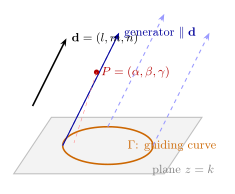
General cylinder. A cylinder with generator direction and guiding curve in a plane consists of all straight lines parallel to that intersect . A point lies on the cylinder if and only if the generator through (parallel to ) meets .
Derivation strategy. Let . The generator through is . Find the parameter that puts this point in the plane of ; substitute the resulting coordinates into the equation of ; then replace with .
Right circular cylinder. For the special case where the guiding curve is a circle (intersection of a sphere and a plane), the cylinder’s axis passes through the circle’s centre with the plane’s normal as direction. Use: (distance from axis) = (radius of circle), equivalently where is the circle’s centre, is the unit axis direction, and is the circle’s radius.
Question Archetypes
| Archetype | Recognition |
|---|---|
| cylinder-from-curve | Generators parallel to a given line; guiding curve given as a conic in a plane |
| right-circular-cylinder | Right circular cylinder through a circle (intersection of sphere and plane) |
cylinder-from-curve (3 question(s); 2020, 2021, 2025)
Find the equation of the cylinder with given generator direction and guiding curve
Recognition Cues
- “Generators parallel to ” or “parallel to the line …”.
- “Guiding curve” or “passing through the curve” — a conic (circle, ellipse) in a plane.
- The plane of the guiding curve is usually or .
Solution Template
- Identify direction and guiding plane (e.g. ).
- Generator through : .
- Intersect with guiding plane: solve for , giving .
- Substitute and into the guiding curve equation.
- Rename to obtain the cylinder’s equation.
Worked Example 1
2020 Paper 1, 2020-P1-Q2c (15 marks)
Generators parallel to ; guiding curve , .
Step 1. ; guiding plane .
Step 2–3. Intersect generator with : .
Step 4. Substitute into ; multiply by 9:
Step 5. Rename:
Worked Example 2
2025 Paper 1, 2025-P1-Q2c-i (10 marks)
Generators parallel to ; guiding curve , .
Step 1. ; guiding plane .
Step 3. ; projected point:
Step 4. Substitute into ; multiply by 9:
Step 5. Expand:
Common Traps
- Solve for from the guiding plane, not . The guiding curve is in the plane in the 2020 problem; using gives the wrong intersection.
- Clear the denominators. After substituting, multiply by (the denominator squared) so the fractions disappear cleanly.
- Verify with a check point. Substituting a known point on the guiding curve should satisfy the cylinder equation. For the 2020 problem, is on and ; check: ✓.
right-circular-cylinder (1 question(s); 2024)
Right circular cylinder passing through the intersection circle of a sphere and a plane
Recognition Cues
- “Right circular cylinder passing through the circle , .”
- The axis is perpendicular to the plane; the radius is the radius of the circle, not the sphere.
Solution Template
- Find the circle’s centre : foot of perpendicular from the sphere’s centre to the plane.
- Find the circle’s radius : .
- Axis direction: unit normal to the plane.
- For a point , impose .
- Expand and simplify.
Worked Example
2024 Paper 1, 2024-P1-Q1e (10 marks)
Right circular cylinder through the circle , .
Step 1. Normal . Distance from origin to plane: . Centre: .
Step 2. .
Step 3–4. , . Condition: Multiply by 3:
Step 5. Expand: .
Common Traps
- Axis direction is the plane’s normal, not related to the sphere centre. The cylinder’s axis goes through the circle’s centre, perpendicular to the plane — not toward the sphere’s centre.
- Subtract the axial component squared. The perpendicular distance from the axis is by Pythagoras. Setting would give the wrong condition.
Marks-Aware Writing
For a 10-mark oblique cylinder: show the projected point explicitly (with the algebra for ), substitute into the guiding curve, and display the final expanded form. Three visible steps: projection, substitution, renaming.
For the 15-mark question: the same steps but show the expansion of the squared brackets. The final expanded form (with all cross terms) is expected.
For the right circular cylinder: state the circle’s centre and radius calculation, set up the Pythagoras condition explicitly, and expand to the final form.
Practice Set
- 2021-P1-Q1e (10 m) — — Hint: direction projects onto ; substitute into .