Ellipsoid
At a Glance
- Frequency: 3 sub-parts across 3 of 13 years (2019, 2020, 2022)
- Priority tier: T3
- Marks (count): 10 (1), 15 (1), 20 (1)
- Average solve time: ~14 min
- Difficulty mix: hard 2, medium 1
- Section: A | Dominant type: proof
Why This Chapter Matters
The ellipsoid delivers the widest marks spread of any T3 atom in analytic geometry: one question each at 10, 15, and 20 marks, with every archetype appearing exactly once. The two hard-rated questions (2019 and 2022) require genuine technique — normal-chord parametrisation and the classical six-normals sextic — while the 2020 tangent-plane question is a clean 10-mark computation using the pencil-of-planes method. Since the 2022 question is worth 20 marks and is genuinely difficult, prepare the tangent-plane and normal-chord archetypes for exam security, and learn the six-normals result as a statement-level theorem with the key substitution derivation.
Minimum Theory
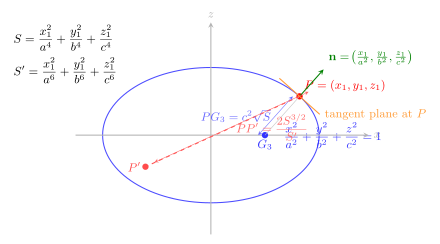
Standard ellipsoid. with semi-axes . The outward unit normal at is proportional to .
Tangent plane and tangency condition. The tangent plane at is . A plane is tangent to the ellipsoid iff Pencil of planes through a line. The line lies in every plane of the form . Tangency of one such plane is a quadratic in , giving (generically) two tangent planes through the line.
Normal chord. At on the ellipsoid, the normal direction is . Write and . Then the length of the normal chord is , and the distance from to where the normal meets the -plane is .
Six normals from an external point. From a general external point , exactly six normals can be drawn to the ellipsoid. The feet of the six normals split into two groups of three, each group lying in a plane. If the plane through the first group is , the plane through the other group is .
Question Archetypes
| Archetype | You are seeing this when… |
|---|---|
| tangent-plane-through-line | Find tangent planes to the ellipsoid passing through a given line |
| normal-chord | Find the length of the normal chord; prove a locus condition involving |
| feet-of-normals | Plane of feet of six normals; find the “reciprocal” plane through the other three feet |
tangent-plane-through-line (1 question(s); 2020)
Recognition Cues
- “Find the (equations of the) tangent plane(s) to the ellipsoid … which pass through the line …”
- The line is given as the intersection of two planes: .
- There are (generically) two tangent planes; the answer is two explicit plane equations.
Solution Template
- Write the pencil. Any plane through the line has the form . Read off the coefficients as functions of .
- Put the ellipsoid in standard form . Read off .
- Apply the tangency condition .
- Solve for . You get a quadratic (generically) with two roots .
- Write the two tangent planes by substituting and into the pencil equation.
- Verify each plane contains the line and is tangent to the ellipsoid.
Worked Example
2020 Paper 1, 2020-P1-Q1e (10 marks)
Find the equations of the tangent plane to the ellipsoid which passes through the line .
Step 1 — Pencil of planes. Any plane through the line is giving , , , .
Step 2 — Standard form. Divide by 27: , so , , .
Step 3 — Tangency condition. : The first two terms: . So: Divide by 9: . Expand: , giving .
Step 4 — Solve. .
Step 5 — Two tangent planes.
: , , , :
: , , , :
Verification. : tangency ✓. Substituting : , single contact point ✓. Plane : tangency ✓.
Common Traps
- Read off carefully. For , divide through to get the standard form; , , . Arithmetic errors here propagate through the whole calculation.
- Keep on the correct side. The pencil equation is , so (positive). If you move the constant to the left you get ; either sign convention works as long as the tangency condition uses the same .
- gives a degenerate-looking plane (the and coefficients vanish). Don’t discard it — it is a perfectly valid tangent plane.
- Always verify: (a) each plane contains the line, and (b) each satisfies the tangency condition.
normal-chord (1 question(s); 2019)
Recognition Cues
- “Find the length of the normal chord through ” — normal chord means the segment of the normal line between its two intersection points with the ellipsoid.
- “Prove that if [length condition], then lies on [a cone or surface].”
- The condition often involves , the distance from to where the normal meets a coordinate plane.
Solution Template
- Set up the normal parametrisation. At on the ellipsoid, the normal is , .
- Define and . ; .
- Find the second intersection . Substitute into the ellipsoid; one root is (at ); the other is .
- Length . .
- Find . Set the -coordinate of the normal to zero: . Then .
- Impose the condition. gives . Expand and rearrange to get the locus.
Worked Example
2019 Paper 1, 2019-P1-Q4b (15 marks)
Find the length of the normal chord through of the ellipsoid and prove that if it equals , where is where the normal meets the -plane, then lies on .
Let on the ellipsoid. Normal direction .
Step 1 — Parametrize normal. Points on the normal: .
Step 2 — Define .
Step 3 — Second intersection. Substituting into the ellipsoid and using is on it ( is one root), the other root is .
Step 4 — Chord length.
Step 5 — . Setting gives , so .
Step 6 — Impose . Expanding: Collect: Multiply by (and drop subscripts): This is homogeneous of degree 2 — a cone with vertex at the origin.
Common Traps
- Do not normalize prematurely. Both and carry the same factor , which cancels in the ratio. Normalising first forces you to carry everywhere and complicates the algebra.
- is independent of . It comes purely from setting the -coordinate to zero: . Many students forget that is on the -plane (not some other plane).
- Sign in the final locus. The computation gives but the stated form has . Both signs describe the same surface; the question’s preferred form uses for the term, so flip the sign of the whole equation if needed.
- The final locus is a cone (no constant term, homogeneous degree 2) — this is a sanity check.
feet-of-normals (1 question(s); 2022)
Recognition Cues
- “From a point, six normals are drawn to the ellipsoid; the feet split into two planes — if is , find .”
- “Show that the plane of three of the six normal feet is given by the reciprocal transformation.”
Solution Template
- Parametrise feet by . A foot satisfies , , , where is a root of the sextic obtained by substituting into the ellipsoid.
- Plane gives a cubic. Substituting the parametrised feet into gives a cubic in with roots .
- Reciprocal cubic. The full sextic factors as a product of two cubics; the cubic whose roots are is obtained by the substitution , , , in the plane equation.
- Write the reciprocal plane. This gives .
- Conclude. Verify that substituting the normal parametrisation for satisfies this plane equation.
Worked Example
2022 Paper 1, 2022-P1-Q2c (20 marks)
are feet of the six normals from a point to the ellipsoid . The plane is . Show the plane is .
Step 1 — Parametrise normal feet. From external point , the foot of a normal at parameter is: Substituting into the ellipsoid gives a sextic in with six roots .
Step 2 — Plane gives a cubic. Three feet on : Clearing denominators gives a cubic in with roots .
Step 3 — The complementary plane. Consider the plane : Substituting the normal parametrisation into : This is a different cubic in .
Step 4 — Factorisation argument. Equations and are cubics whose product (after clearing denominators) equals the sextic from Step 1 (this is the classical Salmon factorisation). Hence the three roots of are exactly — the complementary three feet.
Step 5 — Conclusion. Since correspond to values that satisfy , their coordinates satisfy :
Common Traps
- The reciprocal transformation is , , , . The sign flip on is essential; it gives the in the constant term of the reciprocal plane (not ).
- This is a classical result. UPSC expects you to set up the parametrisation, write down equation for the first cubic, and explain (at a sketch-proof level) why the complementary cubic gives the reciprocal plane. Full algebraic verification of the Salmon factorisation is not expected in 20 marks.
- Do not confuse the six feet (which lie on the ellipsoid) with the six normals (which are lines from an external point). Each normal touches the ellipsoid at exactly one foot.
- The planes and are called conjugate planes of the foot-locus; they arise from a fundamental duality of the six-normals configuration.
Marks-Aware Writing
10-mark question (tangent planes through a line): Set up the pencil in two lines, write the tangency condition, solve for (one quadratic), write the two planes. Verification is expected: show each plane contains the line and satisfies the tangency condition. Total: about 8 computation lines plus two verification checks.
15-mark question (normal chord + locus): Two parts — first derive the chord length (requires setting up the parametrisation, the quadratic in , and reading off the second root), then impose . Each part is worth roughly half the marks. Show the final locus is homogeneous of degree 2 (i.e., a cone) as a closing remark.
20-mark question (six normals, reciprocal plane): Structure: (1) parametrise the normal foot as in terms of — 4 marks; (2) derive the cubic for plane — 6 marks; (3) write the reciprocal plane and verify it corresponds to the complementary cubic — 6 marks; (4) conclude — 4 marks. At this marks level, a clean statement of the Salmon factorisation principle with a coherent algebraic structure earns full marks even if the explicit sextic polynomial is not expanded.
Practice Set
- 2018-P2-Q5a (10 m) — — Hint: tangent plane or normal to an ellipsoid; read off first.
- 2017-P1-Q3d (10 m) — — Hint: director sphere — sum orthonormal tangency conditions.
- 2016-P1-Q4d (15 m) — — Hint: director sphere at 15 marks — state orthonormality identities explicitly.