Frequency: 2 sub-parts across 2 of 13 years (2013, 2014)
Priority tier: T3
Marks (count): 15 (1), 20 (1)
Average solve time: ~22 min
Difficulty mix: hard 1, medium 1
Section: A | Dominant type: proof
Why This Chapter Matters
The hyperboloid of one sheet is the canonical example of a doubly-ruled surface: every point has two lines of each ruling family passing through it. UPSC tests exactly two things about it: (1) finding the equations of the two generators through a specific point, and (2) proving an invariant product relation involving a variable generator and fixed generators through the minor-axis endpoints. Both questions reduce to the same fundamental technique — the two-family factorisation. Master the factorisation and the parameter-substitution method and you can handle both archetypes at any marks level.
Minimum Theory
The hyperboloid of one sheet. The standard form is
a2x2+b2y2−c2z2=1.
The principal elliptic section is the curve z=0: x2/a2+y2/b2=1, an ellipse with semi-axes a (along x) and b (along y). The minor axis of this ellipse has endpoints B=(0,b,0) and B′=(0,−b,0).
Two-family factorisation. Rewrite the hyperboloid as
(ax−cz)(ax+cz)=(1−by)(1+by).
Assign one factor on each side to define two families of lines:
Family Λ(parameter λ):ax−cz=λ(1−by),ax+cz=λ1(1+by).
Family M(parameter μ):ax−cz=μ(1+by),ax+cz=μ1(1−by).
Every point on the hyperboloid lies on exactly one generator of each family. Two generators of the same family never intersect (they are skew); a generator of family Λ always meets every generator of family M.
Direction of a generator. For a generator of family Λ at parameter λ, the direction vector is (−asinθ,bcosθ,c) at the point (acosθ,bsinθ,0) on the principal section. Family M gives direction (−asinθ,bcosθ,−c) at the same point — the z-component flips.
“Find the equations of the two generating lines through the point (acosθ,bsinθ,0) of the principal elliptic section.”
A specific point on the hyperboloid is given; you need the line equations, not just the direction.
The two generators share the same (x,y)-direction (tangent to the ellipse at the point) but differ in the sign of the z-component.
Solution Template
Write the factorisation. State the hyperboloid in factored form (x/a−z/c)(x/a+z/c)=(1−y/b)(1+y/b).
Define the two familiesΛ and M with parameters λ and μ.
Substitute the given point(x,y,z)=(acosθ,bsinθ,0) into the first equation of each family to find λ and μ.
Find the direction vector. For family Λ: differentiate/parametrise along the generator or use the two-family equations at the given point to read off the direction. The direction at the principal section point simplifies to (−asinθ,bcosθ,±c).
Write the line equations through (acosθ,bsinθ,0) with the computed directions.
Worked Example
2014 Paper 1, 2014-P1-Q4c (15 marks)
Find the equations of the two generating lines through any point (acosθ,bsinθ,0) of the principal elliptic section a2x2+b2y2=1,z=0 of the hyperboloid a2x2+b2y2−c2z2=1.
Step 3 — Find λ,μ. At P=(acosθ,bsinθ,0): x/a=cosθ, y/b=sinθ, z/c=0.
From family Λ: cosθ=λ(1−sinθ)⇒λ=1−sinθcosθ.
From family M: cosθ=μ(1+sinθ)⇒μ=1+sinθcosθ.
(Both second equations are satisfied: cosθ/λ=(1+sinθ) follows from cos2θ=(1−sinθ)(1+sinθ).)
Step 4 — Direction vectors. Using 1−λ2=−2sinθ/(1−sinθ) and 1+λ2=2/(1−sinθ):
Family Λ: dΛ∝(−asinθ,bcosθ,c).
Family M: dM∝(−asinθ,bcosθ,−c).
Step 5 — Line equations.
Generator Λ:−asinθx−acosθ=bcosθy−bsinθ=cz.
Generator M:−asinθx−acosθ=bcosθy−bsinθ=−cz.
The two generators share the same (x,y)-direction (tangent to the principal ellipse at P) and are reflections of each other across the z=0 plane.
Common Traps
Both generators share the (x,y)-direction(−asinθ,bcosθ), which is the tangent to the ellipse x2/a2+y2/b2=1 at (cosθ,sinθ). Only the z-component changes sign.
The second equation of each family is automatic. If the first family Λ equation gives λ=cosθ/(1−sinθ), verify the second using cos2θ=(1−sinθ)(1+sinθ) — no separate calculation is needed.
The two families are not symmetric in y: family Λ has (1−y/b) on the right of the first equation and family M has (1+y/b). Swapping them exchanges the families.
At θ=π/2 (i.e., P=B=(0,b,0)): the formula gives sinθ=1, 1−sinθ=0, so λ→∞. At this special point, the family Λ generator reduces to y=b,x/a=z/c, and the family M generator to y=b,x/a=−z/c — read them directly from the factorised form.
generator-product-property (1 question(s); 2013)
Recognition Cues
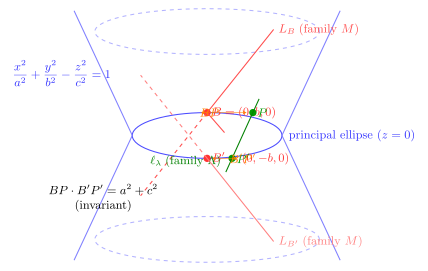
“A variable generator meets the fixed generators through the endpoints B and B′ of the minor axis in P and P′; prove BP⋅B′P′=a2+c2.”
You need to compute distances from B to P and from B′ to P′, then show their product is a constant.
The product is independent of the parameter λ of the variable generator.
Solution Template
Identify B,B′ and their generators.B=(0,b,0) lies on family M generator LB with y=b, x/a=z/c. B′=(0,−b,0) lies on family M generator LB′ with y=−b, x/a=−z/c.
Take a variable generator from family Λ at parameter λ. Find its intersection P with LB by setting y=b and solving the family Λ equations.
Find intersection P′ with LB′ by setting y=−b.
Compute BP and B′P′. Find BP=P−B and B′P′=P′−B′; compute their magnitudes.
Show BP⋅B′P′=a2+c2 by noting that ∣λ∣ and 1/∣λ∣ cancel in the product.
Worked Example
2013 Paper 1, 2013-P1-Q4c (20 marks)
A variable generator meets two generators of the system through the extremities B and B′ of the minor axis of the principal elliptic section of a2x2+b2y2−c2z2=1 in P and P′. Prove that BP⋅B′P′=a2+c2.
Step 1 — Generators through B and B′.
B=(0,b,0): substitute y=b (⇒1+y/b=2, 1−y/b=0) into the family M factorisation. The generator through B is LB:{y=b,x/a=z/c}, with direction (a,0,c).
B′=(0,−b,0): substitute y=−b (⇒1+y/b=0, 1−y/b=2) into family M. The generator through B′ is LB′:{y=−b,x/a=−z/c}, with direction (a,0,−c).
Both LB and LB′ are in family M. They are skew (different y-values, non-parallel directions).
Step 2 — Variable generator ℓλ from family Λ. At parameter λ:
ax−cz=λ(1−by),ax+cz=λ1(1+by).
Step 3 — Intersection P=ℓλ∩LB. Set y=b (so 1−y/b=0, 1+y/b=2):
x/a−z/c=0andx/a+z/c=2/λ.
Adding: 2x/a=2/λ⇒x=a/λ. Then z=c/λ.
P=(a/λ,b,c/λ).
Step 4 — Intersection P′=ℓλ∩LB′. Set y=−b (so 1−y/b=2, 1+y/b=0):
x/a−z/c=2λandx/a+z/c=0.
Adding: 2x/a=2λ⇒x=aλ. Then z=−cλ.
P′=(aλ,−b,−cλ).
Both LB and LB′ must come from the same ruling family. They are both in family M; the variable generator comes from family Λ. A generator of Λ meets every generator of M, so both intersections exist. Two generators of the same family are skew and do not intersect.
The ∣λ∣ cancellation is the entire point. Before computing the product, observe that BP∝1/∣λ∣ and B′P′∝∣λ∣; the product must be ∣λ∣-free. If your intermediate distances don’t show this structure, recheck the intersection calculation.
PDF transcription note. The 2013 paper as printed shows "z2c2" in the hyperboloid equation; the standard correct form is z2/c2. The answer a2+c2 (not a2+1/c2) is consistent with the correct form.
B=(0,b,0) is an endpoint of the minor axis of the principal ellipse only when a>b. If a<b, the endpoints (0,±b,0) are the major-axis endpoints, but the calculation is identical — the problem label “minor” refers to the b-axis regardless.
Marks-Aware Writing
15-mark question (generating lines through a point): Show the factorisation in full (2 marks), define both families (2 marks), find λ and μ by substitution (4 marks), derive the direction vectors (4 marks), write the two symmetric line equations (3 marks). A verification that each line equation is satisfied at P and that the direction lies on the tangent plane is a cheap closing check.
20-mark question (generator product property): Allocate roughly: factorisation + families (4 marks), identify LB and LB′ with justification that they are same-family and skew (4 marks), find P and P′ by explicit substitution (6 marks), compute BP and B′P′ (4 marks), compute and interpret the product (2 marks). The key sentence for full marks: “The factor ∣λ∣ in B′P′ exactly cancels the 1/∣λ∣ in BP, making the product independent of λ.”
Practice Set
2020-P1-Q4b (15 m) — — Hint: ruled surface or hyperboloid — use the two-family factorisation.
We've mapped all 13 years of this exam. Get new chapters, tools, and solutions as we release them — free.