Paraboloid (elliptic and hyperbolic)
At a Glance
- Frequency: 6 sub-parts across 6 of 13 years (2015, 2017, 2018, 2019, 2020, 2023)
- Priority tier: T2
- Marks (count): 10 (2), 13 (2), 15 (2)
- Average solve time: ~11 min
- Difficulty mix: easy 2, hard 4
- Section: A | Dominant type: derivation
Why This Chapter Matters
Paraboloid questions appear in 6 of the last 13 years and are the most technically demanding atom in Paper 1 Analytic Geometry. Four of the six questions are rated hard. The atom covers a wide range: a simple tangent-plane gradient calculation (2017), completing the square to identify canonical form (2023), finding generating lines of a ruled quadric (2018), the locus of perpendicular generators (2020), a cubic normal-count condition (2019), and an envelope-of-tangent-planes problem (2015). The first two are 10-mark easy questions handled by standard gradient/completion-of-squares; the remaining four require deeper technique and care.
Minimum Theory
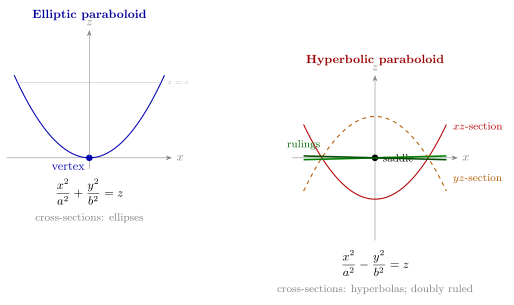
Canonical forms.
| Type | Equation | Key features |
|---|---|---|
| Elliptic paraboloid | Vertex at origin; axis along ; all cross-sections are ellipses | |
| Hyperbolic paraboloid | Saddle point at origin; two families of generating lines |
Tangent plane. At a point on the surface , the tangent plane is .
For the elliptic paraboloid : tangent at is For the general paraboloid : tangent at is .
Reduction to canonical form. Complete the square in and to eliminate cross-terms. Translate coordinates to move the vertex to the origin.
Generating lines (rulings) of the hyperbolic paraboloid. Factor as Two families of rulings (each pair of matching gives a line lying entirely on the surface):
- -family: and .
- -family: and .
Finding generators through a point. For a ruled quadric at a surface point , parametrise the line as ; substitute; the term vanishes (point is on surface); impose and to get two equations in — these factor into two directions.
Normals to a paraboloid. The normal at on passes through a given point iff a cubic equation in (the parameter along the normal) is satisfied — generically three normals.
Envelope of a family of planes. For a 1-parameter family of planes : the envelope is the curve/surface obtained by eliminating from and .
Question Archetypes
Six patterns cover all six questions in the corpus.
| Archetype | You are seeing this when… |
|---|---|
| tangent-plane-at-point | ”Find the tangent plane to [conicoid] at point “ |
| paraboloid-reduction | ”Show [equation] represents a paraboloid; find vertex, axis, principal planes” |
| generating-lines | ”Find the generating lines of [ruled quadric] through point “ |
| normals-from-point | ”Prove three normals can be drawn from ; find the coincidence-condition surface” |
| perpendicular-generators-locus | ”Find the locus of intersection of perpendicular generators” |
| tangent-plane-envelope | ”Two perpendicular tangent planes intersect on [line]; find the envelope” |
tangent-plane-at-point (1 question(s); 2017)
Recognition Cues
- “Find the equation of the tangent plane at point to the conicoid .”
Solution Template
- Verify the point lies on the surface: .
- Compute and evaluate at .
- Write the tangent plane: .
- Simplify and double-check using the split-equation shortcut.
Worked Example(s)
2017 Paper 1, 2017-P1-Q1d (10 marks, compulsory)
Find the tangent plane at to .
. Check: ✓. ; at : .
Tangent plane: :
Common Traps
- Keep track of the sign on the -term: gives , not .
- The split-equation shortcut for : replace each , , . Here: , i.e., ✓.
paraboloid-reduction (1 question(s); 2023)
Recognition Cues
- “Show that represents an elliptic/hyperbolic paraboloid.”
- “Find its vertex, principal axis and principal planes.”
Solution Template
- Complete the square in and in .
- Move all constant terms to the right side; the equation should take the form (elliptic) or with a minus sign (hyperbolic).
- Read off vertex , axis (line through vertex parallel to -axis), principal planes (the two planes of symmetry through the axis).
Worked Example(s)
2023 Paper 1, 2023-P1-Q2c-i (10 marks)
Show is an elliptic paraboloid. Find its principal axis and planes.
Complete the square: Divide by 12: .
This is canonical form — elliptic paraboloid with vertex .
Common Traps
- Track the signs on the completing-the-square constants carefully: , so the residual is etc.
- The “principal planes” for a paraboloid are the two planes of symmetry through the axis — each is parallel to one coordinate plane and contains the axis.
generating-lines (1 question(s); 2018)
Recognition Cues
- “Find the equations of the generating lines of [ruled quadric] through point .”
- The surface equation is often presented as a product of two linear forms.
Solution Template
- Verify is on the surface.
- Parametrise: .
- Substitute into ; expand as a polynomial in .
- The coefficient vanishes (P on surface). Set (linear condition on ) and (quadratic condition).
- From the linear condition express in terms of ; substitute into the quadratic to get a factored equation in ; two factors give two direction ratios.
Worked Example(s)
2018 Paper 1, 2018-P1-Q3c (13 marks)
Find the generating lines of through .
Verify: ✓.
Parametrise . Substituting, the coefficient gives: The coefficient gives . Substituting and multiplying by : Two cases:
- : take , . Line: .
- : take , . Line: .
Verification: substitute into : ✓.
Common Traps
- The surface must be a ruled quadric (product of two linear forms or similar structure) for generating lines to exist.
- The term vanishes automatically; missing the condition means you only impose and find only one equation — not two directions.
- The quadratic in always factors for a ruled quadric; if you can’t factor it, recheck arithmetic.
normals-from-point (1 question(s); 2019)
Recognition Cues
- “Prove that three normals can be drawn from a given point to the paraboloid .”
- “If the point lies on the surface , two normals coincide.”
Solution Template
- Write the normal direction at a surface point : for it is .
- Parametrise the normal through the external point : write in terms of a parameter .
- Impose that the foot lies on the surface: this gives a cubic in (three roots = three normals).
- The cubic has a repeated root (two normals coincide) iff its discriminant ; compute and identify the algebraic surface .
Worked Example(s)
2019 Paper 1, 2019-P1-Q3b (15 marks)
Prove three normals can be drawn from to ; find the coincidence-condition surface.
Normal at has direction . The foot satisfies , , . Substituting into : Expanding, this is a cubic in with leading coefficient — three roots in general.
A repeated root requires . Computing and factoring the discriminant: which (replacing ) is:
Common Traps
- The normal direction at on is (not — the gradient gives , which is proportional to ).
- The derivation of the cubic requires careful expansion; confirm the leading coefficient is (not zero) to assert it genuinely is a cubic.
- The discriminant carries spurious factors; discard and (which zero out only in degenerate cases) to isolate the geometric condition.
perpendicular-generators-locus (1 question(s); 2020)
Recognition Cues
- “Find the locus of the point of intersection of perpendicular generators of the hyperbolic paraboloid .”
Solution Template
- Write down the two families of rulings using the factored form.
- Find the direction vectors of a -ruling and a -ruling (cross-product of the two plane normals for each family).
- Impose perpendicularity: ; express as a condition on .
- At the intersection point, express using the ruling equations; substitute the perpendicularity condition.
Worked Example(s)
2020 Paper 1, 2020-P1-Q4b (15 marks)
Locus of intersection of perpendicular generators of .
-generator direction (after cross-product of its plane normals, scaled by ): .
-generator direction: .
Perpendicularity: .
-coordinate of intersection: From the ruling equations, .
The locus is the plane:
Common Traps
- The two perpendicular generators must come from different families (- and -families), not from the same family.
- The direction vectors scale by ; include this factor consistently in both and before taking the dot product.
- The locus is a constant- plane, not a curve; and remain free.
tangent-plane-envelope (1 question(s); 2015)
Recognition Cues
- “Two perpendicular tangent planes to [paraboloid] intersect in a straight line in the plane . Obtain the curve this line touches.”
- The answer is the envelope of a 1-parameter family of lines.
Solution Template
- Write the tangent-plane equation at a general point : for .
- Perpendicularity of two such planes: .
- Line in : both planes restricted to must coincide, forcing , . Perpendicularity then gives .
- Write the 1-parameter family of lines ; find the envelope by eliminating from and .
Worked Example(s)
2015 Paper 1, 2015-P1-Q4c (13 marks)
Two perpendicular tangent planes to intersect in a line in . Find the curve this line touches.
Tangent plane at : .
For two planes to intersect along a line in : , . Perpendicularity: , so .
On both planes give , i.e.:
Envelope: . Substitute:
Common Traps
- “Intersect in a line in ” forces the traces of both planes on to coincide. This gives and — both conditions must be derived, not guessed.
- In the perpendicularity condition, the normals of the tangent planes are ; the dot product includes the from the -components.
- The envelope step is and simultaneously — don’t confuse with .
Marks-Aware Writing
10-mark questions (2017, 2023): Tangent plane: three lines (verify point, gradient, equation). Paraboloid reduction: display the completing-the-square step clearly, state the canonical form, identify vertex/axis/planes.
13-mark questions (2015, 2018): Show all intermediate steps — the factoring of the quadratic condition (2018) or the envelope derivation (2015) is worth 5–6 marks on its own.
15-mark questions (2019, 2020): These need systematic setup. For normals: derive the cubic, state its degree and leading coefficient, then address the discriminant. For perpendicular generators: write the ruling families, direction vectors, dot product — each step is a mark.
Practice Set
| Year | Paper/Q | Marks | Archetype | One-line hint |
|---|---|---|---|---|
| 2019 | P1-Q3b | 15 | normals-from-point | Normal at : direction ; parametrise external point; substitution gives cubic in ; discriminant yields |