Plane
At a Glance
- Frequency: 5 sub-parts across 5 of 13 years (2013, 2015, 2018, 2023, 2024)
- Priority tier: T2
- Marks (count): 10 (2), 12 (1), 20 (1), 6 (1)
- Average solve time: ~6 min
- Difficulty mix: easy 3, medium 2
- Section: A | Dominant type: computation
Why This Chapter Matters
Planes are the simplest surfaces in 3D and underpin virtually every other analytic-geometry topic — lines, conicoids, and reflection problems all reduce to plane equations at some stage. UPSC has set a plane question in 5 of the last 13 years with marks ranging from 6 to 20, making this one of the most reliable high-value atoms in Section A. Because the three archetypes are structurally distinct, a candidate who learns each template scores cleanly and quickly.
Minimum Theory
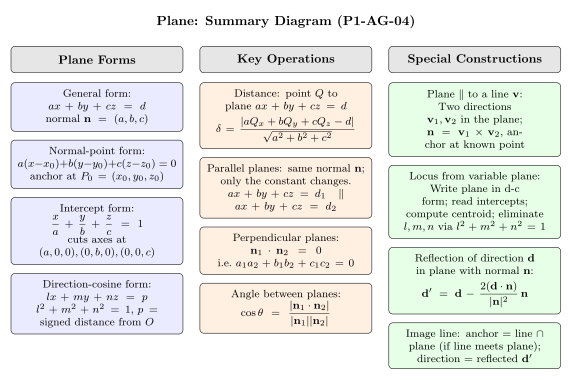
Plane forms. Every plane in can be written as , where is the normal vector. If the plane passes through a known point , it takes the point–normal form . When the plane cuts the coordinate axes at , , (none zero), the intercept form is . The direction-cosine form (with ) has equal to the perpendicular distance from the origin.
Distance formula. The perpendicular distance from a point to the plane is
Parallel and perpendicular planes. Two planes and are parallel when (equivalently, ) and perpendicular when (i.e., ). For parallel planes only the constant changes; the normal is kept identical.
Normal from two directions. If two direction vectors and lie in the plane, the normal is . This is the key construction for building a plane through given points or parallel to a given line.
Reflection of a direction in a plane. If a line has direction vector and the reflecting plane has unit-normal , the reflected direction is The reflected line passes through the intersection of the original line with the plane (the anchor point is unchanged).
Question Archetypes
| Archetype | Recognition |
|---|---|
| plane-construction | ”find a plane through given points/line, parallel (or perpendicular) to a given plane or axis” |
| locus-from-variable-plane | ”variable plane at fixed distance from origin cuts axes; find locus of centroid/foot” |
| reflection-in-plane | ”find image/reflection of a line in a plane” |
plane-construction (3 question(s); 2013, 2015, 2018)
Construct a plane from point/parallelism/distance constraints
Recognition Cues
The question supplies two or more of: a set of points the plane must contain, a line it must be parallel to, or another plane it must be parallel/perpendicular to. You are asked to find the equation of the plane and, in harder variants, the distance from an external point to it.
Solution Template
- Identify which directions lie in the plane (two points give a direction vector; a parallel line gives its direction vector).
- Compute .
- Write the plane in point–normal form anchored at any known point; expand and simplify to .
- If distance is asked, apply the distance formula using the given external point.
Worked Example 1
2013 Paper 1, 2013-P1-Q1d (10 marks)
Find the equation of the plane through and , and parallel to the line joining and . Also find the distance from to the plane.
Step 1 — two directions in the plane.
.
Direction of the given line: .
Step 2 — normal vector.
Step 3 — plane equation (anchor at ):
Verify the line is parallel: . ✓
Step 4 — distance from :
Worked Example 2
2015 Paper 1, 2015-P1-Q3c-i (6 marks)
Find the equation of the plane passing through and , and parallel to the -axis.
Key observation. Parallel to the -axis means the direction lies in the plane, so the -coefficient of the normal is zero. Write the plane as .
Substitute the two points:
- : .
- : .
Subtract: .
Then . Divide through by :
Worked Example 3
2018 Paper 1, 2018-P1-Q4d (12 marks)
Find the equation of the plane through and parallel to .
Parallel plane: the normal is the same, . Any parallel plane has the form .
Substitute :
Note: , confirming the two planes are distinct and truly parallel.
Common Traps
- Parallelism check. After finding the plane, always verify for every line the plane is supposed to be parallel to. A wrong sign in the cross product is caught here.
- “Parallel to the -axis” “perpendicular to the -axis.” Parallel to the -axis means the -direction lies in the plane, which forces the -coefficient of the normal to be zero.
- Parallel planes share only the normal, not the constant. Do not copy the RHS from the given plane; substitute the new point to find .
- Distance verification. For any point known to lie on the plane the distance formula should return zero; test this before computing the required distance.
locus-from-variable-plane (1 question(s); 2023)
Eliminate intercept parameters of a variable plane to find a centroid/point locus
Recognition Cues
The question introduces a plane that varies subject to a single fixed constraint (e.g., fixed distance from the origin). The plane cuts the coordinate axes; you are asked for the locus of the centroid of the resulting tetrahedron (or triangle, or foot of perpendicular, etc.). The key algebraic step is expressing the centroid in terms of the intercepts, then eliminating the intercept parameters using the fixed-distance constraint.
Solution Template
- Write the plane in direction-cosine form (or whatever the fixed quantity is), with .
- Read off the intercepts: , , .
- Compute the centroid of the required figure (tetrahedron: average all four vertices including ).
- Express in terms of the centroid coordinates.
- Substitute into to obtain the locus.
Worked Example
2023 Paper 1, 2023-P1-Q1e (10 marks)
A variable plane is at a constant distance from the origin and meets the coordinate axes at , , . Show that the locus of the centroid of tetrahedron is
Step 1 — direction-cosine form. Write the plane as where (the perpendicular distance from is then ).
Step 2 — intercepts.
Step 3 — centroid of tetrahedron (four vertices ):
Step 4 — express in terms of :
Step 5 — apply :
Common Traps
- Tetrahedron centroid uses four vertices. The centroid of is the average of all four vertices , , , , giving a factor of . Using (the triangle centroid) gives a wrong locus.
- Write the plane in d-c form first. Scaling the normal to unit length is essential so that the constant on the RHS directly equals the perpendicular distance.
- is a constant, not a variable. The locus is in ; appears only as a parameter on the RHS.
reflection-in-plane (1 question(s); 2024)
Reflect a line in a plane (fixed point on plane + reflected direction)
Recognition Cues
The question gives a line in parametric or symmetric form and a plane equation, and asks for the “image” or “reflection” of the line. The reflected line has two ingredients: an anchor point (the intersection of the original line with the plane) and a reflected direction vector (obtained by flipping the normal component of ).
Solution Template
- Find the intersection of the given line with the plane (substitute parametric form into the plane equation and solve for ).
- Compute and apply the reflection formula: .
- Clear fractions in to get integer direction ratios.
- Write the image line through with direction in symmetric form.
Worked Example
2024 Paper 1, 2024-P1-Q2c (20 marks)
Find the image of the line in the plane .
Step 1 — direction and point on the line.
Direction: . A point on the line (at ): .
Plane normal: .
Step 2 — intersection of the line with the plane.
Substitute , , into :
Check: . ✓
Step 3 — reflect the direction.
Use (scaled):
Multiply by : .
Step 4 — image line.
The image line passes through with direction :
Common Traps
- The anchor is the intersection point, not . Reflecting in the plane gives a different point. The correct anchor is , the point where the original line meets the plane, because that point already lies on the plane and so is its own image.
- Use the direction vector, not the position vector. The reflection formula applies to direction vectors; applying it to gives a wrong result.
- Scale before computing the dot product. Scaling to simplifies arithmetic but does not change the final direction (the formula is homogeneous in ).
- Clear fractions in . The reflected direction often has fractional components; multiply through to get integer direction ratios before writing the symmetric form.
Marks-Aware Writing
For a 6–10-mark plane-construction question: Show the two direction vectors, compute the cross product component-by-component, write the point–normal form, and expand to standard form. Box the final equation. If distance is required, show the numerator and denominator of the distance formula separately. A bare final answer without the cross product workings earns at most 3 marks.
For a 10-mark locus question: Write the plane in direction-cosine form explicitly (show ), state the intercept coordinates, compute the centroid with the correct factor, express in terms of the centroid, and substitute. Each of these five steps carries partial marks.
For a 20-mark reflection question: The two conceptual phases (intersection, then direction reflection) each carry roughly half the marks. Show: (a) the substitution into the plane equation, the value of , and the intersection point with a check; (b) , , the reflected direction with arithmetic shown, and the final symmetric equation. A candidate who finds correctly but messes up the reflection still earns 8–10 marks.
Practice Set
- 2024-P1-Q4c (15 m) — — plane through intersection of two planes with a distance condition
- 2023-P1-Q3c (15 m) — — plane family problem
- 2022-P1-Q1e (10 m) — — plane through a point and a line
- 2022-P1-Q2c (20 m) — — reflection/image of a line in a plane
- 2022-P1-Q4c (15 m) — — plane with distance/angle constraint
- 2021-P1-Q2a (20 m) — — image of a line in a plane (same archetype as 2024)
- 2021-P1-Q3b (15 m) — — plane through two lines
- 2021-P1-Q4c (15 m) — — perpendicular planes / angle between planes
- 2020-P1-Q1e (10 m) — — intercept-form locus
- 2019-P1-Q1e (10 m) — — plane through a point and line parallel condition
- 2019-P1-Q2c-i (10 m) — — plane construction with distance
- 2018-P1-Q1e (10 m) — — plane containing a given line
- 2018-P1-Q2d (12 m) — — parallel plane with distance
- 2017-P1-Q2b (15 m) — — plane through three points / coplanarity
- 2017-P1-Q2c (10 m) — — angle between two planes
- 2016-P1-Q1d (10 m) — — foot of perpendicular from a point to a plane
- 2015-P1-Q1e (10 m) — — plane through a line and a point
- 2015-P1-Q3c-ii (7 m) — — plane through two points, perpendicular to given plane
- 2015-P1-Q5e (10 m) — — variable plane locus
- 2025-P1-Q3b (15 m) — — plane construction with multiple constraints
- 2025-P1-Q4a (15 m) — — reflection / image line in a plane