Second-degree equations in three variables
At a Glance
- Frequency: 3 sub-parts across 2 of 13 years (2016, 2017)
- Priority tier: T3
- Marks (count): 10 (2), 15 (1)
- Average solve time: ~12 min
- Difficulty mix: medium 2, hard 1
- Section: A | Dominant type: derivation
Why This Chapter Matters
Two distinct question types hide under this atom: the director sphere (finding the locus of intersection of three mutually perpendicular tangent planes to a conicoid) and ruled-surface generation (finding the surface traced by a moving line meeting two guide lines under a planarity constraint). The director sphere has appeared in identical form in both 2016 and 2017 — knowing the four-step orthonormal-triad proof cold guarantees 10–15 marks whenever it appears. Ruled-surface generation is rarer but tests the same parametric-elimination technique used throughout analytic geometry, so it pays for itself by cross-training other archetypes.
Minimum Theory
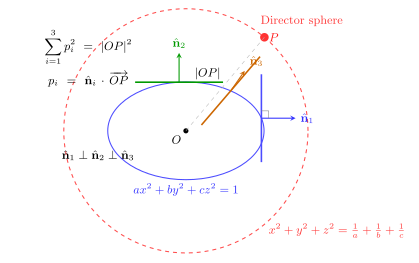
The central conicoid and its tangent planes. For the conicoid , a plane is tangent to it if and only if This is the standard tangency condition. Written in terms of the unit normal (so ), the distance from the origin to the tangent plane is and the condition reads .
Orthonormal triad identity. If is an orthonormal basis of (i.e. mutually perpendicular unit vectors), then for any fixed vector : These two identities are the engine of the director-sphere derivation.
Ruled surface generation. A ruled surface is generated by a one-parameter family of straight lines. To find its equation: parametrise the generator by its two meeting-point parameters on the guide curves; impose any external constraint (such as parallel to a plane) to reduce to one free parameter; then eliminate all parameters to get a single algebraic relation in .
Question Archetypes
| Archetype | You are seeing this when… |
|---|---|
| director-sphere | ”Find the locus of intersection of three mutually perpendicular tangent planes to “ |
| ruled-surface-generation | ”Find the surface generated by a line meeting two lines and parallel to a plane” |
director-sphere (2 question(s); 2016, 2017)
Recognition Cues
- “Find the locus of the point of intersection of three mutually perpendicular tangent planes” to any central conicoid.
- The conicoid is always (a general central quadric without cross terms).
- The answer is always a sphere centred at the origin.
Solution Template
- State the tangency condition. A plane is tangent to iff .
- Work with unit normals. Normalise: with for , and the three normals are mutually perpendicular.
- Write the tangency condition for each plane through . and .
- Sum the three conditions. Use (i) and (ii) .
- Conclude. The locus is .
Worked Example(s)
2016 Paper 1, 2016-P1-Q4d (15 marks)
Find the locus of the point of intersection of three mutually perpendicular tangent planes to .
Step 1 — Tangency condition. A plane is tangent to the conicoid iff
Step 2 — Unit-normal setup. Let the three tangent planes have mutually perpendicular unit normals , , meeting at . For each plane through : .
Step 3 — Three tangency equations. Since :
Step 4 — Sum. Add all three equations. Left side: (Parseval identity for an orthonormal basis). Right side: since for an orthonormal basis.
Step 5 — Locus. Equating:
This is the director sphere of the conicoid, centred at the origin with radius .
2017 Paper 1, 2017-P1-Q3d (10 marks)
Find the locus of the point of intersection of three mutually perpendicular tangent planes to .
This is the identical question to 2016-P1-Q4d. The derivation proceeds through the same five steps; the answer is:
Cross-check. For the unit sphere : the formula gives radius , matching the known circumscribing sphere of a unit-sphere’s mutually perpendicular tangent configuration.
For an ellipsoid with semi-axes (so , etc.), the director sphere has radius — the familiar sum-of-squares formula.
Common Traps
- Use unit normals. The identity holds only when the normals are unit vectors. Without normalisation, each is not the perpendicular distance from the origin, and the completeness sum fails.
- The key identity is , not . The squared projection formula (Pythagoras / Parseval) is what collapses three equations into one.
- Radius formula. For the conicoid in the form , the radius is . If instead the conicoid is written , identify and the radius becomes . Keep the notational convention straight.
- The director sphere exists as a real sphere only when , i.e., at most one of is negative.
- The converse (“if three planes meet on this sphere, they can be mutually perpendicular tangent planes”) is not asked; prove only the forward direction.
ruled-surface-generation (1 question(s); 2016)
Recognition Cues
- “Find the surface generated by a line which meets [two given lines] and is parallel to [a plane].”
- You are given two guide lines and a planarity/direction constraint on the generator.
- The answer is a quadric surface (degree-2).
Solution Template
- Parametrise each guide line. Express a general point on as and on as .
- Write the direction of the generator. .
- Apply the constraint. If the generator is parallel to a plane with normal , then . Solve for one parameter in terms of the other.
- Parametrise the generator. Use the two meeting points and one free parameter along the line: .
- Eliminate all parameters () from the three coordinate equations. The result is the surface equation.
- Verify. Confirm a specific point on a generator satisfies the surface equation.
Worked Example
2016 Paper 1, 2016-P1-Q4a (10 marks)
Find the surface generated by a line which intersects the lines and and is parallel to the plane .
Step 1 — Parametrise the guide lines.
: , . A general point on : .
: , . Put : then , . Point on : .
Step 2 — Generator direction.
Step 3 — Apply the planarity constraint. The plane has normal . Parallel to the plane means :
With this substitution: , so and the end becomes .
Step 4 — Parametrise the generator.
Step 5 — Eliminate and . Elimination (via resultants or substitution) removes both and , giving the surface:
Verification. Substituting the parametrisation into gives identically in .
Common Traps
- Both parameters must be eliminated. After applying the planarity constraint, you reduce from two free meeting-point parameters to one (say ). But the generator itself has another parameter ( along the line). Eliminating only leaves an identity; eliminating only gives a two-parameter family, not a surface. You must eliminate both and .
- Parallelism condition. The condition is , where is the plane’s normal vector — not the plane’s equation evaluated at the point. For , .
- Spurious factors. Resultant elimination often produces extra factors (like or ). The surface is the degree-2 factor; discard factors that are constants or linear in just one variable.
- The generated surface is always a quadric when the two guide lines and constraint are linear — don’t worry if the algebra looks messy; the final answer simplifies.
Marks-Aware Writing
10-mark questions (director sphere or ruled surface): Write out each step cleanly. For the director sphere, the tangency condition + two orthonormality identities + “sum and equate” is the entire proof — four logical lines with one display equation each. For ruled surface, the parametrisation + constraint-reduction + elimination is the expected structure; a final verification earns the last mark.
15-mark questions (director sphere extended or harder ruled surface): Same as above but with additional detail. For the director sphere at 15 marks, write the tangency condition derivation (not just state it), explain why (cite Pythagoras/completeness), and verify the formula at as a special case. For ruled surfaces, show each intermediate step of the elimination and verify by substitution.
Practice Set
- 2024-P1-Q3c (15 m) — — Hint: find the vertex of a cone by setting .
- 2014-P1-Q4a-ii (10 m) — — Hint: complete the square in each variable; cone iff constant vanishes.
- 2018-P1-Q3c (13 m) — — Hint: related conicoid tangent plane problem.
- 2018-P1-Q4c (13 m) — — Hint: cone-from-vertex-curve; vertex , guiding conic .
- 2017-P1-Q1d (10 m) — — Hint: related conicoid / second-degree surface problem.
- 2016-P1-Q4b (10 m) — — Hint: perpendicular generators of the cone .