Shortest distance between two skew lines
At a Glance
- Frequency: 4 sub-parts across 4 of 13 years (2016, 2017, 2018, 2025)
- Priority tier: T3
- Marks (count): 10 (4)
- Average solve time: ~7 min
- Difficulty mix: easy 2, medium 2
- Section: A | Dominant type: computation
Why This Chapter Matters
Shortest-distance questions appear in Section A (Q1 or Q2) in four of the last ten years, always for 10 marks. Every question uses exactly one formula — the scalar triple product divided by the cross-product magnitude. The only variation is how the direction vectors are extracted from the given line forms, and whether the lines turn out to intersect (numerator ). Master the formula and the sign-extraction step, and these questions take under 7 minutes.
Minimum Theory
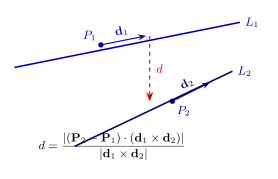
Skew lines. Two lines in 3D that are neither parallel nor intersecting are skew. They have a unique shortest connecting segment, perpendicular to both line directions.
Formula. Let line pass through with direction , and through with direction :
Intersection condition. The lines intersect if and only if the numerator equals zero.
Question Archetypes
| Archetype | Recognition |
|---|---|
| shortest-distance | Given two lines; compute the shortest distance and/or find a parameter value that makes them intersect |
shortest-distance (4 question(s); 2016, 2017, 2018, 2025)
Compute
Recognition Cues
- Two lines given in symmetric (standard) form; asked for “shortest distance.”
- May also ask for a parameter making the lines intersect — set the numerator to zero.
- One line may be given as the intersection of two planes (2018) — extract direction as .
Solution Template
- Extract , and , . Rewrite any "" ratio as ” over ” to get the correct sign.
- Cross product via determinant; compute its magnitude.
- Joining vector .
- Scalar triple product .
- Divide and rationalize any surd.
- Intersection test (if asked): set numerator and solve for the parameter.
Worked Example 1
2017 Paper 1, 2017-P1-Q1e (10 marks)
Find the shortest distance between and .
Step 1. Rewrite ; the -direction ratio is .
Step 2.
Step 3. .
Step 4. .
Step 5.
Worked Example 2
2016 Paper 1, 2016-P1-Q1e (10 marks)
Find the shortest distance between and . For what value of do they intersect?
Step 1. Line : set in to get point , direction .
Step 2.
Step 3–4. ; triple product .
Step 5.
Step 6. Intersection: .
Common Traps
- Sign trap in symmetric form. means the -direction ratio is , not . Rewrite as first — this is the single most common error on this topic.
- Lines as intersections of planes. When a line is given by two plane equations and , extract its direction as and find a point by setting one coordinate to and solving .
- Forgetting to rationalize. should be written as ; an irrational denominator loses marks.
- Intersection parallel. Numerator means coplanar lines that intersect. Denominator means parallel lines — a different (degenerate) case requiring the distance between two parallel lines formula.
Marks-Aware Writing
Write the cross product as a displayed determinant, state each factor of the formula explicitly, and show the final rationalization. The formula itself earns 2 marks; working out each intermediate vector earns 3–4 more; the final division earns the last marks. Skipping the determinant display and just writing the answer costs 4–5 marks.
Practice Set
- 2018-P1-Q2d (12 m) — — Hint: the first line is the intersection of two planes; its direction is ; find a point by setting .
- 2025-P1-Q2c-ii (10 m) — — Hint: same line pair as 2017; direction signs are explicit in this version.