Frequency: 5 sub-parts across 5 of 13 years (2015, 2018, 2019, 2021, 2023)
Priority tier: T2
Marks (count): 10 (2), 15 (2), 7 (1)
Average solve time: ~10 min
Difficulty mix: medium 2, easy 2, hard 1
Section: A | Dominant type: computation
Why This Chapter Matters
Straight lines in 3D appear in every Section A (5-mark and 10-mark slots) as well as 15-mark compulsories, with at least one question in five of the last eleven years. The three archetypes — coplanarity/intersection, projection on a plane, and locus of a moving line — are each solved by a clean, repeatable algorithm. Once you own the scalar-triple-product coplanarity test and the projecting-plane construction, the first four questions become nearly mechanical; the 2023 locus proof requires parametric reasoning but follows a fixed strategy.
Minimum Theory
Three representations of a line. A line through the point P0=(x0,y0,z0) with direction vector d=(l,m,n) can be written in three equivalent forms:
To read direction ratios directly from the symmetric form, the denominator under each variable is one component of d.
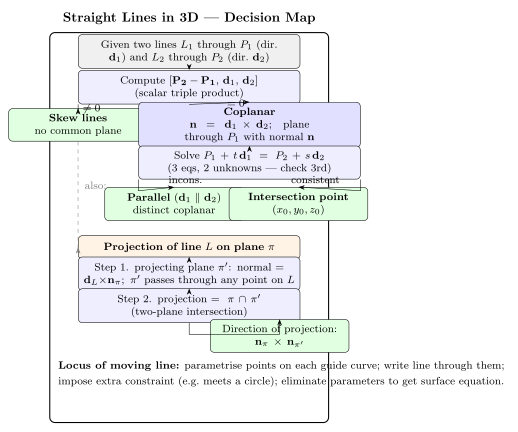
Coplanarity test. Two lines — L1 through P1 with direction d1, and L2 through P2 with direction d2 — are coplanar if and only if
[P2−P1,d1,d2]=0,
where [⋅,⋅,⋅] denotes the scalar triple product (determinant of the 3×3 matrix formed by the three vectors as rows). Geometrically this says the displacement P1P2 lies in the plane spanned by d1 and d2.
Plane containing two coplanar lines. If L1 and L2 are coplanar, their common plane has normal
n=d1×d2
and passes through P1. The plane equation is n⋅(r−P1)=0.
Projection of a line on a plane. The projection of line L (direction dL) onto plane π (normal nπ) is found via the projecting planeπ′: the unique plane containing L and perpendicular to π. Its normal is dL×nπ. The projection is the line of intersection π∩π′.
Question Archetypes
Archetype
Recognition
coplanar-lines-and-plane
Two lines given; “show they intersect / are coplanar; find the plane / point”
line-projection-on-plane
”Find the projection of the line … on the plane …“
locus-of-moving-line
”A line meets [curve 1], [curve 2], [curve 3]; prove the locus is …“
Test two lines for coplanarity/intersection and find the containing plane and intersection point
Recognition Cues
The question gives two lines in symmetric or vector form and asks to “show they intersect”, “prove coplanarity”, “find the plane containing them”, or “find their point of intersection.”
One line may be given by a point and direction with coordinates in arithmetic progression (AP) — this signals the AP-structure result.
After coplanarity is confirmed, a second sub-task usually asks for the plane equation or the intersection point.
Solution Template
Read off P1, d1 from L1 and P2, d2 from L2.
Form v=P2−P1.
Evaluate the scalar triple product [v,d1,d2] as a 3×3 determinant. If it equals zero, the lines are coplanar (or one line contains the other if also d1×d2=0).
Plane: Compute n=d1×d2; simplify to lowest integer ratios. Write n⋅(r−P1)=0.
Intersection: Write P1+td1=P2+sd2. Solve any two coordinate equations for t and s, then verify the third equation is satisfied. Substitute back to find the point.
Worked Example 1
2015 Paper 1, 2015-P1-Q3c-ii (7 marks)
L1 passes through (a−d,a,a+d) with direction ratios (α−δ,α,α+δ); L2 passes through (b−c,b,b+c) with direction ratios (β−γ,β,β+γ). Show L1 and L2 are coplanar and find their common plane.
For any row (u−v,u,u+v), the combination C1+C3−2C2=(u−v)+(u+v)−2u=0. All three rows have this AP structure, so C1+C3−2C2 is the zero column. Hence:
[P2−P1,d1,d2]=0.✓
Step 3 — Find the normal.
n=d1×d2=iα−δβ−γjαβkα+δβ+γ.
Computing:
nx=α(β+γ)−(α+δ)β=αγ−βδ,
ny=−[(α−δ)(β+γ)−(α+δ)(β−γ)]=−2(αγ−βδ),
nz=(α−δ)β−α(β−γ)=αγ−βδ.
So n=(αγ−βδ)(1,−2,1).
Step 4 — Plane through P1=(a−d,a,a+d):
1⋅(x−(a−d))−2(y−a)+1⋅(z−(a+d))=0,
x−2y+z−(a−d)+2a−(a+d)=0,
x−2y+z=0.
The plane equation is independent of all six parameters — a consequence of the pure AP structure.
Worked Example 2
2019 Paper 1, 2019-P1-Q1e (10 marks)
Show that the lines L1:r=(−1,3,−2)+t(−3,2,1) and L2:r=(0,7,−7)+s(1,−3,2) intersect. Find the point of intersection and the plane containing them.
The AP-structure plane is always x−2y+z=0: The parameters a,b,c,d,α,β,γ,δ all cancel out; do not try to express the plane in terms of them. If your plane still contains these letters, recheck the column-combination step.
Use different parameter names for the two lines (t and s, never the same symbol). After solving two coordinate equations, always substitute into the third to confirm consistency — this is the check that distinguishes intersecting from skew.
Cross product vs. scalar triple product: Coplanarity uses the scalar triple product (a number); the plane normal uses the cross product (a vector). Do not confuse them.
Simplify the normal:(4,−8,4) simplifies to (1,−2,1). Using the unsimplified normal gives a correct plane but with a messy constant; simplifying first is cleaner.
line-projection-on-plane (1 question(s); 2018)
Project a line onto a plane via the projecting plane (contains line, perpendicular to plane)
Recognition Cues
The question gives a line in symmetric form and a plane, and asks for “the projection of the line on the plane” or “the image of the line in the plane.”
The answer is a line expressed as the intersection of two planes, or in symmetric form — never a single plane equation.
Solution Template
Read off the line point P and direction dL from the symmetric form; read off the plane normal nπ.
Compute the projecting plane normal: n′=dL×nπ.
Write the projecting plane π′: normal n′, passes through P.
The projection is π∩π′: give both plane equations as the answer.
Optionally find the direction of the projected line: nπ×n′.
Worked Example
2018 Paper 1, 2018-P1-Q1e (10 marks)
Find the projection of the line 2x−1=3y−1=−1z+1 on the plane x+y+2z=6.
Step 1 — Read data.
Line: point P=(1,1,−1), direction dL=(2,3,−1).
Plane: normal nπ=(1,1,2).
Order of the cross product matters: The projecting plane normal is dL×nπ, not nπ×dL. Either gives a valid normal to π′ (they are antiparallel), so the plane equation is the same — but be consistent.
Give the answer as two plane equations, not one. A single plane does not define a line in 3D.
Verify π′ contains the original line: Check that P=(1,1,−1) satisfies 7x−5y−z=3: 7−5+1=3. ✓ Also check that dL⋅n′=(2)(7)+(3)(−5)+(−1)(−1)=14−15+1=0. ✓ (The line is parallel to π′, as required.)
Verify π′⊥π:nπ⋅n′=(1)(7)+(1)(−5)+(2)(−1)=0. ✓
locus-of-moving-line (1 question(s); 2023)
Find the locus traced by a line meeting given curves under a constraint
Recognition Cues
The question describes a line meeting two or three specified guide curves/lines and asks to “prove the locus is” or “find the equation of the locus.”
Guide curves are often: two skew lines given as intersections of planes (e.g.\ y=mx,z=c), and a circle or conic in a coordinate plane.
The answer is a surface equation involving x,y,z (typically a ruled quadric).
Solution Template
Parametrise one point on each guide curve using distinct parameters (e.g.\ α, β).
Write the general point on the moving line as P1+λ(P2−P1) for parameter λ.
Impose the third constraint (e.g.\ lies on a circle) to get one equation relating the parameters.
Express x and y (or x, y, z) in terms of the parameters.
Eliminate all free parameters between the constraint equation and the coordinate expressions.
The resulting equation in x, y, z is the locus.
Worked Example
2023 Paper 1, 2023-P1-Q4c (15 marks)
A variable line meets the lines ℓ1:y=mx,z=c and ℓ2:y=−mx,z=−c and also meets the circle x2+y2=a2,z=0. Prove that the locus of the variable line is
c2m2(cy−mzx)2+c2(yz−cmx)2=a2m2(z2−c2)2.
Step 1 — Parametrise the three guide objects.
Point A on ℓ1 (where y=mx, z=c): A=(α,mα,c) for some α∈R.
Point B on ℓ2 (where y=−mx, z=−c): B=(β,−mβ,−c) for some β∈R.
The variable line passes through A and B. Its parametric form is:
r(λ)=(1−λ)A+λB=((1−λ)α+λβ,(1−λ)mα−λmβ,(1−2λ)c).
Step 2 — Find the point on the circle (z=0).
Set z=0: (1−2λ)c=0⇒λ=21.
At λ=21:
x0=2α+β,y0=2mα−mβ=2m(α−β).
Step 3 — Apply the circle constraint.
x02+y02=a2:
4(α+β)2+4m2(α−β)2=a2.
(α+β)2+m2(α−β)2=4a2.(∗)
Step 4 — Express α and β in terms of a general point (x,y,z) on the moving line.
A general point on the line AB at parameter λ satisfies:
x=(1−λ)α+λβ,y=m(1−λ)α−mλβ,z=(1−2λ)c.
From the z-equation: λ=2cc−z, so 1−λ=2cc+z.
Then:
x=2c(c+z)α+(c−z)β,y=2cm(c+z)α−m(c−z)β.
Solve for α and β. Add and subtract suitably:
2cx=(c+z)α+(c−z)β,(1)
2cy=m(c+z)α−m(c−z)β.(2)
Multiply (1) by m: 2cmx=m(c+z)α+m(c−z)β. Add to (2):
2cmx+2cy=2m(c+z)α⟹α=m(c+z)c(mx+y).
Multiply (1) by m and subtract (2):
2cmx−2cy=2m(c−z)β⟹β=m(c−z)c(mx−y).
Label the midpoint trick carefully. The symmetry z=c and z=−c forces the intersection with z=0 to be the midpoint of AB (λ=21). Identifying this shortcut early saves a parameter.
Keep the m factors. In the expressions for α and β, the denominator carries m; dropping it introduces an incorrect factor throughout.
(c2−z2)2=(z2−c2)2: These are equal as squares, so either sign convention matches the target equation. Do not waste time rewriting — just note they are the same.
This is a 15-mark proof question: Show every algebraic step explicitly — parametrisation, the midpoint calculation, the circle constraint substitution, and the final simplification. Skipping even one step will lose marks.
Marks-Aware Writing
7-mark question (2015): Show the determinant, write the column-combination argument in one line (C1+C3−2C2=0), compute the cross product for the normal, and state the plane. Four clear steps = full marks.
10-mark question (2018, 2019): Show the scalar triple product calculation with the determinant written out (not just the result). For the intersection, display the three coordinate equations, show which two you solved, and verify the third. State the plane equation in a box. About 6–8 lines of working.
15-mark question (2021, 2023):
Coplanarity (2021): Same as above but you must also show the intersection computation with both parameters and the z-check. The plane derivation and intersection together need roughly 10–12 lines.
Locus proof (2023): A proof must be complete. The six steps above (parametrise → midpoint → circle constraint → solve for α,β → substitute → simplify) each carry marks. Write the boxed final equation followed by QED (■). Partial proofs that reach only the constraint (∗) typically earn 7–8 out of 15.
Practice Set
2024-P1-Q2c (20 m) — — coplanarity + intersection + plane; treat as a combined 2021-type question
2013-P1-Q1d (10 m) — — line meets two lines; find point and plane
2015-P1-Q2d (13 m) — — AP-structure variant; practise the column-combination argument
2021-P1-Q1e (10 m) — — projection of a line on a plane
2020-P1-Q2c (15 m) — — locus-type problem; use parametric construction
2020-P1-Q3c (15 m) — — coplanar lines; verify and find plane
2017-P1-Q1e (10 m) — — standard coplanarity + intersection
2016-P1-Q1e (10 m) — — symmetric-form lines; find common plane
2016-P1-Q4a (10 m) — — projection of a line on a plane
2025-P1-Q1e (10 m) — — coplanar or projection; classify and solve
2025-P1-Q2c-i (10 m) — — intersection + plane; standard template
We've mapped all 13 years of this exam. Get new chapters, tools, and solutions as we release them — free.