Frequency: 4 sub-parts across 4 of 13 years (2016, 2017, 2018, 2021)
Priority tier: T3
Marks (count): 13 (1), 15 (3)
Average solve time: ~8 min
Difficulty mix: medium 2, easy 2
Section: A | Dominant type: computation
Why This Chapter Matters
Every appearance of this atom has been a 13–15 mark question in Section A — high reward for moderate effort. The four archetypes cover the complete UPSC repertoire: surface area of a tilted plane (2016), volume under a paraboloid cap (2017), volume of an elliptic solid of revolution (2018), and area of an astroid via Beta functions (2021). The two most common errors are forgetting the Jacobian when changing coordinates for an ellipse, and computing the wrong special case of the Beta function. Get these right and the marks follow mechanically.
Minimum Theory
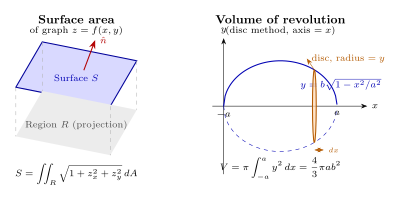
Surface area of a graph. For z=f(x,y) over a region R:
S=∬R1+zx2+zy2dA.
When z=z(x,y) is a plane, zx and zy are constants and the radicand is a constant — the surface area is just (constant factor) × (projected area).
Volume by a double integral. Volume of the solid between z=z1(x,y) and z=z2(x,y) over region R:
V=∬R(z2(x,y)−z1(x,y))dA.
Volume of revolution — disc method. Revolving y=f(x)≥0 around the x-axis: at each station x, the cross-section is a disc of radius f(x):
V=π∫ab[f(x)]2dx.
Parametric area. For a closed curve x=x(t), y=y(t) traversed counter-clockwise:
A=∮xdy=∫x(t)y˙(t)dt.
Beta function.∫0π/2cosmθsinnθdθ=21B(2m+1,2n+1), where B(p,q)=Γ(p+q)Γ(p)Γ(q). Key values: Γ(1/2)=π, Γ(3/2)=21π, Γ(5/2)=43π.
”Show the area of the astroid is …”; parametric curve + Beta function
surface-area (1 question; 2016)
Recognition Cues
“Find the surface area of the plane … cut off by the cylinder … and the coordinate planes.”
The surface is a plane (so zx,zy are constants and the integrand is constant).
Solution Template
Express the surface as z=z(x,y) from the plane equation. Compute zx,zy.
Compute the area factor1+zx2+zy2. For a plane this is a constant.
Identify the projected region R in the xy-plane: the projection of the given boundaries (usually a disc or sector).
Surface area = (area factor) × (area of R).
Worked Example
2016 Paper 1, 2016-P1-Q3c (15 marks)
Find the surface area of x+2y+2z=12 cut off by x=0, y=0, and x2+y2=16.
From z=(12−x−2y)/2: zx=−1/2, zy=−1.
Area factor: 1+1/4+1=9/4=3/2.
Projected region R: x≥0, y≥0, x2+y2≤16 — the quarter disc of radius 4. Area of R = 41π(4)2=4π.
S=23×4π=6π.
Common Traps
The cylinder x2+y2=16 plus x=0, y=0 bounds a quarter disc (first quadrant only), not the full disc. Area = 4π, not 16π.
The plane x+2y+2z=12 has normal (1,2,2), ∣(1,2,2)∣=3, so the area scaling factor is 3/2 (the z-component of the unit normal is 2/3, and 1/(2/3)=3/2). Both routes give the same answer.
volume-by-integration (1 question; 2017)
Recognition Cues
“Find the volume of the solid above the xy-plane and below the surface z=f(x,y) cut off by z=c.”
The base region is often an ellipse — use stretched polar coordinatesx=arcosθ, y=brsinθ.
Solution Template
Identify the base region R: where the surface meets the cap z=c, i.e., f(x,y)=c.
Set up the volume: V=∬R[c−f(x,y)]dA.
Change to stretched polar coordinates if R is an ellipse: x=arcosθ, y=brsinθ, Jacobian =abr.
Evaluate the resulting iterated integral.
Worked Example
2017 Paper 1, 2017-P1-Q2a (15 marks)
Volume above the xy-plane, below x2+y2/4=z, cut off by z=9.
Base region: x2+y2/4≤9 (ellipse, semi-axes 3 and 6). Height: 9−(x2+y2/4).
Stretched polar: x=rcosθ, y=2rsinθ, so x2+y2/4=r2, Jacobian =2r.
Revolution about the x-axis means radius = y, integrate in x → volume =34πab2. About the y-axis: radius = x, integrate in y → 34πa2b. The asymmetry in a vs b catches many students.
Use symmetry (0 to a and double) to avoid sign errors.
area-by-integration (1 question; 2021)
Recognition Cues
“Show the area of the astroid x2/3+y2/3=a2/3 is 3πa2/8.”
Parametric form x=acos3θ, y=asin3θ combined with the Beta function.
Solution Template
Parametrize: use x=acos3θ, y=asin3θ.
Area formula:A=∮xdy=∫02πx(θ)y˙(θ)dθ.
Compute y˙:y˙=3asin2θcosθ.
Integral becomes:A=3a2∫02πcos4θsin2θdθ=3a2⋅4∫0π/2cos4θsin2θdθ (by symmetry).
Show the area of the astroid x2/3+y2/3=a2/3 is 83πa2.
Following the template: B(5/2,3/2)=Γ(4)Γ(5/2)Γ(3/2)=6(3/4)π⋅(1/2)π=6(3/8)π=16π.
So ∫0π/2cos4θsin2θdθ=32π, and A=3a2×4×32π=83πa2. □
Common Traps
The four-fold symmetry gives ∫02π(⋯)=4∫0π/2(⋯). Don’t integrate 0 to π/2 and forget the factor of 4.
Γ(5/2)=23⋅21⋅π=43π (recursive formula Γ(n+1)=nΓ(n), not Γ(n+1)=n!).
The Beta formula gives ∫0π/2cosmsinn=21B((m+1)/2,(n+1)/2) — note the 21 factor.
Marks-Aware Writing
13–15 mark computation: Write the setup equation (area/volume integral) on one line, the substitution on the next, the intermediate integral, and the final evaluation. Show the substitution Jacobian and the Beta function computation explicitly — the examiner is checking each step. Conclude with a sanity check (e.g. the sphere limit for the ellipsoid).
Practice Set
2024-P1-Q3b (20 m) — volume computation;
2023-P1-Q2b (15 m) — area/volume;
2022-P1-Q3b (15 m) — similar structure;
2018-P1-Q1d (10 m) — short area computation;
We've mapped all 13 years of this exam. Get new chapters, tools, and solutions as we release them — free.