Curve tracing (cartesian and polar)
At a Glance
- Frequency: 2 sub-parts across 2 of 13 years (2022, 2023)
- Priority tier: T3
- Marks (count): 20 (2)
- Average solve time: ~10 min
- Difficulty mix: hard 1, medium 1
- Section: A | Dominant type: computation
Why This Chapter Matters
Curve tracing carries 20 marks — the largest single question in the calculus cluster and twice the weight of a typical Section A item. The examiner asks for a complete systematic analysis: domain, symmetry, intercepts, asymptotes, and a rough sketch. Both past questions involve implicit equations that must be solved for , followed by a sign analysis to find the real domain. Mastering the seven-step checklist below and the sign-table method for domain analysis turns this high-stakes item into a routine procedure.
Minimum Theory
Seven-step curve-tracing checklist (Cartesian). For any curve : (1) Rewrite as or if possible. (2) Domain: find where via a sign table; boundary points are curve endpoints or asymptotes. (3) Symmetry: invariance means -axis symmetry; means -axis symmetry; both means origin symmetry. (4) Intercepts: set and . (5) Asymptotes: vertical asymptotes where denominator ; horizontal asymptotes from as ; oblique asymptotes from . (6) Tangent at special points: at a boundary point where , compute to determine if the curve ends sharply or with a vertical tangent. (7) Monotonicity: whether increases or decreases as increases.
Sign table method. To determine the sign of : list all real zeros of and in order, test one value in each interval, and track sign changes. The curve exists precisely where the expression is .
Vertical tangent criterion. From , differentiate: , so . At a boundary point where and , — the curve has a vertical tangent at .
Question Archetypes
| Archetype | You are seeing this when… |
|---|---|
| curve-tracing | ”Trace the curve ” — full analysis required for 20 marks |
curve-tracing (2 question(s); 2022, 2023)
Recognition Cues
- “Trace the curve ” — an implicit equation that rearranges to .
- The question awards 20 marks, signalling that a complete systematic treatment with labelled steps and a sketch is expected.
- The equation involves even powers of only (so symmetry); the -structure gives a finite real domain.
Solution Template
- Rewrite as . Factor numerator and denominator.
- Sign table. List all zeros of ; determine sign of in each interval; the curve exists where .
- Symmetry. State axis/origin symmetry.
- Intercepts. Find where (zeroes of numerator) and where .
- Asymptotes. Vertical: where denominator ; horizontal: .
- Tangent at boundary points. Compute at the endpoints; state “vertical tangent” if .
- Monotonicity. Whether increases/decreases along each branch.
- Sketch. Label all key features.
Worked Example
2022 Paper 1, 2022-P1-Q4b (20 marks)
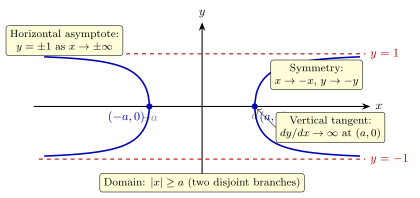
Trace the curve (where is a real constant).
Step 1 — Rewrite.
Step 2 — Domain. . Curve exists for and . These are two disjoint branches.
Step 3 — Symmetry. depends only on : invariant under both and . Symmetric about both axes (and origin).
Step 4 — Intercepts. At : , so . Curve passes through .
Step 5 — Asymptotes. As : , so . Horizontal asymptotes . No vertical asymptote (curve has no denominator factor tending to zero; the exclusion is a gap, not an asymptote).
Step 6 — Tangent at .
At , : . Vertical tangent at .
Step 7 — Monotonicity. For : increases as increases (since decreases). So increases from at toward as .
Step 8 — Sketch description. Two symmetric “trumpet” pieces, each with upper and lower arcs. Left piece: from narrowing to the point with a vertical tangent. Right piece: mirror image, from upward and rightward to the asymptote .
2023 Paper 1, 2023-P1-Q4b (20 marks)
Trace the curve .
Step 1 — Rewrite.
Step 2 — Sign table. Zeros: (numerator), (denominator).
| Region | Real? | |||
|---|---|---|---|---|
| no | ||||
| yes | ||||
| yes () | ||||
| no | ||||
| yes |
Domain: .
Step 3 — Symmetry. Only appears: symmetric about the -axis. No symmetry in .
Step 4 — Intercepts. At : . At : , so .
Step 5 — Asymptotes.
Vertical: as : , , ; so . Vertical asymptote . As : , ; . Vertical asymptote .
Horizontal (right branch): as : . The -axis is a horizontal asymptote for the right branch.
Step 6 — Tangent at .
Derivative of : .
At : . As , . Vertical tangent at .
Step 7 — Monotonicity. Left branch : decreases from (at ) to at , giving a closed loop. Right branch : decreases from (at ) toward as .
Step 8 — Sketch description. Left piece: a closed “beak” between and , with as and pinching to a point at . Right piece: two arcs from at , asymptotically approaching the -axis.
Common Traps
- Missing the gap. Always set up the sign table first; many students assume the curve is connected and miss the excluded interval (e.g.\ in 2023 and in 2022).
- Confusing vertical asymptotes with excluded domain. In 2022, is just an excluded region (not an asymptote); in 2023, are genuine vertical asymptotes because there.
- Forgetting vertical tangents. At any boundary point where and , the tangent is vertical. Always compute at such points.
- Sign errors in the table. Tracking the sign of near : for slightly above , and , so the product is negative. Verify each interval independently.
- Horizontal asymptote only on one branch. In 2023, the -axis is an asymptote only for the right branch (); the left branch ends at a vertical asymptote, not at the -axis.
Marks-Aware Writing
Both questions are 20 marks. Full marks require all seven features to be clearly addressed. A marking scheme breakdown: domain/sign analysis (4 marks), symmetry (2 marks), intercepts (2 marks), asymptotes — vertical and horizontal (4 marks), tangents at boundary points (3 marks), monotonicity/shape (2 marks), sketch with all features labelled (3 marks). An answer that correctly finds the domain and asymptotes but skips tangents and monotonicity earns about 12 marks. Always present the sign table explicitly — it shows method and earns marks even if a subsequent conclusion has an error.
Practice Set
- 2016-P1-Q8d (15 m) — — Hint: follow the seven-step checklist; isolate and perform the sign analysis before sketching.