Frequency: 10 sub-parts across 8 of 13 years (2013, 2015, 2016, 2017, 2018, 2022, 2024, 2025)
Priority tier: T1
Marks (count): 10 (3), 12 (2), 13 (1), 15 (4)
Average solve time: ~10 min
Difficulty mix: medium 9, easy 1
Section: A | Dominant type: computation
Why This Chapter Matters
Double integrals appear in 8 of the last 13 years, almost exclusively in Section A. The questions test one skill above all others: identifying the region correctly and setting up limits. Every computation mistake flows from a wrong region, and every region mistake flows from not sketching the curves. Five archetypes cover all appearances; the most common (5 of 10) is integration over a described region in Cartesian coordinates.
Minimum Theory
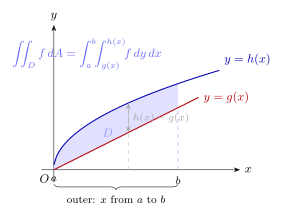
Iterated integrals. For f continuous on a region D:
∬DfdA=∫ab∫g(x)h(x)f(x,y)dydx=∫cd∫p(y)q(y)f(x,y)dxdy.
Choose the variable order so that the region boundaries are cleanest to express.
Change of variables. Under x=x(u,v), y=y(u,v):
∬Dfdxdy=∬D′f(x(u,v),y(u,v))∣J∣dudv,J=∂(u,v)∂(x,y).
Alternatively, compute ∣∂(u,v)/∂(x,y)∣ and take its reciprocal for ∣J∣.
Polar coordinates.x=rcosθ, y=rsinθ, dA=rdrdθ.
Bounding a double integral. If m≤f(x,y)≤M on D, then m⋅Area(D)≤∬Df≤M⋅Area(D).
Question Archetypes
Five patterns cover all double integral questions.
Bracket =(4(y2+2y+1)−(y2−6)2/4)… expanding and collecting: integrand =81(−y5+16y3+8y2−32y).
I=81∫−24(−y5+16y3+8y2−32y)dy=8288=36.
2015 Paper 1, 2015-P1-Q4a (13 marks)
∬R∣y−x2∣dA over R=[−1,1]×[0,2].
Absolute value.∣y−x2∣=x2−y below the parabola y=x2, y−x2 above. Split the y-integral at y=x2 for each x:
I1(x)=∫0x2x2−ydy=32∣x∣3,I2(x)=∫x22y−x2dy=32(2−x2)3/2.
Integrate over x∈[−1,1] (both integrands even in x):
I=32=1/2∫−11∣x∣3dx+32=3π/4+2∫−11(2−x2)3/2dx=31+2π+34=35+2π.
(The (2−x2)3/2 piece uses substitution x=2sinθ and cos4 reduction.)
2016 Paper 1, 2016-P1-Q4c (15 marks)
∬[0,1]2fdA where f=x+y for x2<y<2x2, f=0 elsewhere.
Capped region. For x≤1/2: band x2<y<2x2 fits inside the unit square. For x>1/2: 2x2>1 so the upper limit is capped at y=1.
Always sketch first. The most common error is setting up limits for the wrong region (e.g., swapping which curve is upper vs lower).
For D bounded by a parabola and a line, using y as the outer variable often avoids splitting; using x outer may require two separate integrals.
For the absolute-value integral (2015): unpack ∣y−x2∣ into two cases. Do not try to evaluate ∣f∣ directly.
For the 2016 two-parabola integral: the split point is x=1/2 (where 2x2=1 hits the top of the square), notx=1. Missing this cap gives an incorrect answer.
For the 2018 arctan integral: the factor x in the numerator cancels the 1/x from the arctan antiderivative, leaving a constant inner integral — a telltale sign that the problem is simpler than it looks.
The region is a rhombus or parallelogram with sides x±y= const or xy= const.
The integrand is a function of x+y and x−y, or of x2−y2 and xy.
Substitution makes both the region (a rectangle) and the integrand simpler.
Solution Template
Set u,v to be the natural level-set functions.
Compute the forward Jacobian∂(u,v)/∂(x,y) and invert: dxdy=∣J−1∣dudv where ∣J−1∣=1/∣∂(u,v)/∂(x,y)∣.
Transform the region to a rectangle in (u,v).
Rewrite the integrand in (u,v) — often it simplifies drastically.
Evaluate as a product of single integrals if separable.
Worked Example(s)
2015 Paper 1, 2015-P1-Q3d (12 marks)
∬R(x−y)2cos2(x+y)dA over rhombus with vertices (π,0),(2π,π),(π,2π),(0,π).
Substitution:u=x+y, v=x−y. Rhombus sides: x+y=π, 3π and x−y=±π — so the rhombus maps to the rectangle [π,3π]×[−π,π]. Forward Jacobian ∂(u,v)/∂(x,y)=det(111−1)=−2, so dxdy=21dudv.
I=21∫π3πcos2udu∫−ππv2dv=21⋅π⋅32π3=3π4.
2017 Paper 1, 2017-P1-Q1c (10 marks)
∬Rxy(x2+y2)dA over R:{−3≤x2−y2≤3,1≤xy≤4}.
Substitution:u=x2−y2, v=xy. Region maps to [−3,3]×[1,4]. Forward Jacobian ∂(u,v)/∂(x,y)=2(x2+y2), so dxdy=dudv/[2(x2+y2)].
Integrand ×dxdy=xy(x2+y2)⋅dudv/[2(x2+y2)]=vdudv/2 — the (x2+y2) cancels perfectly.
I=∫−33∫142vdvdu=415⋅6=245.
Common Traps
Compute the forward Jacobian ∣∂(u,v)/∂(x,y)∣ and use dxdy=∣J∣1dudv — NOT the other way around.
For the rhombus: the Jacobian of (u,v)=(x+y,x−y) is −2, giving ∣J∣=2 and dxdy=21dudv. Dropping the 21 halves the answer.
Verify the region maps to a rectangle (check all four side equations).
area-between-curves (1 question; 2022)
Recognition Cues
“Use double integration to find the area common to [circle] and [parabola].”
Area =∬DdA where D is the common region.
Worked Example(s)
2022 Paper 1, 2022-P1-Q3b (15 marks)
Area common to circle x2+y2=4 and parabola y2=3x.
Intersection:x2+3x=4⇒x=1 (so y=±3). By symmetry, double the area for y≥0.
y outer (parabola x=y2/3 left, circle x=4−y2 right):
Aupper=∫03(4−y2−3y2)dy.∫034−y2dy via y=2sinθ (θ∈[0,π/3]) =4∫0π/3cos2θdθ=32π+23.
∫03y2/3dy=3/3.
A=2(Aupper)=2(32π+23−33)=34π+33.
Common Traps
“Common to” both curves means inside both: inside the disc (x2+y2≤4) AND inside the parabola (y2≤3x).
Intersection x=1, not x=2 — solve x2+3x=4 carefully.
The trig substitution gives θ∈[0,π/3] (since sin−1(3/2)=π/3), not [0,π/2].
area-polar (1 question; 2024)
Recognition Cues
“Find the area inside/outside [cardioid/circle/rose].”
Region described using r=f(θ); double integration in polar coordinates.
Worked Example(s)
2024 Paper 1, 2024-P1-Q4b (15 marks)
Area inside cardioid r=a(1+cosθ) and outside circle r=a.
Intersections:a(1+cosθ)=a⇒θ=±π/2. For ∣θ∣<π/2, cardioid ≥ circle.
A=∫−π/2π/2∫aa(1+cosθ)rdrdθ=2a2∫−π/2π/2[(1+cosθ)2−1]dθ=2a2∫−π/2π/2(2cosθ+cos2θ)dθ.
Using symmetry and ∫0π/2cos2θdθ=π/4:
A=a2(2+π/4)⋅11=a2(2+4π)=4a2(π+8).
Common Traps
Integration range is [−π/2,π/2]only — for ∣θ∣>π/2 the cardioid is inside the circle, so there is no required region there.
The half-angle identity cos2θ=(1+cos2θ)/2 is needed for the cos2 term.
integral-bounds (1 question; 2017)
Recognition Cues
“Prove A≤∬Df≤B” where f involves a distance function.
Worked Example(s)
2017 Paper 1, 2017-P1-Q4d (10 marks)
Prove π/3≤∬Ddxdy/x2+(y−2)2≤π over unit disc D.
Key: integrand =1/dist((x,y),Q) where Q=(0,2) is outside D. For any P∈D: dist(P,Q)∈[2−1,2+1]=[1,3], so 1/dist∈[1/3,1].
31⋅π∬DdA≤∬DdistdA≤1⋅π,i.e.3π≤I≤π.■
Common Traps
Q=(0,2) is outside the disc — distance is bounded below by 1 (the integral is proper, not improper).
Reciprocating: large distance → small integrand; min distance at (0,1) gives max integrand =1.
Marks-Aware Writing
10-mark questions (2017-Q1c, 2017-Q4d, 2025): Sketch the region (one line description), set up the iterated integral, evaluate. For change-of-variables: state the substitution, Jacobian, new region, integral.
12-13-mark questions (2015-Q3d, 2018): Change-of-variables or inner-then-outer integration. Show the substitution and Jacobian computation explicitly. For 2018: show the cancellation of the x factor.
15-mark questions (2013, 2015-Q4a, 2016, 2022, 2024): Full working: identify region (with sketch/description), set up limits with explanation of which curve is upper/lower, inner integral, outer integral. For absolute-value integrands: show the region split explicitly.
Practice Set
Year
Paper/Q
Marks
Archetype
One-line hint
2025
P1-Q3c-i
10
double-integral-region
Parabola above line; inner y∈[x,4x−x2]; result 54/5
2024
P1-Q4b
15
area-polar
Polar; θ∈[−π/2,π/2]; A=a2(2+π/4)=a2(π+8)/4
2022
P1-Q3b
15
area-between-curves
y outer; intersection at y=±3; trig sub for circle term
2018
P1-Q4b
12
double-integral-region
x cancels 1/x in arctan; inner integral =π/4−arctan(1/a) is constant
2017
P1-Q4d
10
integral-bounds
Q=(0,2) outside disc; distance ∈[1,3]; multiply by area π
2017
P1-Q1c
10
change-of-variables-integral
u=x2−y2, v=xy; Jacobian 2(x2+y2) cancels; result 45/2
2016
P1-Q4c
15
double-integral-region
Split at x=1/2 where 2x2=1; two separate iterated integrals
2015
P1-Q4a
13
double-integral-region
Absolute value splits at y=x2; inner integrals give $2
2015
P1-Q3d
12
change-of-variables-integral
u=x+y, v=x−y; Jacobian $
2013
P1-Q3c
15
double-integral-region
y outer avoids splitting; parabola left, line right; y∈[−2,4]; result 36
We've mapped all 13 years of this exam. Get new chapters, tools, and solutions as we release them — free.