Functions of two/three variables: limits, continuity
At a Glance
- Frequency: 4 sub-parts across 3 of 13 years (2015, 2016, 2019)
- Priority tier: T3
- Marks (count): 10 (3), 12 (1)
- Average solve time: ~7 min
- Difficulty mix: medium 2, easy 1, hard 1
- Section: A | Dominant type: proof
Why This Chapter Matters
This atom covers the three fundamental tools for analysing multi-variable functions at a point: the path test (to prove a limit does not exist), the - argument (to prove it does), and the factorisation trick (to handle removable discontinuities). Each has appeared as a 10–12 mark Section A question. The path-test and epsilon-delta problems are particularly formulaic — once you know the recipe, they take under 8 minutes.
Minimum Theory
Limit in . means: for every there is such that .
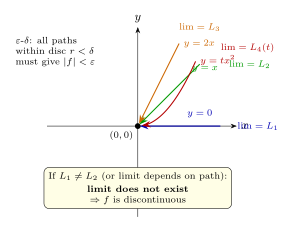
Path test (prove non-existence). If has different limits along two different paths through , then does not exist. Useful paths: lines ; parabolas ; along axes ( or ).
Epsilon-delta argument (prove existence). Convert to polar: , . If for some constant uniform in , then choosing proves .
Continuity. is continuous at if .
Implication: continuity of at implies continuity of the section functions and at and (the converse is false).
Question Archetypes
| Archetype | Recognition cue |
|---|---|
| path-test-discontinuity | Examine continuity at ; function defined as there |
| epsilon-delta-continuity | ”Find such that whenever “ |
| slice-continuity-proof | ”If is continuous at , show the section functions are continuous” |
| removable-via-factoring | Rational form or similar; show continuity and differentiability |
path-test-discontinuity (1 question; 2015)
Recognition Cues
- Piecewise function, for and at origin.
- “Examine continuity and differentiability.”
- The expression has or in the denominator.
Solution Template
- Try the -axis path (): compute .
- Try another path ( or ): compute the limit. If different from step 1, limit does not exist, is discontinuous.
- Conclude non-differentiability (discontinuity not differentiable).
- Check partial derivatives at by definition (they may or may not exist separately).
Worked Example
2015 Paper 1, 2015-P1-Q4d (12 marks)
Examine continuity and differentiability of at , where .
Path (): .
Path (, ): .
This depends on (e.g. ; ; ). The limit is path-dependent.
Conclusion: is not continuous at (limit does not equal , and doesn’t even exist). Hence is not differentiable at .
Partials: (from ), but does not exist (from for ).
Common Traps
- The natural path test is parabolic , not linear . Linear paths sometimes give the same limit (false positive); parabolic paths expose the true direction-dependence.
- Discontinuity at a point does not stop the partial derivatives existing: here even though is discontinuous. The failure of to exist is an additional irregularity.
epsilon-delta-continuity (1 question; 2016)
Recognition Cues
- “Find such that whenever .”
- The function is given with a piecewise definition at .
- Requires an explicit , not just an existence argument.
Solution Template
- Switch to polar: , , so for some bounded .
- Bound uniformly: find .
- Choose : if , take (here ).
Worked Example
2016 Paper 1, 2016-P1-Q3b (15 marks)
Find for where , .
(The numerator has degree 5, denominator degree 4 — this is the corrected version with .)
Polar: numerator , denominator . So where (check: , max = 1 at ).
So . Choose .
(A conservative elementary bound gives ; both are correct.)
Common Traps
- The bound must hold uniformly in — not just for specific paths.
- The 2016 question as printed has a typo ( instead of ); the non-homogeneous version is discontinuous at the origin and no exists. Solve the homogeneous version.
slice-continuity-proof (1 question; 2019)
Recognition Cues
- “If is continuous at , show the functions and are continuous at and respectively.”
- Pure - proof; no computation.
Worked Example
2019 Paper 1, 2019-P1-Q1b (10 marks)
Show: continuous at continuous at and continuous at .
Proof. Let . For any , continuity of gives with .
For any with : the point satisfies , so . Hence is continuous at . The argument for is identical.
Remark. The converse is false: (with ) has and (both continuous), but — jointly discontinuous.
Common Traps
- The key computation is (the second coordinate is fixed). This is the only non-trivial step.
- The converse must not be proved — mention the counterexample to show awareness.
removable-via-factoring (1 question; 2019)
Recognition Cues
- Function has denominator (or similar) and the question asks to show it is continuous and differentiable at a specific point with .
- Factoring the numerator completely removes the singularity at that point.
Worked Example
2019 Paper 2, 2019-P2-Q1b (10 marks)
Show for , at , is continuous and differentiable at .
Factoring: for . Since , on a neighbourhood of the denominator is nonzero and .
Continuity: . Continuous.
Differentiability: exactly. The remainder with gradient is 0 = . Differentiable with .
Common Traps
- Verify at the target point before factoring. Here ✓.
- The function also has a special value at on the diagonal, but that point is irrelevant to behaviour at .
Marks-Aware Writing
10-mark proof (slice continuity): Four lines: state the from joint continuity, observe , apply the joint , conclude. Then one sentence on the counterexample to the converse.
12-mark path test + partial derivatives: Show two paths giving different limits (2 lines each). State discontinuity. State non-differentiability follows. Then compute and by definition. Full-marks answer shows all four items.
Practice Set
- 2013-P1-Q3b (15 m) — mixed partials Schwarz failure;
- 2019-P1-Q4c-i (12 m) — continuity analysis;
- 2018-P1-Q3b (12 m) —
- 2017-P1-Q3c (15 m) — mixed partials at origin;