Jacobian
At a Glance
- Frequency: 4 sub-parts across 4 of 13 years (2014, 2019, 2021, 2024)
- Priority tier: T3
- Marks (count): 15 (2), 8 (1), 7 (1)
- Average solve time: ~8 min
- Difficulty mix: medium 3, easy 1
- Section: A | Dominant type: computation
Why This Chapter Matters
The Jacobian appears in three distinct roles in UPSC exams, each with its own algorithm. The simplest (compute a Jacobian determinant, 7 marks) is purely mechanical. The hardest (use a Jacobian substitution to evaluate a double integral, 15 marks) requires recognising which substitution transforms the integration region into a rectangle and separates the integrand into Beta functions. The middle archetype (functional dependence via vanishing Jacobian) is conceptual but short. Know all three roles.
Minimum Theory
Definition. For functions and , the Jacobian is
Change of variables. If and is one-to-one, then
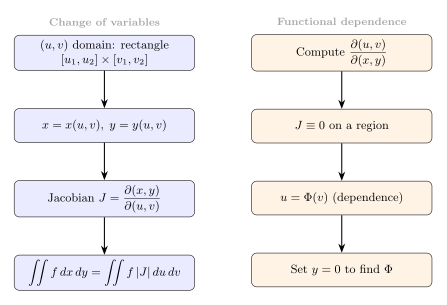
Functional dependence. If on an open region, then and are functionally dependent — there exists a function such that (or ). To identify , evaluate at a convenient special point.
Question Archetypes
| Archetype | Recognition |
|---|---|
| compute-jacobian | ”Find ” — direct computation of the determinant |
| jacobian-change-of-variable | ”Using the transformation … evaluate ” — change of variables in a double integral |
| functional-dependence | ”Show are functionally related; find the relation” — Jacobian implies dependence |
compute-jacobian (1 question(s); 2021)
Compute a Jacobian determinant directly
Recognition Cues
- Explicit formulae for and in terms of or other coordinates.
- May simplify by expressing in the new variables before computing partial derivatives.
Solution Template
- Express and in terms of the independent variables (simplify using trig identities if possible).
- Compute all four partial derivatives.
- Evaluate the determinant.
Worked Example
2021 Paper 1, 2021-P1-Q3a-i (7 marks)
, , , . Find .
Step 1. (depends only on ); (using ).
Step 2. , ; , .
Step 3. Determinant:
Common Traps
- Simplify first. Express and in before differentiating; computing directly is fine but more work.
- One row may be sparse. When , we have , making the determinant a structure — use this to skip algebra.
jacobian-change-of-variable (1 question(s); 2014)
Use a Jacobian change of variables to transform a double integral
Recognition Cues
- A specific substitution is given (e.g. , ).
- The integration region is a triangle or other non-rectangular shape.
- After substitution, the integrand must factorise and/or the limits become .
Solution Template
- Invert the substitution to express in terms of .
- Compute the Jacobian .
- Transform the limits: find the image of the original region in coordinates.
- Rewrite the integrand in ; check for factorisation.
- Evaluate using Beta functions if the integrand has the form .
Worked Example
2014 Paper 1, 2014-P1-Q2c (15 marks)
Using , , evaluate over the triangle , , .
Step 1. Inversion: , .
Step 2. Jacobian: .
Step 3. Limits: the triangle maps to the unit square , .
Step 4. Transform: Integral:
Step 5. Beta functions: .
Common Traps
- The Jacobian is , not . Don’t forget the factor — without it the integral has the wrong value.
- Half-integer Gamma values: , , , and so on by the recurrence .
- Integration region. The triangle , , maps to the unit square — verify this by tracing each edge.
functional-dependence (2 question(s); 2019, 2024)
Use a vanishing Jacobian to detect and find a functional relation between and
Recognition Cues
- Two functions and are given; the question asks whether they are “functionally related.”
- The Jacobian will be computed and found to be identically zero.
- The actual relationship is then identified (usually a standard identity).
Solution Template
- Compute directly.
- Show the Jacobian is identically zero — this proves functional dependence.
- Identify : set one variable to a convenient value (e.g. ) to pin down .
Worked Example 1
2024 Paper 1, 2024-P1-Q2b (15 marks)
, . Find . Are functionally related?
Step 1. , ; , .
Step 2. Jacobian:
Step 3. Functionally dependent. By the addition formula (valid for ): , i.e.
Worked Example 2
2019 Paper 1, 2019-P1-Q4c-ii (8 marks)
If and , show using the Jacobian.
Step 1. Let and . Then , .
Step 2. Jacobian .
Step 3. Functional dependence: . Set : and . So , giving .
Common Traps
- The Jacobian cancels by design. In functional-dependence problems, the numerators of and are crafted to cancel exactly. If the terms don’t cancel, recheck the partial derivatives.
- Functional dependence gives only the form. The Jacobian proves exists, but doesn’t tell you what is. You must find separately by specialising variables — setting is almost always the right move.
- Domain restriction. The addition formula (and the functional relation) hold only for ; state this restriction in the conclusion.
Marks-Aware Writing
7-mark Jacobian computation: show each partial derivative computed, display the determinant, then the evaluation. Three lines of algebra suffice.
15-mark change-of-variables: the examiner awards marks for (a) the Jacobian correctly computed, (b) the transformed limits (unit square), (c) the separation of the double integral, (d) the Beta function identification, and (e) the numerical answer. Missing the Jacobian factor (forgetting the ) or mis-identifying the Beta parameters each costs 3 marks.
8-mark functional dependence: the vanishing of the Jacobian (shown by explicit calculation) and the identification of via are both required. A proof with only the Jacobian step and no identification of earns half marks.
Practice Set
- 2021-P1-Q3a-i (7 m) already worked in full above.