Lagrange’s method of multipliers (constrained extrema)
At a Glance
- Frequency: 8 sub-parts across 8 of 13 years (2013, 2014, 2015, 2016, 2019, 2020, 2022, 2025)
- Priority tier: T1
- Marks (count): 13 (1), 15 (2), 20 (5)
- Average solve time: ~12 min
- Difficulty mix: hard 3, easy 3, medium 2
- Section: A | Dominant type: computation
Why This Chapter Matters
Lagrange multipliers appear in 8 of the last 13 years, predominantly as 20-mark Section A questions — each appearance can swing an attempt by two full parts. The method is universal: one procedure handles distances, volumes, applied word problems, and the abstract maximum-on-an-ellipsoid problems that UPSC particularly favours. Every question reduces to the same four-step skeleton; the only variation is recognising which type you are looking at and how many constraints are present.
Minimum Theory
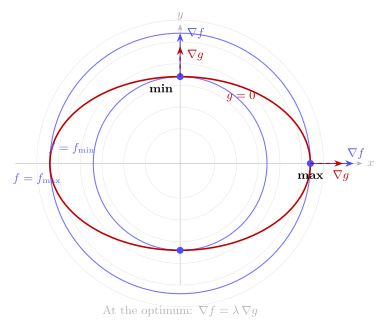
The method. To find the extreme values of subject to a single constraint , form the Lagrangian and set all partial derivatives to zero: The geometric content: at an extremum the level surface of is tangent to the constraint surface, so their normals are parallel — .
Two constraints. When there are two constraints and , introduce two multipliers: This gives five equations for the five unknowns . For the specific problem of extremising on the intersection of a quadric and a plane, the trick is to multiply each gradient equation by its variable and sum — this identifies (see quadratic-form-extrema below).
Nature of critical points. Lagrange multipliers find stationary points; max or min must be confirmed separately. On a compact constraint (ellipse, sphere) the largest value is the maximum and the smallest the minimum. On an unbounded constraint (a plane), a single stationary point of is always a minimum since the function grows without bound.
Question Archetypes
Four patterns cover all Lagrange multiplier questions in this atom.
| Archetype | You are seeing this when… |
|---|---|
| constrained-distance | minimise a squared distance or on a single constraint |
| applied-constrained-optimization | a word problem (cone, wire, box) with a fixed volume, length, or surface |
| symmetric-constrained | symmetric objective (, ) on a symmetric constraint (sphere or ellipsoid) |
| quadratic-form-extrema | extremise on a quadric and a plane — two constraints |
constrained-distance (2 question(s); 2013, 2020)
Recognition Cues
- “Find the shortest distance between and by Lagrange multipliers.”
- “Find the extreme value of subject to .”
- The objective is a squared distance or squared linear functional; the constraint is a curve, plane, or surface.
Solution Template
- Write the squared distance/objective and the constraint .
- Set and write all gradient equations.
- Solve for in terms of (or a single parameter ).
- Substitute into to find .
- Compute at each critical point; the smallest is the minimum.
- Verify geometrically using the point-to-plane formula as a check.
Worked Example(s)
2013 Paper 1, 2013-P1-Q3a (20 marks)
Find the shortest distance between the line and the ellipse by Lagrange multipliers.
The distance from to the line is . Minimise the squared distance subject to .
Let . The conditions give and , i.e.
The line does not meet the ellipse (discriminant of is ), so , . Solve: , . Substitute into :
Two critical points:
- : , ; then ; distance .
- : , ; then ; distance .
2020 Paper 1, 2020-P1-Q4c (20 marks)
Find the extreme value of subject to by Lagrange’s method.
Set with : Constraint: , so .
This is a minimum (the constraint is a plane; as the point recedes; no maximum exists). Geometric check: perpendicular distance from origin to is , giving ✓.
Common Traps
- Minimise , not the distance itself; the critical points are identical and the algebra is cleaner. Recover the true distance by dividing by at the end.
- In the 2013 problem, verify the line and ellipse do not intersect (discriminant ); if they did, the minimum distance would be zero and Lagrange would be unnecessary.
- In the 2020 problem, state explicitly that this is a minimum only — there is no maximum on a plane.
- Arithmetic: , not — a common slip.
applied-constrained-optimization (2 question(s); 2015, 2022)
Recognition Cues
- A word problem involving a geometric shape (cone, box, wire) with a fixed quantity (volume, perimeter, length).
- “Find the dimensions for which the [canvas / area / cost] is least, given that the [volume / length] is fixed.”
- One constraint (the fixed quantity), one objective (the quantity to optimise).
Solution Template
- Introduce variables for the dimensions and write (objective) and (constraint) explicitly.
- Work with or a convenient power if it avoids square roots.
- Set and solve for the ratio of variables.
- Use the constraint to recover actual values or the requested ratio.
- State the nature (min or max) by convexity, second derivative, or boundary argument.
Worked Example(s)
2015 Paper 1, 2015-P1-Q2b (13 marks)
A conical tent is of given capacity. Find the ratio of height to base radius for the least canvas.
Let = base radius, = height. Volume constraint: (fixed). Canvas = lateral surface: (minimise). Work with to eliminate the square root: Set : .
Then , so is convex ( for all ), so this is the global minimum.
2022 Paper 1, 2022-P1-Q2b (15 marks)
A wire of length is cut into two parts bent into a square and a circle. Use Lagrange’s method to find the least sum of areas.
Let the square use length and the circle use length , with . Areas: (side ), (radius ). Minimise subject to .
: Constraint: , .
is strictly convex (sum of quadratics), confirming this is the global minimum.
Common Traps
- “Canvas” for a conical tent means lateral surface only (, no floor). Using total surface area is a common error.
- In the wire problem, the square side is (perimeter side); the circle radius is . Errors here cascade into wrong areas.
- The 2015 problem can be solved by direct substitution without invoking Lagrange; both approaches are acceptable unless the question specifies.
- The 2022 problem explicitly requires Lagrange — show the setup even if you verify the answer by substitution.
symmetric-constrained (2 question(s); 2019, 2025)
Recognition Cues
- The objective is a symmetric function of all variables: , , or the volume of an inscribed box.
- The constraint is symmetric: or an ellipsoid .
- Often stated with (first-octant restriction).
Solution Template
- Set and write the three gradient equations.
- Multiply each equation by the corresponding variable; observe all three products are equal.
- Conclude (or on a sphere).
- Substitute into the constraint to find the common value.
- Confirm the nature: boundary (any variable ) gives ; the interior critical point is the maximum.
Worked Example(s)
2019 Paper 2, 2019-P2-Q4a (15 marks)
Find the maximum value of subject to , .
: , etc. Since , divide by : Constraint: . Maximum: Boundary: any variable gives , confirming this is the maximum.
AM–GM check: with : , so , equality at ✓.
2025 Paper 2, 2025-P2-Q3b (20 marks)
Show that the volume of the greatest rectangular parallelepiped inscribed in is .
The box centred at the origin with first-octant vertex on the ellipsoid has volume (8 octants). Maximise subject to .
: , etc. Multiply each by respectively — all three give , forcing Call this ; constraint gives , so .
Common Traps
- Factor of 8: the inscribed box has 8 vertices; volume where is the first-octant vertex. Forgetting this gives — one-eighth of the correct answer.
- On the ellipsoid: equal ratios , not equal values. Only when do we get .
- AM–GM is a valid two-line alternative for the 2019 sphere problem and can serve as a check.
- State the boundary argument explicitly: at boundary, positive at the critical point — confirms maximum.
quadratic-form-extrema (2 question(s); 2014, 2016)
Recognition Cues
- Extremise subject to two constraints: an ellipsoid () and a plane ().
- Often phrased “find the maximum and minimum values of …” with a geometric interpretation requested.
- The presence of both a quadric and a homogeneous plane constraint is the signal.
Solution Template
- Introduce two multipliers: .
- Write the three gradient equations.
- Key trick: multiply each equation by its variable and sum; using both constraints gives .
- Express in terms of and ; apply the plane constraint to get the secular equation:
- Clear denominators; solve the resulting quadratic in for the two extreme values.
- Geometric interpretation: the constraint intersection is a central elliptical section of the ellipsoid; are its semi-axes.
Worked Example(s)
2014 Paper 1, 2014-P1-Q3b (20 marks)
Find max/min of subject to and . Interpret geometrically.
With multipliers , the gradient equations are , and analogously for . Multiply by and sum, then substitute both constraints:
Solving: , etc. Substitute into the plane condition : This quadratic in yields the two squared extreme distances and .
Geometric interpretation. The surface is an ellipsoid; the plane through its centre cuts it in a central ellipse. The extreme values and are the semi-major and semi-minor axes of that ellipse.
2016 Paper 1, 2016-P1-Q3a (20 marks)
Find max/min of subject to and .
Here and . The secular equation is: Clearing denominators gives . Discriminant :
Common Traps
- Two constraints require two multipliers. The secular equation is the result of eliminating both and ; using only one multiplier is a fundamental error.
- The secular equation has denominators or equivalently depending on normalisation — keep the form consistent when clearing denominators.
- In the 2016 example, the quadratic is . Verify: discriminant (clean square root — if yours isn’t clean, check the algebra).
- The geometric interpretation (“semi-axes of central ellipse”) is required in the 2014 question — state it explicitly and name the ellipsoid.
Marks-Aware Writing
13-mark questions (2015): Set up in 2–3 lines, minimise via a single-variable derivative, state the ratio, confirm minimum by convexity. No geometry required.
15-mark questions (2019, 2022): Full Lagrange setup — write , state , solve the system, apply the constraint, compute the extremum, confirm nature. Box the answer.
20-mark questions (2013, 2014, 2016, 2020, 2025): Introduce notation (1–2 lines), write all gradient equations clearly, show the key algebraic step (identification of , or the two-case split), apply the constraint, compute all critical values, state which is max/min and why. For 2014: include the geometric interpretation paragraph. For the secular-equation problems (2014, 2016): display the quadratic explicitly and show the discriminant.
Practice Set
| Year | Paper/Q | Marks | Archetype | One-line hint |
|---|---|---|---|---|
| 2025 | P2-Q3b | 20 | symmetric-constrained | Equal ratios ; factor 8 for full box; |
| 2022 | P1-Q2b | 15 | applied-constrained-optimization | ; square gets of wire; |
| 2020 | P1-Q4c | 20 | constrained-distance | ; constraint gives ; minimum only on a plane |
| 2019 | P2-Q4a | 15 | symmetric-constrained | Divide by ; symmetry forces ; |
| 2016 | P1-Q3a | 20 | quadratic-form-extrema | Secular eq with ; quadratic ; roots and |
| 2015 | P1-Q2b | 13 | applied-constrained-optimization | Lateral surface only; ; minimise; |
| 2014 | P1-Q3b | 20 | quadratic-form-extrema | Multiply by , sum; identify ; secular eq |
| 2013 | P1-Q3a | 20 | constrained-distance | Minimise on ellipse; ; two points; shortest dist |