Frequency: 8 sub-parts across 6 of 13 years (2013, 2017, 2018, 2019, 2021, 2025)
Priority tier: T2
Marks (count): 10 (1), 12 (2), 15 (4), 15 (1)
Average solve time: ~13 min
Difficulty mix: medium 5, hard 3
Section: A | Dominant type: computation
Why This Chapter Matters
Partial-derivatives questions appear in 6 of the last 13 years at 10–15 marks, always in Section A (the compulsory half of the paper). Four distinct archetypes rotate unpredictably: computing mixed second partials at a singular origin where the standard formulas break down; applying Euler’s theorem to disguised homogeneous functions; checking existence of partials for piecewise-defined functions; and using the total differential to approximate values. The mixed-partials-at-origin type is the trickiest — it appears in 2013, 2017, 2021, and 2025 and demands the limit-definition approach. The Euler homogeneous type (2019, 2025) requires recognising which composite expression is homogeneous and extracting the degree. The other two archetypes are mechanical once you know which branch applies.
Minimum Theory
Partial derivatives at singular points. The standard quotient-rule formulas for fx and fy are valid only where f is smooth. At an isolated singular point (typically the origin with a 0/0 form), return to the limit definition: fx(0,0)=limh→0[f(h,0)−f(0,0)]/h. To compute fxy(0,0), first find fx(0,y) for general y, then differentiate that in y at y=0.
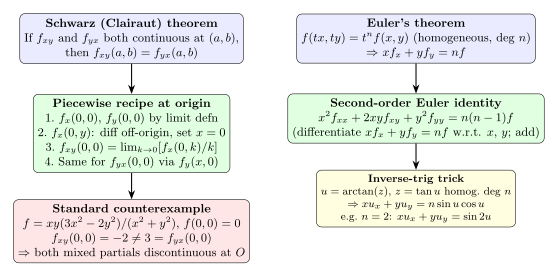
Schwarz–Clairaut theorem. If fxy and fyx are both continuous at a point then fxy=fyx there. Piecewise functions with a singularity at the origin are designed so that Clairaut’s hypotheses fail, forcing fxy(0,0)=fyx(0,0).
Euler’s theorem on homogeneous functions.ϕ(x,y) is homogeneous of degree n iff ϕ(tx,ty)=tnϕ. First-order: xϕx+yϕy=nϕ. Second-order: x2ϕxx+2xyϕxy+y2ϕyy=n(n−1)ϕ.
When f=ψ(u) is homogeneous. If v=ψ(u) is homogeneous of degree n but u is not, rewrite Euler’s identity via chain rule: xux+yuy=nv/ψ′(u)=:G(u). The second-order identity becomes x2uxx+2xyuxy+y2uyy=G(u)[G′(u)−1].
Total differential.f(x0+Δx,y0+Δy)≈f(x0,y0)+fx(x0,y0)Δx+fy(x0,y0)Δy. Choose (x0,y0) to make f(x0,y0) a clean number.
Question Archetypes
Four patterns cover every partial-derivatives question in the corpus.
Piecewise f(0,0)=0 with formula involving xy/(something) or ∣x2−y2∣; “find fxy(0,0) and fyx(0,0).”
“Show they are equal” or “show they are unequal.”
Continuity of fxy and fyx at the origin is often part of the required answer.
Solution Template
First partials away from origin — quotient/chain rule on the formula.
First partials at origin — limit definition: fx(0,0)=limh→0f(h,0)/h (assuming f(0,0)=0); usually both are 0.
fx(0,y) — evaluate limh→0[f(h,y)−f(0,y)]/h for general y (holding y fixed). This is a one-variable limit giving a function of y.
fxy(0,0) — differentiate fx(0,y) at y=0: limk→0[fx(0,k)−0]/k.
fy(x,0) and fyx(0,0) — same procedure with x and y swapped.
Continuity — approach along y=0 and x=0; if limits differ, fxy is discontinuous at the origin.
Worked Example(s)
2013 Paper 1, 2013-P1-Q3b (15 marks)
f(x,y)=xy3/(x+y2) for (x,y)=(0,0), f(0,0)=0. Compute fxy(0,0) and fyx(0,0). Discuss continuity of fxy and fyx at (0,0).
Partials away from origin:fx=y5/(x+y2)2, fy=xy2(3x+y2)/(x+y2)2.
At origin:fx(0,0)=fy(0,0)=0.
fx(0,y):limh→0[f(h,y)−0]/h=limh→0y3/(h+y2). For y=0: fx(0,y)=y3/y2=y. So:
fxy(0,0)=limk→0kk−0=1.
fy(h,0)=0 for all h (the formula gives 0), so:
fyx(0,0)=limh→0h0−0=0.
Continuity: fxy(x,y)=y4(5x+y2)/(x+y2)3 off origin. Along y=0: limit is 0=1. fxy is discontinuous. Both fxy and fyx are discontinuous at (0,0).
2025 Paper 1, 2025-P1-Q4b (15 marks)
f(x,y)=xy(x2−y2)/(x2+y2) for (x,y)=(0,0), f(0,0)=0. Find fxy(0,0) and fyx(0,0).
fx(0,y):[f(h,y)−0]/h=y(h2−y2)/(h2+y2)→y(−y2/y2)=−y. So fx(0,y)=−y:
fxy(0,0)=limk→0k−k=−1.
fy(x,0):[f(x,k)−0]/k=x(x2−k2)/(x2+k2)→x. So fy(x,0)=x:
fyx(0,0)=limh→0hh=+1.
fxy(0,0)=−1,fyx(0,0)=+1.
Common Traps
Never plug (0,0) into the formula for fx or fy — the formula is 0/0 at the origin. The limit definition is mandatory.
The formula for fxy off the origin may look the same as fyx, but their values at the origin are determined by separate iterated limits, not by the formula.
For the continuity discussion, one contradiction suffices: approach along y=0 typically gives one limit, the value fxy(0,0) is another.
euler-homogeneous (2 question(s); 2019, 2025)
Recognition Cues
A function u=ϕ−1(g(x,y)) where g involves fractional powers; “show g is homogeneous of degree n, hence show [second-order PDE].”
“If u=xf(y/x)+g(y/x), show [first-order Euler identity] and [second-order Euler identity].”
Solution Template
Identify the homogeneous piece. Not u itself, but v=ψ(u) (e.g. sin2u). Check: does v(tx,ty)=tnv(x,y)? If yes, n is the degree.
First-order Euler.xvx+yvy=nv. Use chain rule vx=ψ′(u)ux: xux+yuy=nv/ψ′(u)=:G(u).
Second-order Euler. Differentiate xux+yuy=G(u) w.r.t. x (multiply by x) and w.r.t. y (multiply by y); add: x2uxx+2xyuxy+y2uyy=G(u)[G′(u)−1].
Substitute G(u) and G′(u) for the specific ψ.
Worked Example(s)
2019 Paper 1, 2019-P1-Q4c-i (12 marks)
u=arcsin(x1/3+y1/3)/(x1/2+y1/2). Show sin2u has degree −1/6. Hence derive the second-order identity.
v=sin2u=(x1/3+y1/3)/(x1/2+y1/2). v(tx,ty)=t1/3−1/2v=t−1/6v, so n=−1/6. ✓
G(u)=nv/ψ′(u)=(−61sin2u)/(2sinucosu)=−121tanu.
G′(u)=−121sec2u. G′(u)−1=−1213−12tan2u.
x2uxx+2xyuxy+y2uyy=12tanu(1213+12tan2u).
2025 Paper 1, 2025-P1-Q3c-ii (10 marks)
u=xf(y/x)+g(y/x). Show (I) xux+yuy=xf(y/x); (II) x2uxx+2xyuxy+y2uyy=0.
Second order (n(n−1)=0 for both n=1 and n=0): x2Pxx+…=0 and x2Qxx+…=0. Sum: x2uxx+2xyuxy+y2uyy=0. ✓
Common Traps
It is rarely u itself that is homogeneous — look for a composite ψ(u).
The second-order formula contains a −1 in [G′(u)−1] from the xux+yuy term that appears when you differentiate the first-order identity. Dropping this −1 produces a wrong coefficient in the final PDE.
For the u=xf+g type, the elegant route is Euler on each homogeneous part separately; expanding everything with the chain rule and t=y/x also works but takes longer.
partial-existence (1 question(s); 2018)
Recognition Cues
Piecewise f with seam along y=0 or x=0; “which of fx(a,b) and fy(a,b) exists?”
The specified point (a,b) may lie in the interior of one branch (making both partials exist trivially) or on the seam.
Solution Template
Check the branch. Is (a,b) strictly inside {y>0}, {y<0}, or on y=0?
If strictly interior: both partials exist and equal the derivatives of that branch’s formula at (a,b).
If on the seam: compute the one-sided limits of the difference quotient in the perpendicular direction.
Worked Example(s)
2018 Paper 1, 2018-P1-Q3b (12 marks)
f(x,y)=xy2 if y>0; −xy2 if y≤0. Which of fx(0,1) and fy(0,1) exists?
(0,1) has y=1>0, so the point is interior to the y>0 branch.
Both exist. The seam at y=0 is irrelevant for a point at y=1.
Common Traps
The seam is a distractor unless the point is actually on it. Always check the coordinates first.
If the point is (a,0) on the seam and a=0, then fy(a,0) requires a one-sided limit argument; fx(a,0) typically exists by comparing left and right limits in x.
differential-approximation (1 question(s); 2019)
Recognition Cues
“Using differentials, find an approximate value of f(a+ϵ,b+δ).”
The base point (a,b) is chosen so f(a,b) is a round number.
Solution Template
Choose base(x0,y0) where f is clean; compute Δx,Δy.
Compute fx(x0,y0) and fy(x0,y0) exactly.
Applyf≈f0+fxΔx+fyΔy.
Worked Example(s)
2019 Paper 2, 2019-P2-Q2c (15 marks)
Approximate f(4.1,4.9) where f(x,y)=(x3+x2y)1/2.
Base (4,5): f(4,5)=144=12. Δx=0.1, Δy=−0.1.
fx(4,5)=(48+40)/24=11/3; fy(4,5)=16/24=2/3.
df=311(0.1)+32(−0.1)=0.3. So f(4.1,4.9)≈12.3.
Common Traps
Δy=4.9−5=−0.1: the two terms partially cancel. A sign error gives df=0.433 instead of 0.3.
Keep exact fractions for the partial derivatives; rounding 11/3≈3.67 and 2/3≈0.67 then multiplying introduces avoidable error.
Practice Set
2017-P1-Q3c (15 m) — — mixed partials at origin for a different piecewise function; apply the limit-definition template.
2021-P1-Q2b (15 m) — — f=∣x2−y2∣; compute fxy(0,0) and fyx(0,0) (they turn out to be equal here).
We've mapped all 13 years of this exam. Get new chapters, tools, and solutions as we release them — free.