Central force motion and Kepler’s laws
At a Glance
- Frequency: 6 sub-parts across 6 of 13 years (2015, 2016, 2021, 2023, 2024, 2025)
- Priority tier: T2
- Marks (count): 10 (3), 13 (1), 20 (2)
- Average solve time: ~14 min
- Difficulty mix: easy 1, medium 3, hard 2
- Section: B | Dominant type: derivation
Why This Chapter Matters
Central force motion appears in 6 of the last 13 years and consistently earns high marks (the two 20-mark questions in 2023 and 2024 are among the most demanding in the entire corpus). Three problem types are tested: (1) finding the orbit path by solving Binet’s equation, (2) computing the time for a particle to fall from rest to the centre of force, and (3) applying Kepler’s areal-velocity law to find the time over an arc. The hard questions (2023, 2024) require recognising either a pedal-equation relationship or a perfect-square structure in . Mastering the energy–angular-momentum setup and Binet’s equation covers all six questions.
Minimum Theory
Setup. A particle of mass moves in a plane under a central force directed toward the origin . The angular momentum is conserved. Substituting , the Binet orbit equation in polar coordinates is: where is the magnitude of the force per unit mass. This reduces to a second-order ODE for .
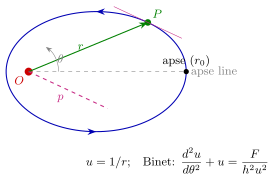
Pedal equation. For a central orbit, (where is the perpendicular from to the tangent). Combined with energy conservation , the pedal equation as a function of describes the orbit shape independently of time.
Standard Binet solutions.
| Force law | Binet ODE | General orbit |
|---|---|---|
| (Kepler) | Conic (ellipse/parabola/hyperbola) | |
| (harmonic) | Ellipse centred at | |
| Spiral or sec-type, depending on |
Apse condition. At an apse (pericentre or apocentre), the radial velocity vanishes: , equivalently . This pins integration constants.
Energy method for radial fall. If a particle falls radially toward from rest at : The fall time is — typically evaluated by a trigonometric substitution.
Kepler’s laws. For a gravitational orbit ():
- First law: orbits are ellipses with the Sun at a focus.
- Second law (areal velocity): the radius vector sweeps equal areas in equal times. Rate: .
- Third law: , where is the semi-major axis.
Kepler’s areal law for an arc. Time to traverse arc .
Question Archetypes
Three patterns cover every central-force question in the corpus.
| Archetype | You are seeing this when… |
|---|---|
| central-orbit-path | ”Find the equation of the orbit” given a force law and initial conditions |
| orbital-fall-time | ”Find the time to fall to the centre” from rest (or after stopping) |
| kepler-areal | ”Use Kepler’s law; find the time over [an arc]” — areal velocity argument |
central-orbit-path (3 question(s); 2015, 2016, 2023)
Recognition Cues
- “A particle is projected from an apse at distance with velocity ; find the orbit.”
- “Force proportional to ” / “varies inversely as the cube” / “central acceleration .”
- “Will the path be the curve ?” — verify the pedal equation.
Solution Template
Binet-equation route (most questions):
- Write the force per unit mass in terms of : express as a function of .
- Write Binet’s equation: . Divide to get an ODE for .
- Identify the ODE type: constant-coefficient (if ), and solve. For the ODE is with .
- Apply apse conditions: (initial distance) and (apse).
- Find from the circular-orbit condition: for a circle of radius , , giving or directly from the projected velocity.
Pedal-equation route (2023 type):
- Compute using energy conservation.
- Form the pedal equation as a function of .
- Verify the candidate curve by computing its pedal equation directly (via ) and matching.
Worked Example(s)
2015 Paper 1, 2015-P1-Q8b (13 marks)
Central force ; two apsidal distances . Find the orbit.
Force per unit mass (toward ). The equations of motion in Cartesian give , — a 2D isotropic harmonic oscillator. The general solution is an ellipse centred at the force centre: The apsidal distances are the max and min of , equal to the semi-axes and :
Key distinction from Kepler (): for , the force centre is at the centre of the ellipse (not a focus); apsidal distances are the semi-axes.
2016 Paper 1, 2016-P1-Q5e (10 marks, compulsory)
Central acceleration ; projected from apse at distance with velocity , where is the circular speed at . Find the orbit.
Step 1 (Binet). . Binet’s equation: , so
Step 2 ( from initial conditions). Circular speed: , so . Projection: . At the apse velocity is purely transverse, so :
Step 3 (solve ODE). : solution is .
Step 4 (apse conditions). is an apse: ; .
Common Traps
- becomes zero at — the orbit has an asymptote there (particle escapes). This is a spiral to infinity, not a closed orbit.
- For : the centre of the ellipse is at ; apsidal distances = semi-axes.
- For : the ellipse has at a focus; apsidal distances are .
- At an apse: , so velocity is wholly transverse, giving directly.
orbital-fall-time (2 question(s); 2021, 2024)
Recognition Cues
- “A planet is suddenly stopped; find the time to fall into the Sun.”
- “Projected at with speed ; find the time to reach the centre.”
- Involves setting up an energy integral and integrating with a trig substitution.
Solution Template
- Energy + angular momentum. Compute and from the initial conditions.
- Radial equation. Write where .
- Perfect-square check. Try to express as for simple — this unlocks an analytic integral.
- Integrate. . Use (for Kepler) or substitutions.
- Ratio. Compare with to give the ratio.
Worked Example(s)
2021 Paper 1, 2021-P1-Q5d (10 marks, compulsory)
A planet in circular orbit of radius is suddenly stopped. Find the time to fall into the Sun and its ratio to the orbital period.
Radial fall. Force: . Initially at rest at , so , .
Trig substitution. Let ; the integral becomes :
Ratio. Kepler’s third law: .
Alternative (degenerate ellipse). The fall is half a degenerate ellipse with semi-major axis ; its period is . Fall time ✓.
2024 Paper 1, 2024-P1-Q8c (20 marks)
Central acceleration ; projected from distance at with circular speed. Prove fall time .
Step 1 (initial conditions). Circular speed: , so . Projection at : , .
Step 2 (radial equation). Effective potential :
Step 3 (perfect square). Multiply by : . So
Step 4 (integrate).
Common Traps
- The trig substitution for Kepler () regularises the singularity at where .
- The perfect-square step in 2024 is the key: . Without it the integral has no closed form.
- “Projected at ” means the velocity makes with the radial direction, so the radial and transverse components are both .
kepler-areal (1 question(s); 2025)
Recognition Cues
- “Earth travels over half its orbit [the far half / near half]; how much longer than ?”
- Kepler’s second law: equal areas in equal times.
Solution Template
- Identify the two parts of the orbit (split by the minor axis or another chord).
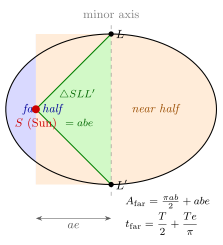
- Compute the area swept by the radius vector from the focus for each part. For the far half: .
- Time area: .
- Substitute and numerically.
Worked Example(s)
2025 Paper 1, 2025-P1-Q5c (10 marks, compulsory)
Prove that the Earth takes approximately 2 days longer over the half of its orbit remote from the Sun (separated by the minor axis), given .
Ellipse: semi-axes , Sun at focus (taking centre at origin). The minor axis () cuts the orbit into near and far halves. Endpoints of minor axis: , .
Area of far half. The far arc () plus radii , sweeps: Triangle has base and height : .
Time for far half.
Extra time.
Common Traps
- The triangle is added for the far half (focus is on the near side). For the near half, the triangle would be subtracted.
- Use ; don’t confuse (per year) with the angular momentum in orbit equations.
- The answer holds exactly; the “2 days” is the numerical approximation for Earth’s parameters.
Marks-Aware Writing
10-mark and 13-mark questions (2015-Q8b, 2016-Q5e, 2021-Q5d, 2025-Q5c): Structure the solution in clearly labelled steps — setup, key conservation law, ODE/integral, boundary conditions, boxed result. For Binet: write the equation, simplify, solve; 2–3 displayed equations.
20-mark questions (2023-Q8b, 2024-Q8c): These require methodical work — energy, angular momentum, radial equation, and a non-trivial integration step. The 2023 pedal equation verification and the 2024 perfect-square identification are the crux moves — describe them explicitly. Examiners allocate 5–6 marks just for setting up the energy–angular-momentum conservation correctly.
Practice Set
| Year | Paper/Q | Marks | Archetype | One-line hint |
|---|---|---|---|---|
| 2023 | P1-Q8b | 20 | central-orbit-path | Energy gives pedal eq ; verify has same pedal eq via |