Common catenary
At a Glance
- Frequency: 4 sub-parts across 4 of 13 years (2015, 2021, 2022, 2025)
- Priority tier: T3
- Marks (count): 20 (1), 15 (1), 12 (1), 10 (1)
- Average solve time: ~12 min
- Difficulty mix: hard 2, medium 2
- Section: B | Dominant type: computation/proof
Why This Chapter Matters
Catenary questions appear in Section B at 10–20 marks and are among the harder mechanics problems. Every question derives from three standard catenary formulae; mastering these three formulae plus the geometric meaning of the parameter converts a daunting question into an algebra problem. The key is to identify which formula pairs are needed for the particular question and to use the hyperbolic identity to eliminate the parameter.
Minimum Theory
The catenary. A uniform heavy chain hanging freely under gravity hangs in a catenary. Taking the lowest point at , the equation is where is the ratio of the horizontal tension to the weight per unit length .
Standard formulae. With = arc length from the vertex and = angle of tangent to horizontal:
| Quantity | Formula |
|---|---|
| Arc length from vertex | |
| Height above vertex | |
| Tension at a point | (weight of string from vertex to lowest support) |
| Intrinsic equation |
Key identities. , so : the “Pythagorean” form (tension = , a useful shortcut).
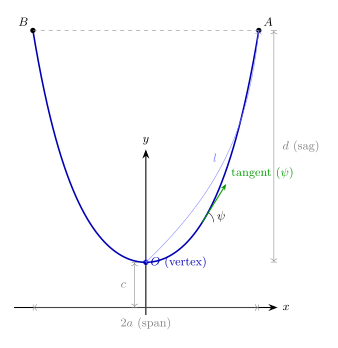
Question Archetypes
| Archetype | Recognition |
|---|---|
| catenary | Derive an identity relating , , , ; find tensions at given inclinations; cable span formula |
catenary (4 question(s); 2015, 2021, 2022, 2025)
Recognition Cues
- A chain or cable hangs between two points; given some of: length , sag , half-span , parameter .
- “Show that …” or “find the tension at …” or “show of tensions…” — all require the three standard formulae above.
- The phrase “catenary parameter ” signals that the answer will be expressed in terms of .
Solution Template
- Set up coordinates: place the vertex at ; supports at (for symmetric catenary).
- Write the two formulae that relate the given quantities to the unknowns.
- Eliminate the intermediate variable (usually ) using .
- For tensions: use (where is the horizontal tension) and the intrinsic relation .
Worked Example 1
2025 Paper 1, 2025-P1-Q5d (10 marks)
Two points , on the same horizontal line, apart. Equal strings , hang from , and are tied at . Arc length of each string , depth of below = . Show: .
Setup. By symmetry is the vertex; , are the supports at .
Arc length: , so .
Sag: , so .
Subtract:
Worked Example 2
2021 Paper 1, 2021-P1-Q6a (20 marks)
At points , , on a catenary the inclinations are in AP with common difference . Weights of portions , are , . Prove: (i) . (ii) .
Part (i). Tension: . Let be the inclination at ; , .
Harmonic mean: .
Using sum-to-product: .
So .
Part (ii). The vertical tension changes by the weight of the segment: and .
Using , and similarly for :
Common Traps
- Mixing up , , and . The sag is measured from the vertex to the support level (not from the support to any other reference). The arc length runs from the vertex to the support along the curve. The half-span is the horizontal distance.
- is the elimination tool. Almost every catenary proof involves writing and and then taking the difference, using this identity.
- Tension = , not . The horizontal tension is constant along the catenary; the total tension increases with inclination via .
- Weight of a segment = change in vertical tension. — this is the load-bearing physics that connects weights to inclinations.
Marks-Aware Writing
For 10-mark identity proofs: state the two catenary formulae used, substitute, and show the algebraic steps explicitly. The key step (factoring and using ) must be written out.
For the 20-mark tensions-in-AP question: each of the two parts requires a separate derivation; the sum-to-product formula () and the weight–tangent relation must both be stated explicitly.
For the 12-mark cable span formula (2022): use the small-sag (large-) expansion of and to first order in ; state the expansion explicitly.
Practice Set
- 2015-P1-Q8a (12 m) — — Hint: chain over circular pulley; 2/3 contact means support points are from the bottom; tangent angle at leaving point is ; use arc .
- 2022-P1-Q6a (20 m) — — Hint: expand and for large .