Constrained motion
At a Glance
- Frequency: 7 sub-parts across 7 of 13 years (2013, 2014, 2017, 2020, 2021, 2024, 2025)
- Priority tier: T2
- Marks (count): 15 (4), 17 (1), 20 (2)
- Average solve time: ~15 min
- Difficulty mix: medium 4, hard 3
- Section: B | Dominant type: computation
Why This Chapter Matters
Circular-motion questions appear in 7 of the last 13 years and span the 15–20 mark range in Section B — the highest-value slot in Paper 1. Every question uses exactly two equations: energy conservation (to find the speed at any angle) and the radial Newton’s-law equation (to find tension or normal reaction). The variation lies entirely in what the examiner asks you to derive — tension at a given angle, the height where the string goes slack, a time integral, a regime classification — but the setup is always the same. Master these two equations once and you cover 7 past appearances. The rolling-dynamics question (2020) is the only outlier; it adds one extra equation (angular momentum of the wheel).
Minimum Theory
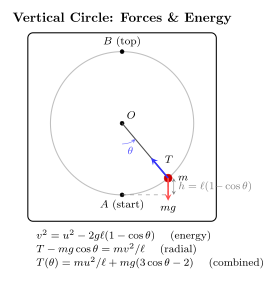
Energy conservation. A particle of mass moving along a smooth circular path of radius starting with speed at the lowest point has speed at height above the start: For a vertical circle of radius , at angle from the downward vertical the height is , so
Centripetal (radial Newton) equation. The net radially inward force equals . With tension (string) or normal reaction (wire/surface) and the radial component of gravity (outward for ; inward for ): Combining (E) and (R) gives the master formula for tension at any angle:
Wire vs. string. A string can only pull (tension ); it goes slack when . A wire (bead) can push or pull; “just reaches the top” means speed there, not , requiring (not ).
Conditions for complete circular motion. For a string: minimum launch speed is (so that at the top). For a wire or inside of a fixed surface: (speed reaches zero at the top).
When the string goes slack. Set in (T): . This gives (upper half) when .
Velocity regimes for smooth surface/cylinder. Let the contact surface provide only an inward normal reaction . Then , which rewrites as . At (top): . Three cases: oscillation (), departure in upper half (), complete revolution ().
Rolling dynamics. For a rigid wheel of moment of inertia rolling without slip (wheel radius , linear acceleration , angular acceleration ): rail friction . Whole-system Newton: for two wheel-axle sets each of mass .
Question Archetypes
Four patterns cover every question in the corpus.
| Archetype | You are seeing this when… |
|---|---|
| vertical-circle-tension | find the tension/reaction and speed at a specific angle; or show a property of the tension |
| vertical-circle-slack | string/cord goes slack; find the height and speed at that moment |
| vertical-circle-regimes | classify motion by the launch speed into oscillation, departure, and complete revolution |
| rolling-dynamics | a rolling wheel or wheeled vehicle; find the acceleration and axle forces |
vertical-circle-tension (3 question(s); 2013, 2017, 2024)
Recognition Cues
- “Particle on a string/wire of length , projected with speed ; find the velocity and tension when the string is [horizontal / vertical / at angle ].”
- “Show that the sum of tensions at the ends of any diameter is constant.”
- “Find the time when the reaction vanishes.” (Bead on wire variant — requires a time integral.)
Solution Template
- Energy. Write at the required angle.
- Radial equation. . Substitute to get .
- Answer the specific question: evaluate at , , etc.; or show cancellation between and .
- Wire variant. If “just reaches the top” → → . Set in (R) to find where reaction vanishes; convert to a time integral via .
Worked Example(s)
2013 Paper 1, 2013-P1-Q7a (20 marks)
Particle of mass 2.5 kg on string 0.9 m, projected horizontally at 8 m/s. Find velocity and tension when string is (i) horizontal (ii) vertically upward.
kg, m, m/s. Using :
(i) Horizontal (, ): , m/s. N.
(ii) Vertically up (, ): , m/s. N.
Check: N .
2017 Paper 1, 2017-P1-Q7c (17 marks)
Bead on smooth vertical circular wire of radius , projected from lowest point just to reach highest point . Find time when the reaction vanishes.
Bead (wire, two-sided): “just reaches ” means , so .
Speed at angle : .
Reaction: (using inward Newton on wire). Set : .
Time: , so . Integrate (where , so , ):
2024 Paper 1, 2024-P1-Q7b (15 marks)
Particle on string of length , complete vertical revolution with initial speed . Show sum of tensions at ends of any diameter is constant.
. Diametrically opposite: .
Since , the terms cancel: This is independent of .
Common Traps
- Wire vs. string: bead on a wire can be pushed outward; “just reaches top” means (), not (). The reaction formula is , which vanishes at (not at the top).
- Sign of gravity’s radial component: below horizontal (), and gravity pulls the particle away from the pivot (outward); above horizontal (), and gravity assists tension (inward). The formula handles both automatically.
- Shortest-form check: the difference is a standard result worth memorising.
vertical-circle-slack (2 question(s); 2014, 2021)
Recognition Cues
- “Particle on cord/string struck with speed ; find velocity and height when cord becomes slack.”
- “Prove circular motion ceases at height [expression]; also prove the greatest height above [reference].”
- The initial speed is explicitly less than , signalling that the particle won’t complete the loop.
Solution Template
- Energy. .
- Slack condition. Set in (R): (note: valid only for , i.e. ).
- Solve simultaneously. Substitute from Step 1 into the slack condition and solve for , then compute height and speed .
- After slack (optional). The particle becomes a projectile at the slack point with speed directed tangentially. Use projectile kinematics to find the maximum height, if asked.
Worked Example(s)
2014 Paper 1, 2014-P1-Q7b (15 marks)
Particle on cord, struck with . Find velocity and height when cord becomes slack.
, so cord goes slack above horizontal.
Energy: .
Slack: (from with ). Wait: the slack condition gives … but so is impossible unless we use the correct sign. For : , i.e. , so . ✓
Equate: .
2021 Paper 1, 2021-P1-Q7c (15 marks)
Pendulum (length , string) projected horizontally with , where . Prove (i) circular motion ceases at height ; (ii) max height above projection point is .
Part (i): Energy: . Slack condition (, ): .
Equate: .
Height: .
Part (ii): At the slack point: height ; ; velocity is tangential (perpendicular to the string).
The string makes angle with the downward vertical at the slack point (), so the velocity vector makes angle with the horizontal. The upward component of velocity: (since , sin of the velocity angle…).
Actually the velocity is tangential to the circle, perpendicular to the radius. The angle of the velocity above horizontal equals (since in the upper half ). So:
- Horizontal: … too complex.
Using the result that at slack: and height above projection is . The velocity at slack is tangential; from this point the particle moves as a projectile. The additional height gained is where is the upward component, (the angle above horizontal).
.
Additional height .
Total max height = . After algebra (set ):
Common Traps
- is the condition for slack — confirm this at the start. If the problem says , the particle turns back in the lower half without ever reaching the upper half.
- The slack condition is , which gives (correct only for ). Forgetting the sign flip gives — a point in the lower half — which is nonsensical.
- After slack, the particle follows a parabolic projectile trajectory (not circular). The maximum height calculation must use projectile kinematics from the slack point.
vertical-circle-regimes (1 question(s); 2025)
Recognition Cues
- “A particle is projected from the lowest point of a smooth vertical [circle/cylinder/sphere] with speed ; classify the subsequent motion according to .”
- Three thresholds: (reach the horizontal level), (complete revolution at minimum).
- Asked to prove the departure angle in terms of for the intermediate case.
Solution Template
- Energy. .
- Reaction. For a surface that can only push inward: .
- Turning (): ; this is in the lower half iff iff .
- Leaving (): ; this is in the upper half iff iff .
- Classify: if , the particle turns before leaving ( first). If , so complete revolution. Otherwise it leaves with .
- Departure angle: where is the angle of the tangential velocity with the horizontal.
Worked Example(s)
2025 Paper 1, 2025-P1-Q8c (20 marks)
Particle projected from lowest point of smooth vertical circular cylinder of radius with horizontal velocity . Show: (i) → oscillates in lower half; (ii) → complete circle; (iii) → leaves tangentially with .
This is exactly the template above applied to the cylinder (inward normal reaction ).
Reaction: (from substituting energy into the radial equation).
Case (i): : turning point has , so . In the lower half always, so particle stays in contact and oscillates.
Case (ii): : and .
Case (iii): at (upper half). At this point , so particle leaves tangentially. The velocity is tangent to the circle, making angle with the horizontal:
Common Traps
- The three boundaries and must be derived, not guessed — show them from and conditions.
- For a cylinder (track pushes particle inward), throughout the lower half automatically. In Case (i) it is not necessary to check separately: the turning point comes first.
- In Case (iii), the departure angle formula (not itself) follows from the geometry: for .
rolling-dynamics (1 question(s); 2020)
Recognition Cues
- A wheeled vehicle or rolling wheel: “prove the acceleration is .”
- “Find the horizontal force exerted on each axle.”
- Rolling constraint: (no slipping).
Solution Template
- Rolling constraint. Linear acceleration and angular acceleration of each wheel: .
- Rotational equation for one wheelset. Torque about axle friction at rail wheel radius: , so .
- Linear equation for whole truck. External horizontal forces: drive forward, friction backward (two wheelsets): .
- Solve for . Substitute : , giving .
- Axle force. Isolate one wheelset: , so .
Worked Example(s)
2020 Paper 1, 2020-P1-Q8c (15 marks)
Four-wheeled railway truck total mass ; each wheel-pair+axle mass , radius of gyration , wheel radius . Force along level track. Prove ; find horizontal force on each axle.
Two wheelsets (factor of 2). Per wheelset: , . Whole truck: .
Axle force , forward on each axle (the truck body pushes the wheelset forward to accelerate it translationally and spin it up).
Common Traps
- The truck has two wheelsets so the effective rotational inertia term is , not .
- is the total mass of the whole truck (body + both wheelsets). The linear equation is correct as stated.
- The “horizontal force on each axle” is the bearing reaction from the truck body on the wheelset — it must supply both translational acceleration () and the reaction to the friction torque (), giving .
Practice Set
- 2017-P1-Q5c (10 m) — — vertical circle; particle on inner side of fixed sphere; find the height at which it leaves the sphere (set ).
- 2025-P1-Q7a (15 m) — — centripetal equation applied to a different constrained-motion setup.