Equilibrium of a system of particles
At a Glance
- Frequency: 8 sub-parts across 5 of 13 years (2013, 2014, 2016, 2020, 2021)
- Priority tier: T2
- Marks (count): 10 (2), 15 (4), 20 (2)
- Average solve time: ~15 min
- Difficulty mix: medium 5, hard 2, easy 1
- Section: B | Dominant type: computation
Why This Chapter Matters
Equilibrium questions have appeared in 5 of the last 13 years with a strong 15- and 20-mark weighting, and the sub-types rotate unpredictably — hinged rods, polygon frameworks, string-and-rod assemblies, and beam-support problems all appear. The unifying skill is setting up clean moment (torque) equations about strategic points to eliminate unknown reactions. The polygon framework problems (hexagon 2013, pentagon 2014) are the hardest and take the most time; the rod and beam problems are more mechanical. All problems reduce to: (1) identify the force system, (2) apply moment balance about the right pivot to eliminate unknowns, (3) resolve for the required quantity.
Minimum Theory
Equilibrium conditions. A rigid body or system is in equilibrium iff (i) the vector sum of all external forces is zero () and (ii) the sum of moments (torques) about any point is zero (). In 2D, these give three scalar equations: , , for any chosen pivot .
Moment of a force about a point. For force applied at point relative to pivot at the origin: . Equivalently, , where is the perpendicular distance from to the line of action. The sign convention (clockwise/counterclockwise) must be consistent.
Strategic pivot choice. Choose the pivot at the point where the most unknowns act; their moments vanish, simplifying the equation. For a hinged body: take moments about the hinge. For a rod on two supports: take moments about one support to find the other’s reaction.
Smooth constraints. A smooth wall or surface exerts a reaction perpendicular to itself (no friction). A smooth vertical wall → purely horizontal reaction. A smooth inclined plane → reaction perpendicular to the plane.
CG of compound bodies. For uniform rods or bodies with weights and CG positions : the compound CG is . For equilibrium with a free pivot, the compound CG must lie directly below the suspension point.
Polygon frameworks. A freely-jointed polygon of equal rods loaded at the joints: analyse rod-by-rod starting from the rod whose forces are simplest (usually the bottom rod, with only two joint forces and its own weight). Apply force balance and moment balance for each rod; use Newton’s third law at joints.
Question Archetypes
Five patterns cover every equilibrium question in the corpus.
| Archetype | You are seeing this when… |
|---|---|
| rod-equilibrium | one or two rods hinged or leaning against a wall; find the hinge reaction or inclination |
| framework-equilibrium | a polygon framework of equal uniform rods; find the stress in an internal rod |
| beam-supports | a beam on two supports with tilting conditions; find the beam weight or CG |
| string-rod-equilibrium | two weights on strings held apart by a rod; find the rod’s angle with the vertical |
| string-tension | an endless string passing over pegs and through a hanging ring; find the string tension |
rod-equilibrium (3 question(s); 2016, 2020, 2021)
Recognition Cues
- A uniform rod is hinged at one end and leans against a smooth wall, or is pulled aside by a force.
- “Find the hinge reaction” or “find the inclination at equilibrium.”
- Two or more joined rods hanging from a fixed pivot: “find the angle with the vertical.”
Solution Template
Single rod against a smooth wall:
- Identify the three forces: weight at midpoint, smooth-wall reaction (horizontal), hinge reaction .
- Take moments about the hinge: . Solve for .
- Resolve horizontally () and vertically (). Compute .
Rod pulled aside by horizontal force:
- Identify the pivot (hinge), the horizontal force at the free end, and the weight at the midpoint.
- Take moments about the hinge; equate clockwise and counterclockwise moments.
- Solve for the inclination angle .
Two joined rods hanging freely:
- Compute the CG of the compound body in terms of the angle .
- Require (CG directly below the pivot). Solve for .
Worked Example(s)
2016 Paper 1, 2016-P1-Q7a (15 marks)
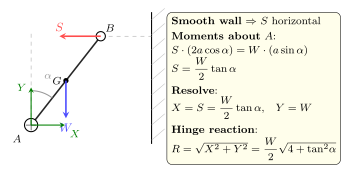
Uniform rod , length , hinged at , rests against a smooth vertical wall; inclination to vertical. Show hinge reaction .
Forces: at midpoint ; horizontal reaction at (smooth wall); hinge at .
Moments about : , giving .
Resolve: ; (wall carries no vertical load).
Note: lever arms are horizontal offset of weight () and vertical height of wall contact (). Swapping them is the classic error.
2020 Paper 1, 2020-P1-Q5d (10 marks)
Rod hinged at , length ; pulled from vertical by horizontal force at the free end. Find inclination.
Moments about : . Insert : , so .
2021 Paper 1, 2021-P1-Q5c (10 marks)
Rods and rigidly joined at with , hung from . Find angle makes with vertical.
The condition means (right angle at , by Pythagoras). Let , . CG condition (CG must be directly below ): take coordinates with at origin, at angle from vertical. The -component of CG:
Expand and set to zero: , giving .
Common Traps
- Smooth vertical wall → horizontal reaction only. The hinge carries the entire weight vertically (); only the horizontal component requires the moment calculation.
- Lever arm for weight = horizontal offset; lever arm for horizontal force = vertical offset. Swapping these is the most common error in rod problems.
- For compound rods: use the CG of each rod (its midpoint), not its endpoint, when computing the weighted average.
framework-equilibrium (2 question(s); 2013, 2014)
Recognition Cues
- A regular polygon (hexagon or pentagon) of equal uniform rods, jointed at vertices, suspended from one joint.
- An internal string or rod connects two non-adjacent midpoints; find its tension or compression.
Solution Template
- Set up the geometry of the regular polygon; identify symmetry to reduce the number of unknowns.
- Write equilibrium (force balance + moment balance) for the bottom rod(s); work upward rod-by-rod.
- Apply Newton’s third law at each joint (force on rod at from = force on rod at from ).
- Solve the resulting system for the internal stress.
Worked Example(s)
2013 Paper 1, 2013-P1-Q7c (15 marks)
Regular hexagon of 6 equal rods, fixed horizontal; string between midpoints of and . Find tension.
By left-right symmetry, horizontal forces at are .
Rod : vertical balance: . (I)
Rod : torque about : . (II)
Rod : torque about : . (III)
From (II)+(III): , so . Substituting into (I):
2014 Paper 1, 2014-P1-Q7c (20 marks)
Regular pentagon suspended from ; light rod connects midpoints of and . Find the stress.
Interior angle . Analyse from bottom rod upward (by mirror symmetry about vertical through ).
Rod (horizontal): vertical balance gives (upward force on at from ).
Rod (torque about ): derives .
Rod (torque about ): derives .
Equating both expressions for : :
The negative sign means the rod is in compression (pushes midpoints apart). Contrast with the hexagon (2013) where tension.
Common Traps
- “Form a hexagon/pentagon” means a regular polygon in UPSC mechanics.
- Work from the bottom rod upward; each rod’s joint forces from the one below are known before you analyse the one above.
- The internal rod’s force acts at the midpoint of the respective rods ( and ), not at the joints — the moment arm to the rod’s endpoint is exactly half the rod’s length.
- Pentagon vs. hexagon: the hexagon’s natural collapse is inward (bottom hangs) → string is in tension; the pentagon’s is midpoints-together → rod is in compression.
beam-supports (1 question(s); 2020)
Recognition Cues
- A beam on two supports; hanging a weight at one end causes the beam to tilt (one support lifts off).
- Two such tilting conditions (one at each end) are given; find the beam’s weight.
Solution Template
- Let beam weight , CG at distance from one end (do not assume uniform).
- Tilt condition 1 (load at end ): beam tilts about support ; reaction at far support vanishes. Moments about : .
- Tilt condition 2 (load at end ): beam tilts about support ; reaction at near support vanishes. Moments about : .
- Add the two equations; the unknown cancels. Solve for .
Worked Example(s)
2020 Paper 1, 2020-P1-Q6c (15 marks)
Beam , supports with . Tilts with at or at . Find beam weight.
Tilt with at (pivots about , ): . (1)
Tilt with at (pivots about , ): . (2)
Add (1)+(2): .
Common Traps
- Do not assume the beam is uniform; CG position must be kept as an unknown and eliminated between the two equations. Assuming (midpoint) forces and is only valid when stated.
- Correctly identify which support the beam tilts about: load at → tilt about (the near support, not the far one).
string-rod-equilibrium (1 question(s); 2016)
Recognition Cues
- Two weights suspended from a fixed point by strings , kept apart by a light rod .
- Strings make angles with the rod. Find the angle the rod makes with the vertical.
Solution Template
- The two tensions pass through ; their resultant also passes through .
- For equilibrium, the combined weight (downward) must act through — the vertical through passes through the rod.
- Take moments about : where are the horizontal positions of relative to .
- Express in terms of and the perpendicular from to the rod; cancel the common factor.
Worked Example(s)
2016 Paper 1, 2016-P1-Q7b (15 marks)
Weights at ; strings make angles with rod ; show .
Let be the foot of perpendicular from to the rod, . Then , (on opposite sides of ). Positions: ; .
Moments about (tensions through contribute nothing): .
Cancel : .
Common Traps
- and lie on opposite sides of , giving a difference in the denominator (not a sum). Placing them both on the same side gives the wrong sign.
- The tensions pass through , so their moment about is exactly zero — that is why the moment equation involves only the weights.
string-tension (1 question(s); 2016)
Recognition Cues
- An endless string of length passes over pegs at the corners of a fixed polygon (usually a square or rectangle) and through a hanging ring of weight .
- Find the tension in the string.
Solution Template
- From the total string length , subtract the portions that lie along fixed sides (known lengths); the remainder is the sum of the segments from the ring to the pegs it contacts.
- From the geometry (half-width of the ring’s position, length of each slant segment ), find where is the angle each slant makes with the vertical.
- Vertical equilibrium of the ring: , giving where is the horizontal offset.
- Substitute and simplify.
Worked Example(s)
2016 Paper 1, 2016-P1-Q7c (20 marks)
Square , side ; string length passes over 4 corner pegs and through a ring of weight . Show .
Length accounting. The ring contacts the two upper pegs; the rest of the loop covers two vertical sides () and one horizontal bottom (). So slant segments: , giving .
Geometry. Ring is on the axis of symmetry; horizontal offset to each upper peg is . So .
Equilibrium. :
Note: , positive since .
Common Traps
- The ring’s segments connect to the upper two pegs, not all four. The remaining string covers 2 vertical sides + 1 bottom = , hence .
- The horizontal half-separation is (the ring hangs on the axis of the square, and the upper pegs are at ), not .
- The smooth pegs and ring mean tension is uniform throughout the whole string — apply this immediately.
Marks-Aware Writing
10-mark questions (2020-Q5d, 2021-Q5c): Two steps — set up forces (one sentence), take moments and solve. For the compound-rod CG problem: state the CG formula explicitly, expand the moment condition, and solve for .
15-mark questions (2013-Q7c, 2016-Q7a, 2016-Q7b, 2020-Q6c): Four to five steps. For framework problems: work through each rod in sequence, labelling forces; state Newton’s third law at each joint explicitly. For string-rod: derive the moment equation and show the full cancellation.
20-mark questions (2014-Q7c, 2016-Q7c): Full structured solution. For the pentagon: label the geometry table, then do three separate rod analyses. For the string: the length accounting and geometry steps each require a clear diagram description.
Practice Set
| Year | Paper/Q | Marks | One-line hint |
|---|---|---|---|
| 2024 | P1-Q6a | 15 | Tetrahedron on smooth plane; ring on slant sides; virtual work — displace ring by , compute work of and work resisted by stress in horizontal rods |
| 2023 | P1-Q7b | 15 | Hemisphere on smooth wall; three forces (string, wall reaction, weight); moments about wall contact to find ; use result |
| 2013 | P1-Q5d | 10 | Inclined plane friction: resolve along plane () and perp (); use with limiting friction for sliding; |
| 2014 | P1-Q5d | 10 | Two rods on a circle; virtual work: displace angle , compute drop in CG; set virtual work = 0 for equilibrium |
| 2015 | P1-Q5d | 10 | Rod + weight on string from point above hinge; moments about hinge give tension; use geometry of the string triangle |
| 2015 | P1-Q6b | 13 | Two ladders leaning at at ; moments about foot; friction at floor; weight on top increases at and hence floor friction — find limit |
| 2022 | P1-Q5c | 10 | Work-energy: work done dragging up = ; dragging back = subtracted from resistance; total net work |
| 2022 | P1-Q7c | 15 | Stability of balanced cylinder: raise CG by when cylinder rocks by ; differentiate height of CG; stable iff which gives |
| 2022 | P1-Q8b | 15 | Chain of rods: resolve force at joint vertically — rods below carry weight ; each rod’s inclination … derive the pattern |
| 2020 | P1-Q7c-i | 10 | Square framework: moments for the rods; diagonal rod thrust from the equilibrium of a corner joint; result |
| 2019 | P1-Q5c | 10 | Rod sliding in ring; friction at ring; resolve normal + along rod; eliminate normal reaction from the two equations to get |