Friction (limiting friction)
At a Glance
- Frequency: 5 sub-parts across 4 of 13 years (2013, 2015, 2019, 2022)
- Priority tier: T3
- Marks (count): 10 (3), 13 (1), 15 (1)
- Average solve time: ~9 min
- Difficulty mix: easy 3, medium 1, hard 1
- Section: B | Dominant type: computation
Why This Chapter Matters
Friction questions appear in Section B and range from straightforward inclined-plane calculations (10 marks) to complex ladder/rod problems (13–15 marks). All share a single mechanical principle: at the point of slipping, . The difficulty lies in correctly identifying the direction of each friction force (it always opposes the tendency of motion) and choosing the right torque axis to eliminate unknown reactions. Three archetypes cover every historical variant.
Minimum Theory
Laws of friction. When a body is on the verge of sliding (limiting equilibrium), the friction force satisfies where is the normal reaction and is the coefficient of limiting friction. Below limiting equilibrium, . The direction of friction opposes the tendency of motion — not the actual velocity, but the direction in which the body would slide if the constraining force were slightly reduced.
Equilibrium of a rigid body. For static equilibrium, both must hold. For a 2D problem take components along and perpendicular to any convenient direction, then take moments about the point where the most unknown forces act — this eliminates those unknowns from the torque equation.
Decomposing weight on an inclined plane. For a plane at angle to the horizontal, a weight has components: Normal reaction (when no additional perpendicular forces act); limiting friction .
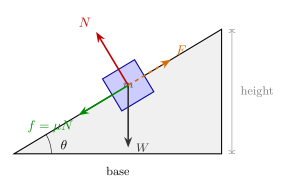
Question Archetypes
| Archetype | Recognition |
|---|---|
| friction-incline | Body on a rough inclined plane; find or critical force to prevent sliding |
| ladder-friction | Ladder/rod resting on rough floor and wall; find reaction, force, or weight to cause slipping |
| friction-equilibrium | Rod or ring with limiting friction; force/moment balance with or similar geometry |
| friction-work | Work done dragging a body up and back down a rough inclined plane |
friction-incline (1 question(s); 2013)
Equilibrium on a rough inclined plane; find the coefficient of friction
Recognition Cues
- A block or body rests on an inclined plane with a known angle (or known base and height).
- An applied force parallel to the plane “just prevents” sliding up or down.
- The question asks for .
Solution Template
- Find the geometry: use base/height to compute and .
- Normal reaction: .
- Friction direction: opposes the tendency of motion. “Just prevents sliding down” → friction acts up the slope.
- Force balance along the plane: applied force friction component of weight along slope.
- Apply limiting friction: and solve.
Worked Example
2013 Paper 1, 2013-P1-Q5d (10 marks)
The base of an inclined plane is 4 m and height is 3 m. A force of 8 kgf parallel to the plane just prevents a 20 kgf weight from sliding down. Find .
Geometry. Hypotenuse ; , .
Normal reaction. kgf.
Along the plane (uphill positive). The body tends to slide down; friction acts up, applied force kgf also acts up:
Common Traps
- Wrong friction direction. “Just prevents sliding down” means friction acts uphill. “Just prevents sliding up” would put friction downhill. Always determine direction from the stated tendency, not habit.
- Applied force has no normal component when is parallel to the plane, so regardless of .
ladder-friction (2 question(s); 2013, 2015)
Ladder or leaning-rod problem with rough floor and/or wall
Recognition Cues
- A uniform ladder rests with one end on a rough floor and the other against a rough or smooth wall.
- An applied horizontal force pushes the lower end, or a weight at the apex causes the system to slip.
- The question asks for the minimum force or the limiting weight.
Solution Template
- Free-body diagram: label all forces at each contact point — normal reaction perpendicular to the surface, friction along the surface.
- Assign friction directions: lower end friction opposes horizontal slip; upper end friction opposes vertical slip. Determine slip directions from the described motion.
- Horizontal and vertical force balance (two scalar equations).
- Moments about one contact point (usually the one with more unknowns) to get a third equation and solve for the reaction at the other end.
- Apply at the critical contact; solve.
Worked Example 1
2013 Paper 1, 2013-P1-Q7b (15 marks)
Uniform ladder at ; upper end against rough wall (), lower end on rough ground (). Find minimum horizontal force to push the lower end toward the wall.
Setup. Lower end tends to slip toward wall; upper end tends to slip upward. Ground friction acts away from wall; wall friction acts downward.
Force balance.
Moments about the lower end (with , so ):
Substituting:
Worked Example 2
2015 Paper 1, 2015-P1-Q6b (13 marks)
Two equal ladders (4 kgf each) lean at apex angle on a rough floor (coefficient ). Find weight at apex to cause slipping.
Setup. Each ladder makes with the vertical. Take the right ladder from base to apex .
Moments about . Torque of weight at midpoint , half apex weight at , and horizontal reaction at (outward, from left ladder):
Limiting equilibrium. (horizontal balance) and (vertical balance), with :
(Sanity check: gives — ladders just balance under own weight; gives — ladders slip unaided.)
Common Traps
- Apex reaction is purely horizontal (by symmetry of the two-ladder configuration). Do not add a vertical component.
- Half of apex weight. The additional weight at the apex distributes equally to both ladders; each carries extra vertical force.
- Torque using coordinates. For a force at point relative to the torque axis, the torque is . Using this formula avoids sign errors.
friction-equilibrium (1 question(s); 2019)
Limiting friction in a rod-and-ring system; derive from the geometry
Recognition Cues
- A rod with one end in a ring on a smooth horizontal rod; joined to a third point by a string.
- A geometric condition at slipping (e.g. ) is given and must be interpreted geometrically before the force analysis.
Solution Template
- Interpret the geometric condition as Pythagoras to find the string direction.
- Identify all three forces: weight, string tension (now with known direction), ring reaction (normal vertical + friction horizontal).
- Moments about the ring to find tension .
- Resolve horizontally and vertically to find and .
- Apply and simplify.
Worked Example
2019 Paper 1, 2019-P1-Q5c (10 marks)
Rod has end in a ring on rough horizontal rod ; and joined by string. At slipping: . Prove .
Step 1. , so string rod .
Step 2. String tension perpendicular to : components (horizontal) and (vertical, downward).
Step 3 — Moments about (rod length ):
Step 4 — Resolve. Friction: . Normal: .
Step 5. .
Using :
Common Traps
- Missing the Pythagoras step. State explicitly: ” gives , so and .” Without this the subsequent geometry has no foundation.
- Ring normal is vertical. The ring slides on a horizontal rod; its normal reaction is vertical (perpendicular to that rod), not perpendicular to rod .
- Wrong sign for tension’s vertical. The string slopes downward from to , pulling downward; this reduces the ring’s normal to .
friction-work (1 question(s); 2022)
Work done dragging a body up and back down a rough inclined plane
Recognition Cues
- A body dragged distance up a rough slope and returned, with applied force parallel to the plane.
- Condition ensures the body does not slide on its own either way.
- The question asks for total work done on the round trip.
Solution Template
- Force to drag up: ; work .
- Force to drag down: ; work .
- Total: .
Worked Example
2022 Paper 1, 2022-P1-Q5c (10 marks)
Weight , incline , coefficient . Find total work to drag distance up and back.
Going up (friction opposes upward motion, acts downhill):
Going down (friction still opposes motion, now acts uphill; body cannot slide on its own):
Check: zero net displacement zero work against gravity; all work equals friction dissipation . ✓
Common Traps
- Friction direction on the downward trip. Friction always opposes the direction of motion; when the body moves downward, friction acts up the slope.
- Condition is essential. It ensures — you must push to move the body downhill — and guarantees the energy formula is correct.
Marks-Aware Writing
For a 10-mark incline problem: two equations (normal balance + along-slope balance) are sufficient. Write each balance with its sign convention and state explicitly.
For a 13–15 mark ladder problem: the examiner marks (a) a described or labelled force diagram, (b) horizontal and vertical balance, (c) the torque equation with the axis stated, (d) the algebraic solution. Skipping any of these costs 3–5 marks even if the final answer is correct.
For the 2019 proof: the Pythagoras insight must be stated explicitly (”, so ”) before the force analysis — it is the pivot of the whole proof.
Practice Set
- 2015-P1-Q6b (13 m) — — Hint: symmetric setup; take moments about the base of one ladder; half the apex weight acts on each.