Principle of virtual work
At a Glance
- Frequency: 6 sub-parts across 6 of 13 years (2014, 2015, 2020, 2022, 2023, 2024)
- Priority tier: T2
- Marks (count): 10 (3), 15 (3)
- Average solve time: ~15 min
- Difficulty mix: medium 4, hard 2
- Section: B | Dominant type: computation
Why This Chapter Matters
This atom appears in 6 of the last 13 years with marks ranging from 10 to 15. The questions split almost evenly between two techniques: classical moment balance (taking moments about a hinge or contact point) and the explicit principle of virtual work (giving the system a virtual displacement and requiring zero virtual work). Both techniques appear in Section B, meaning you choose from two optional questions in Q6–Q8 — mastering one or both wins you 10–15 marks reliably. The hard questions (2020, 2024) involve multi-body frameworks and require identifying the single geometric degree of freedom carefully before applying virtual work.
Minimum Theory
Classical equilibrium. For a rigid body or a connected system in static equilibrium, the sum of all forces is zero and the sum of all moments about any point is zero. The key skill is choosing a clever moment axis — typically a hinge, wall contact, or joint — so that unknown reaction forces pass through it and drop out of the moment equation.
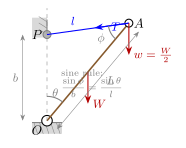
Sine rule for moments. If a string of length is attached to the free end of a rod of length hinged at , and the string’s far end is at a point distance from , then the angle between the rod and the string satisfies (sine rule in triangle ). The moment of the tension about is .
Principle of virtual work (PVW). A conservative system in equilibrium satisfies: for any admissible virtual displacement of the generalised coordinate , the total virtual work is zero: For systems under gravity, this becomes: equilibrium requires , where is the total potential energy expressed as a function of the single free coordinate .
Working method for PVW. Identify the single degree of freedom (e.g., an angle, a length). Express the height of every weight in the system as a function of . Write (taking a fixed datum). For internal forces in a rod or rod under tension , include the work for each such element. Differentiate and set to zero.
When each method excels. Moment balance is fastest for a rod-and-string problem with two or three forces. PVW is cleanest when the system has multiple bodies (framework, chain of rods) because you never need to compute internal joint reactions — they cancel automatically in the virtual work equation.
Question Archetypes
| Archetype | You are seeing this when… |
|---|---|
| moment-equilibrium | Hinged rod with weight and string; chain of rods under end force |
| virtual-work | Framework hung from a corner; tetrahedron with ring; two rods on a circle |
moment-equilibrium (3 question(s); 2015, 2022, 2023)
Recognition Cues
- “A rod is movable in a vertical plane about a hinge at one end … string of length … find the tension.”
- “A chain of rods, smoothly jointed, is suspended from one end; a horizontal force is applied to the other end; find the inclinations.”
- “A solid hemisphere is supported by a string fixed to its rim and to a smooth vertical wall … find the value of .”
Solution Template
- Draw and label. Identify all forces: weight(s) at their CG locations, tensions/reactions at contact/hinge points. The diagram below shows the standard setup for a hinged-rod-and-string problem.
- Choose a moment axis. Pick the point through which the most unknown forces pass (hinge, wall-contact). The reaction at that point produces zero moment.
- Compute each moment. For a force of magnitude at perpendicular distance from the axis, moment . If is not obvious, use with position vector from the axis.
- Apply the sine rule to any triangle formed by rod + string + vertical/horizontal to find angles between forces and rod.
- Set net moment to zero. The desired unknown appears linearly; solve. Check by force balance if needed.
Worked Example(s)
2015 Paper 1, 2015-P1-Q5d (10 marks)
A rod of 8 kg is movable in a vertical plane about a hinge at one end; to the other end is fastened a weight equal to half of the rod; this end is fastened by a string of length to a point at a height above the hinge vertically. Obtain the tension in the string.
Let be the hinge, the free end, rod length , string length , point directly above at height .
Forces on rod: weight kg-wt at midpoint of rod, weight kg-wt at , tension in string at , reaction at .
Take moments about (reaction drops out). Let be the angle .
Gravity moment (clockwise): .
Tension moment (anticlockwise): by the sine rule in triangle , , where . Perpendicular from to the rod has magnitude … more precisely . The moment of about is .
Setting moments equal: .
Both and cancel:
Common traps: The rod length must cancel — if it doesn’t, check the perpendicular-distance calculation. The total clockwise moment is because acts at arm and acts at arm, giving .
2022 Paper 1, 2022-P1-Q8b (15 marks)
A chain of equal uniform rods is smoothly jointed and suspended from one end . A horizontal force is applied to the other end . Find the inclinations of the rods to the downward vertical in equilibrium.
Sub-chain method. Consider rod in isolation. The tension at joint (pulled by the rods below) has:
- Horizontal component (the applied force propagates unchanged up the chain).
- Vertical component downward (weight of the rods below ).
Take moments about for rod alone (weight at midpoint, arm ; tension at with components , position ):
The denominator decreases as increases: the bottom rod () is most inclined with ; the top rod is least inclined.
2023 Paper 1, 2023-P1-Q7b (15 marks)
A solid hemisphere supported by a string fixed to a point on its rim and to a point on a smooth vertical wall with which the curved surface is in contact. If is the inclination of the string with the vertical and is the inclination of the base to the vertical, find .
Place the wall-contact at the origin, so the centre of the hemisphere (radius ) is at . The axis of the hemisphere (perpendicular to the base, pointing toward the curved side) makes angle with the horizontal, so it points in direction .
CG of a solid hemisphere is from the flat base along the axis:
Rim attachment (upper rim point in cross-section):
Force balance. Tension makes angle with the vertical toward the wall, direction . Vertical: . Horizontal: .
Moments about the wall-contact . Moment from (at ): . Moment from at : . Setting total to zero and substituting :
Divide by : , so .
Common Traps
- The horizontal propagation of force up a jointed chain: the horizontal component of tension at every joint equals the applied horizontal force — a fact many students miss.
- The CG of a solid hemisphere is at from the flat face (not , which is the shell result).
- The denominator in is , an arithmetic sequence from top to bottom — the bottom rod has the largest tilt.
virtual-work (3 question(s); 2014, 2020, 2024)
Recognition Cues
- “Using the principle of virtual work, find …”
- “Two rods on a smooth vertical circle … find the relation between , , .”
- “A square framework hung from a corner … find the thrust in the horizontal diagonal rod.”
- “A regular tetrahedron of six light rods … ring resting on slant sides … find the stress.”
Solution Template
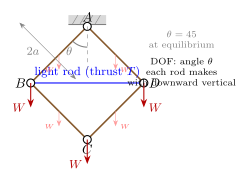
The diagram below shows the square-framework problem — the canonical PVW setup. The single DOF is angle ; all weights are expressed in terms of ; differentiating and applying virtual work gives the thrust directly.
- Identify the single degree of freedom (angle, base-edge length, vertical span). Every other geometric quantity must be expressible as a function of .
- Express all heights as . For each weight in the system, write its vertical position (positive upward) as .
- Write the total potential energy .
- Include internal-rod work. If an internal rod of force (tension positive, compression negative) has length , contribute to the virtual work (tension opposes stretching). Equivalently, write … simpler: use .
- Set (for gravity-only problems) or (when internal forces are involved):
- Evaluate at the given configuration (specific angle, specific ).
Worked Example(s)
2014 Paper 1, 2014-P1-Q5d (10 marks)
Two equal uniform rods and , each of length , are freely jointed at and rest on a smooth fixed vertical circle of radius . If is the angle between the rods, find the relation between , and via virtual work.
DOF: angle (half the angle between the rods). By symmetry, sits on the vertical through the circle’s centre . The tangency condition (each rod tangent to the circle) gives for the height of above .
CG of each rod is at its midpoint, at height above .
Total PE:
Equilibrium :
2020 Paper 1, 2020-P1-Q7c-i (10 marks)
A square framework of four uniform rods each of weight , jointed together, is hung from corner . A weight is suspended from each of the three lower corners. The shape is preserved by a light rod along the horizontal diagonal . Find the thrust in the light rod.
DOF: angle that each rod makes with the downward vertical. With rod length :
Heights above (negative = below ):
- Midpoints of upper rods , : each.
- Midpoints of lower rods , : each.
- Corners , (hung weights): .
- Corner (hung weight): .
Length of diagonal , so .
Virtual work equation ( = thrust, which does positive work when lengthens):
The negative sign means the rod is in compression (thrust). At (square configuration):
Pitfall: account for all weights — the coefficient comes from (two upper CGs, two lower CGs, and hung weights, hung weight).
2024 Paper 1, 2024-P1-Q6a (15 marks)
A regular tetrahedron of six light rods, each of length , rests on a smooth horizontal plane. A ring of weight and radius is supported by the slant sides. Find the stress in any horizontal side by virtual work.
DOF: base-edge length (initially ; slant rods have fixed length ). Apex height . The ring contacts each slant rod at horizontal distance from the axis, giving height above base:
At : , , and
Virtual work (three base rods, each with tension ; ring weight at height ):
Sign: (tension) when ; compression otherwise. The three base rods hold the base against the spreading force of the ring.
Common Traps
- DOF identification: the single degree of freedom must capture the full configuration. For the circle problem it is the half-angle ; for the square it is the rod angle from the vertical; for the tetrahedron it is the base-edge length .
- All weights contribute to : in the square framework, seven separate weights (four rod weights at midpoints plus three hung weights) must all be included.
- Sign of internal rod work: a rod under tension opposes lengthening, so it contributes to . Setting total gives .
- Evaluate at the specific configuration: the virtual-work equation gives a general result; substitute the given geometry ( for the square, for the tetrahedron) only at the end.
Marks-Aware Writing
10-mark question: A complete answer needs a labelled diagram (2 min), the equilibrium equation (force or moment balance / PVW set-up), and the final result derived cleanly in 3–4 steps. Stating the principle used (e.g., “Taking moments about the hinge…”) earns method marks even if subsequent arithmetic goes wrong.
15-mark question: Expect a harder geometry step (locating the CG of the hemisphere, deriving heights in the framework, or computing for the tetrahedron). Show each step explicitly; the examiner awards marks at each junction. For PVW problems, write the expression for in full before differentiating.
Practice Set
- 2023-P1-Q5c (10 m) — — Moment balance with a string-and-weight system; identify the effective arm using the sine rule.
- 2020-P1-Q6c (15 m) — — Virtual work on a mechanical system; start by writing total PE as a function of the single angle.
- 2016-P1-Q7b (15 m) — — Chain of rods or hinged system; use the sub-chain tension approach to find inclinations.