Projectile motion
At a Glance
- Frequency: 5 sub-parts across 5 of 13 years (2015, 2018, 2021, 2022, 2023)
- Priority tier: T2
- Marks (count): 10 (2), 13 (1), 15 (2)
- Average solve time: ~9 min
- Difficulty mix: medium 4, easy 1
- Section: B | Dominant type: computation
Why This Chapter Matters
This atom appears in Section B in 5 of the last 13 years, making it one of the more reliable Dynamics questions in Paper 1. Every UPSC question reduces to writing the parabolic trajectory in range-factored form and then reading off the constraint; once you recognise which archetype you are in, the algebra follows mechanically. The four archetypes (geometric constraints, locus of vertices, perpendicular-direction proof, range from height) have been set at least once each since 2015 — breadth is thin, depth is shallow, scoring potential is high.
Minimum Theory
Standard setup. A particle is projected from the origin with speed at angle above the horizontal. Taking horizontal and vertically upward, the equations of motion under gravity are
Eliminating gives the parabolic trajectory
Standard results.
| Quantity | Formula |
|---|---|
| Range (level ground) | |
| Maximum height (apex) | |
| Time of flight | |
| Apex location |
Range-factored form (key trick). Using and , the trajectory rewrites as
This form is zero at and automatically; it never contains or separately, only their combination . When the problem gives as data (or the range is geometrically fixed), substituting the constraint point immediately gives .
Two angles for the same range. For given the range is the same for complementary angles and .
Trajectory with OY vertically downward. If OY points downward (gravity acts in the positive -direction), the trajectory equation changes sign in the gravity term:
This sign flip is the only change; all other kinematics are standard.
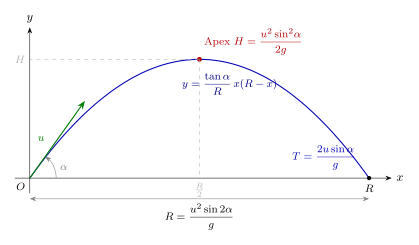
Figure: Standard projectile parabola with apex at , range , time of flight , and the range-factored form .
Question Archetypes
| Archetype | Recognition |
|---|---|
| projectile-constraints | Geometric conditions (clears a wall, grazes a cone apex, hits a target) — find and/or |
| projectile-locus | ”As the angle varies, find the locus of vertices (or some other point)“ |
| projectile-property-proof | ”Prove that two projection directions are perpendicular”, “show the bisector direction is …“ |
| projectile-range | Compare or derive range when projected from a height above the landing level |
projectile-constraints (2 question(s); 2015, 2018)
Find launch speed and/or elevation so a projectile satisfies one or two geometric constraints
Recognition Cues
- The question specifies a wall, cone, or target that the projectile must just clear or land on.
- Two unknowns ( and ) appear — you need two equations.
- Either the range is fixed geometrically (so use range-factored form) or the apex is pinned (use formula).
- Phrases: “just clears”, “grazes the apex”, “strikes at a point”, “horizontal range ”.
Solution Template
- Set up coordinates so the launch point is a convenient origin; identify the landing point and any intermediate constraint point.
- Write the range-factored trajectory if is known or can be expressed geometrically; otherwise write the full trajectory .
- Impose each constraint (e.g., the point the projectile must pass through) to get equations in and .
- Solve the system — typically divide one equation by the other to get , then back-substitute for .
- State the answer clearly: exact form preferred (, ).
Worked Example 1
2015 Paper 1, 2015-P1-Q7b (13 marks)
A particle is projected from the foot of a cone whose semi-vertical angle is and height . The particle just grazes the apex of the cone and lands at the diametrically opposite point on the base circle. Find the initial speed and angle of projection .
Setup. The cone has height and semi-vertical angle , so the base radius is . Place the origin at the launch point (the foot of the cone on the near edge of the base). The apex is at and the landing point (diametrically opposite base edge) is at .
Key observation. The apex lies at horizontal distance from the launch point, which is exactly half the horizontal range . A point at on a parabola is the apex of the parabola (the trajectory’s highest point). Therefore the projectile’s vertex coincides with the cone apex — this is both the “grazing” condition and the apex-of-trajectory condition.
Two equations. The apex of the trajectory has height and lies at :
The range is and , so :
Divide (1) by (2):
Back-substitute into (1). From : . Then , giving
Verification. , which confirms the launch direction is steeper than the cone slant (), so the particle genuinely clears the exterior of the cone.
Worked Example 2
2018 Paper 1, 2018-P1-Q5e (10 marks)
A projectile is fired with speed at elevation and just clears a wall of height at horizontal distance from the point of projection. If the horizontal range on level ground is , find .
Apply the range-factored form. The trajectory is . At the height equals :
Solve for :
No further computation is needed. The formula is valid as long as (the wall is within the range).
Common Traps
- Apex at , not at the constraint point. In the cone problem the constraint point happens to be the apex because — this is a coincidence you must verify, not assume. Confirm by checking the horizontal position of the grazing point equals .
- Forgetting the factor in the denominator. Writing instead of is the most common slip in the wall problem.
- Direction of the launch vs. cone slant. After finding , verify to confirm the flight is outside (not through) the cone.
projectile-locus (1 question(s); 2021)
Find the locus traced by the vertices of a family of projectile parabolas as the projection angle varies with fixed launch speed
Recognition Cues
- Fixed ; angle (or ) is a parameter that varies over .
- “Find the locus of the vertex” or “find the curve traced by the highest point.”
- Parametric elimination: write for the vertex in terms of , eliminate .
Solution Template
- Write the vertex coordinates as functions of :
- Set and express , — recognise as a trigonometric parametrisation of an ellipse or circle.
- Eliminate using to get the Cartesian locus.
- State the centre and semi-axes; check (vertex is always above the -axis).
Worked Example
2021 Paper 1, 2021-P1-Q8b (15 marks)
A particle is projected with velocity at various angles from a fixed point. Find the locus of the vertices of the paths.
Vertex coordinates. With :
Eliminate . Let . Then and , so
This is an ellipse centred at with semi-major axis (horizontal) and semi-minor axis (vertical). Only the upper half (, corresponding to ) is traced, but UPSC accepts the full ellipse equation.
Common Traps
- Off-by-two error in . It is easy to write (the range formula) for the vertex height. The correct formula is .
- Missing the centre shift. The ellipse is centred at , not the origin. Writing is wrong.
- Only upper half. Strictly traces the upper half of the ellipse; if the question asks for “locus” state the full ellipse.
projectile-property-proof (1 question(s); 2022)
Prove a geometric property of trajectories, typically involving the Vieta relations for two complementary projection directions through a given point
Recognition Cues
- Fixed (often expressed as for algebraic neatness); a specific point is reachable by two different angles.
- Asked to prove the two directions are perpendicular, or that one direction bisects a specified angle.
- Axes may be unconventional: OY vertically downward (gravity in positive -direction).
Solution Template
- Write the trajectory equation for the given axis convention; substitute .
- Rearrange as a quadratic in (the two roots are and for the two angles reaching point ).
- Apply Vieta’s formulae: product of roots ; sum of roots .
- For the perpendicularity condition: two lines at angles to the horizontal are perpendicular iff . Set the Vieta product equal to and simplify.
- For the bisector condition: identify the bisector direction using the half-angle identity where .
Worked Example
2022 Paper 1, 2022-P1-Q5d (10 marks)
A particle is projected from with speed where . Axes: horizontal, vertically downward. From , two directions of projection reach the same point on the trajectory. Show that (i) if the two directions are perpendicular, the locus of is ; (ii) if one direction bisects the angle , find that direction.
Trajectory with OY downward. With gravity in the direction: Substitute and :
Rearrange as a quadratic in :
Vieta’s formulae for the two roots :
Part (i) — Perpendicular directions. The two projection directions are perpendicular iff :
Part (ii) — Bisector of . Let , so . From on the locus: .
The bisector direction has . Using the half-angle identity:
Express and from : , .
Substitute and note (using ):
Verify this is a root of : since , both roots of are real and their Vieta product is , confirming they are perpendicular; the bisector root is the one with smaller absolute slope.
Common Traps
- Sign of the gravity term. With OY downward the trajectory is — both terms are positive. Using the standard upward formula (minus sign) gives the wrong quadratic and the wrong Vieta product.
- Perpendicularity condition. Two directions at angles to the horizontal are perpendicular iff , not . The product equals because slopes of perpendicular lines satisfy .
- Half-angle denominator. The identity is valid for , which covers all acute .
projectile-range (1 question(s); 2023)
Compare the range of a projectile launched from height above the landing level with the sea-level range
Recognition Cues
- Two scenarios: same speed , same angle , but one launched from height (Range ) and one from the landing level (Range ).
- Asked to “show ” and find the ratio .
- Solving a quadratic in (time of flight from the elevated position) is unavoidable; take the positive root.
Solution Template
- Write (standard range formula).
- For : solve the vertical displacement equation (landing is below launch). Take the positive root:
- Write .
- Form and show it is positive.
- Express the ratio in simplified form.
Worked Example
2023 Paper 1, 2023-P1-Q6b (15 marks)
A particle is projected with speed at elevation from the top of a cliff of height . The sea-level range is (as if projected from sea level). Let be the actual range. Prove and find the ratio .
Sea-level range.
Time of flight from height . The particle falls a net height below the launch point, so , i.e., . Positive root:
Range from height.
Prove .
Since , . Thus , i.e., .
Find the ratio.
Factor out of the square root:
Common Traps
- Sign when landing below launch. If launch is at height above the landing level and is measured upward from launch, then the landing condition is , giving . Using on the right gives a shorter (wrong) flight time.
- Choosing the wrong root. The quadratic in has two roots; the physical one (landing after launch) is always the positive root — equivalently, the root with the sign before the square root.
- Simplification of the ratio. The clean form requires factoring from inside the square root: . This step is easy to skip, leaving a messy answer that may not match the expected boxed form.
Marks-Aware Writing
For a 10-mark question (e.g., 2018-P1-Q5e, 2022-P1-Q5d): One clean derivation suffices. Write the trajectory in the appropriate form, substitute the constraint, and box the answer. Show one intermediate line of algebra explicitly — examiners cannot award method marks for hidden steps.
For a 13-mark question (e.g., 2015-P1-Q7b): Set up coordinates clearly (1–2 lines), state both equations labelled (1) and (2), divide to get , back-substitute for , take the square root, and state both answers boxed. Add the brief verification that the launch angle exceeds the cone’s slant angle.
For a 15-mark question (e.g., 2021-P1-Q8b, 2023-P1-Q6b): The method must be broken into legible stages: vertex parametrisation and elimination (locus problem), or time-of-flight derivation and range comparison (height problem). State the final answer in boxed display math. For the ratio problem, explicitly write the inequality step before calling the proof complete.
OY-downward problems (2022). State the axis convention at the top of your solution. Write the trajectory equation with the sign (downward gravity) to signal to the examiner you know the convention. Any answer written with the standard sign will be marked wrong even if the final locus is accidentally correct.
Practice Set
- 2024-P1-Q6b (15 m) — — projectile over a wall; find maximum range for given wall dimensions; use range-factored form and optimise over
- 2020-P1-Q5c (10 m) — — complementary angles and the range formula; verify sum/difference identities hold
- 2016-P1-Q5e (10 m) — — projectile constraints: given two conditions derive the launch parameters