Frequency: 8 sub-parts across 8 of 13 years (2013, 2014, 2015, 2018, 2019, 2023, 2024, 2025)
Priority tier: T1
Marks (count): 10 (4), 12 (1), 15 (2), 20 (1)
Average solve time: ~11 min
Difficulty mix: medium 3, easy 3, hard 2
Section: B | Dominant type: derivation
Why This Chapter Matters
SHM has appeared in 8 of the last 13 years with a consistently high mark ceiling — half the questions are 12 marks or above. The questions decompose into four templates: extract amplitude/period/frequency from given velocity-position or velocity-acceleration data; find the time to return to a given point; analyse two-phase motion when an elastic string alternates between taut (SHM) and slack (free flight); or bound the period of a nonlinear oscillator. The first two templates are quick and reliable marks; the two-phase and period-bounds templates are the hard 15/20-mark questions and require careful phase-matching. Mastering the velocity formula v2=ω2(A2−x2) and the parametric form x=Asin(ωt+ϕ) unlocks all four.
Minimum Theory
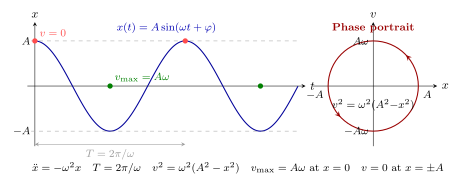
Equation and solutions. SHM about a centre O is defined by x¨=−ω2x (acceleration proportional to displacement, directed toward O). The general solution is x(t)=Asin(ωt+ϕ), where A is the amplitude and ω=2π/T the angular frequency. The velocity formula obtained by first integration (energy integral) is
v2=ω2(A2−x2).
At the extremes x=±A: v=0 (momentarily at rest). At the centre x=0: v=Aω (maximum speed). Acceleration: a=−ω2x, so ∣a∣ is maximum at the extremes (∣a∣max=ω2A) and zero at the centre.
Extracting the period. Two velocity-position pairs (v1,x1) and (v2,x2) immediately give ω by subtracting the velocity formula:
v12−v22=ω2(x22−x12)⟹ω2=x22−x12v12−v22,T=2πv12−v22x22−x12.
One velocity-acceleration pair (v,a) at displacement x gives: ω2=−a/x, A2=x2+v2/ω2.
Time to return to a point. In the parametric form, x(t)=Asin(ωt+ϕ0) with ϕ0 determined by initial position and direction. The next time the particle passes through x=b (while moving outward from O: ϕ0=arcsin(b/A) with cosϕ0>0) is when ωt+ϕ0=π−ϕ0, i.e. t=(π−2ϕ0)/ω. Using π/2−arcsin(b/A)=arccos(b/A): t=(T/π)arccos(b/A). Similarly from ϕ0=arctan(pω/v): t=(T/π)arctan(v/(pω)).
Elastic string SHM. For a particle on an elastic string (natural length ℓ, modulus λ, mass m), when the extension is positive the equation of motion gives SHM about the equilibrium length ℓ0=ℓ+mgℓ/λ, with ω2=λ/(mℓ). When the string goes slack, the motion switches to free projectile under gravity alone.
Question Archetypes
Four patterns cover every SHM question in the corpus.
“Find the time of one complete oscillation” from data about velocity at specific displacements.
“Find the new amplitude” when velocity is instantaneously changed but position is unchanged.
Two (vi,xi) pairs are given — subtract the velocity formula to eliminate A and find ω.
A velocity-acceleration pair is given — use ω2=∣a∣/∣x∣ and v2+a2/ω2=A2ω2.
Solution Template
From two extreme positions and mid-velocity:
Identify the extremes (zero-velocity points) x1,x2; amplitude A=∣x2−x1∣/2, centre at the midpoint.
At the midpoint (centre), velocity is maximised: vmax=Aω.
ω=vmax/A, T=2π/ω.
From two velocity-position pairs:
Write v12=ω2(A2−x12) and v22=ω2(A2−x22).
Subtract: v12−v22=ω2(x22−x12); solve for ω2 (then T).
If A is needed: add back to find A2.
From one velocity-acceleration pair:
From a=−ω2x: ω2=∣a∣/∣x∣ (but need sign — a and x must have opposite signs).
From two states: subtract u2−v2=(f22−f12)/ω2 to find ω2.
Worked Example(s)
2013 Paper 1, 2013-P1-Q5c (10 marks)
SHM in line OPQ; velocity zero at P (distance x from O) and Q (distance y); velocity v at midpoint. Find period.
P,Q are the extremes; midpoint M is the centre. Amplitude A=∣y−x∣/2. At M: v=Aω=(∣y−x∣/2)ω. Hence ω=2v/∣y−x∣ and:
T=vπ∣y−x∣.
Note: the distances x,y from O fix P,Q; only their difference matters. The origin O may or may not be the centre of oscillation.
2015 Paper 1, 2015-P1-Q5c (10 marks)
Amplitude a, period T. Velocity trebled at displacement 2a/3 from mean; period unchanged. Find new amplitude.
Original velocity at x=2a/3: v12=ω2(a2−4a2/9)=5ω2a2/9.
After trebling velocity (same x, same ω), new amplitude A′ satisfies (3v1)2=ω2(A′2−4a2/9):
9⋅95ω2a2=ω2(A′2−94a2)⟹A′2=5a2+94a2=949a2.A′=37a.
2018 Paper 1, 2018-P1-Q6b (12 marks)
Velocities v1,v2 at distances x1,x2 from centre. Find period.
Subtract: v12−v22=ω2(x22−x12), so ω=(v12−v22)/(x22−x12):
T=2πv12−v22x22−x12.
Amplitude A cancels and is not required.
2024 Paper 1, 2024-P1-Q6b (15 marks)
Velocities u,v and accelerations f1,f2 at two positions. Find k such that distance =k(v2−u2); show amplitude formula.
From a=−ω2x: positions are xi=−fi/ω2. The velocity identity becomes u2=ω2A2−f12/ω2 and v2=ω2A2−f22/ω2. Subtract:
u2−v2=ω2f22−f12⟹ω2=u2−v2f22−f12.
The amplitude is half the distance between the extreme positions (P and Q), not the full distance. The midpoint of PQ is the centre — at that point velocity is maximum, not zero.
When velocity is changed by an impulse (2015 problem), the position is unchanged at the instant of impulse. Only the velocity changes; substitute the same x=2a/3 into the new energy equation with the new velocity.
In the two-pair subtraction (2018), the numerator carries the x2 terms (x22−x12) and the denominator the v2 terms (v12−v22). Swapping produces a negative radicand.
shm-time (2 question(s); 2014, 2023)
Recognition Cues
A particle passes through a specific point P at a given position b (or p) from the centre, moving outward. “Find the time before it returns to P.”
Or: given the result is T/2, find the corresponding position.
Solution Template
Write x(t)=Asin(ωt+ϕ0) with ϕ0 chosen so that Asinϕ0=b and x˙(0)=Aωcosϕ0>0 (outward). Hence ϕ0=arcsin(b/A)∈(0,π/2).
The next passage through x=b satisfies ωt+ϕ0=π−ϕ0, giving t=(π−2ϕ0)/ω.
Substitute and simplify using π/2−arcsin(b/A)=arccos(b/A): t=(T/π)arccos(b/A).
If amplitude A is not given but velocity v at position p is:
A2=p2+v2/ω2 and ϕ0=arctan(pω/v); time =(T/π)arctan(v/(pω)).
Worked Example(s)
2014 Paper 1, 2014-P1-Q5c (10 marks)
SHM period T, amplitude a; particle at x=b moving outward. Prove time to return is (T/π)cos−1(b/a).
Set x=asin(ωt+ϕ0); initial conditions give ϕ0=arcsin(b/a) with cosϕ0>0. Next return when ωt+ϕ0=π−ϕ0:
t=ωπ−2arcsin(b/a)=ω2(π/2−arcsin(b/a))=ω2arccos(b/a).
With ω=2π/T:
t=πTcos−1(ab).■
Period T; particle at P (OP=p) with velocity v outward. Find time to return. Find p when return time is T/2.
Since amplitude A is unknown, use: A2=p2+v2/ω2 and ϕ0=arctan(pω/v). The return time is t=(π−2ϕ0)/ω; using π/2−arctan(x)=arctan(1/x):
t=πTarctan(pωv),ω=T2π.
For t=T/2: arctan(v/(pω))=π/2, requiring v/(pω)→∞, hence p=0. Geometrically: from the centre, the particle travels to the extreme and back in exactly T/2.
Common Traps
At the extreme (b=A), the formula gives t=0, which means the “next return” is immediate — the particle is at the turning point and will return through b=A after a full period. This is a limiting case of the formula.
The identity π/2−arctanx=arctan(1/x) (valid for x>0) is the key simplification from the 2ϕ0 form to the arctan form. Derive it, don’t assume it.
“Along OP” means outward (velocity >0 in the direction away from O). If the particle is moving inward, the phase is in (π/2,π) and the return time is different.
shm-composite (1 question(s); 2025)
Recognition Cues
A heavy particle attached to an elastic string fixed at one end; the particle is released from a stretched position.
While the string is taut (extended beyond natural length), the motion is SHM about the equilibrium length.
Once the particle rises past the natural length of the string, the string goes slack and motion is free flight under gravity alone.
The question asks for total time to return to the release point.
Solution Template
Find the equilibrium lengthℓ0 (where tension = weight): λ(ℓ0−ℓ)/ℓ=mg, so ℓ0=ℓ(1+mg/λ).
Write the SHM centre (at ℓ0) and amplitude A=∣y0−ℓ0∣ from the release point.
Use x(t)=ℓ0+Acos(ωt) (starts at rest). Find the time t1 when x(t1)=ℓ (string goes slack) by solving cos(ωt1)=(ℓ−ℓ0)/A.
Find the speed v0=∣x˙(t1)∣=Aω∣sin(ωt1)∣ at the transition.
Free flight: projectile upward with speed v0; time to return to ℓ is t2=2v0/g.
By time-reversal symmetry, the return through the SHM region mirrors phase 1. Total Treturn=2t1+t2.
Worked Example(s)
2025 Paper 1, 2025-P1-Q6b (15 marks)
Elastic string, natural length a, fixed at O; particle at lower end, released from C where string has length 4a; modulus =mg. Show particle returns to C in time a/g(23+4π/3).
Setup. With downward as positive and y = distance below O: equilibrium at y0=2a (Hooke + weight balance), ω2=g/a, amplitude A=4a−2a=2a. Position: y(t)=2a+2acos(ωt).
Phase 1 — SHM until string goes slack (y=a):
2a+2acos(ωt1)=a⇒cos(ωt1)=−21⇒ωt1=32π⇒t1=3ω2π=32πga.
Speed at y=a: ∣y˙∣=2aωsin(2π/3)=2aω⋅23=3ag (directed upward).
The SHM centre is the equilibrium length2a (where tension equals weight), not the natural length a and not the midpoint of the total path.
At y=a, cos(ωt1)=−1/2 comes from (a−2a)/2a=−1/2; this gives ωt1=2π/3 (not π/3). Using the wrong branch gives the wrong time.
The free-flight time uses v0=3ag (from the SHM velocity formula at the transition point). Using v0=2aω (maximum SHM speed) gives the wrong speed.
shm-period-bounds (1 question(s); 2019)
Recognition Cues
The acceleration is Fy with F>0 a positive even function of y — a generalised SHM where the “spring constant” varies with position.
The question asks to bound the period T by 2π/Fmax<T<2π/Fmin.
Often applied to the nonlinear pendulum oscillating at large angle.
Solution Template
Energy integral. From y¨=−F(y)y and v=0 at y=a: multiply by y˙ and integrate to get y˙2=2∫yaF(s)sds.
Period. By symmetry: T=4∫0a2∫yaF(s)sdsdy.
Sandwich. For F2≤F(s)≤F1: F2⋅21(a2−y2)≤∫yaFsds≤F1⋅21(a2−y2). Inverting the inequality in the period integral and integrating ∫0ady/a2−y2=π/2 gives the bound.
Pendulum.F=(g/l)sinθ/θ (write y¨=−(g/l)(sinθ/θ)y with y=lθ). On [0,π/6], sinθ/θ decreases from 1 to 3/π, so F1=g/l and F2=(3g)/(lπ).
Worked Example(s)
2019 Paper 1, 2019-P1-Q7c (20 marks)
Acceleration Fy toward origin, F positive and even; particle vibrates between ±a. Show 2π/F1<T<2π/F2; apply to pendulum at 30°.
Step 1 — Energy.y˙2=2∫yaF(s)sds.
Step 2 — Bounds.F2≤F≤F1 gives F2⋅21(a2−y2)≤∫yaFsds≤F1⋅21(a2−y2). In the period integral, larger denominator → smaller T:
4∫0aF1(a2−y2)dy<T<4∫0aF2(a2−y2)dy.
Both integrals equal π/2 after substituting y=asinu:
F12π<T<F22π.■
Pendulum (θmax=π/6). Write lθ¨=−gsinθ; set y=lθ so y¨=−(g/l)(sinθ/θ)⋅y with F=(g/l)sinθ/θ. Since sinθ/θ is decreasing on [0,π/6]:
F1=lg(at θ=0),F2=lg⋅π/6sin(π/6)=lg⋅π3.
Substituting:
2πgl<T<2π3glπ=2πgl3π.■
Common Traps
The bounding is on ∫yaF(s)sds — the integrand is the momentF(s)⋅s, not F(s) alone. Bounding F by its extremes pulls the constant out but leaves ∫yasds=21(a2−y2).
Larger F → larger speed → smaller period: so F1 (max) gives the lower bound 2π/F1 and F2 (min) gives the upper bound. This direction is easy to reverse.
Pendulum: sin(π/6)=1/2, so sin(π/6)/(π/6)=(1/2)/(π/6)=3/π. The resulting π/3 factor ≈ 1.023 means the true period barely exceeds the small-angle approximation.
Marks-Aware Writing
10-mark questions (2013-Q5c, 2014-Q5c, 2015-Q5c, 2023-Q5d): Two to three steps. Write the energy relation or parametric form; derive the answer algebraically; box the result. For time-return questions, state the phase ϕ0 and the symmetry argument sin(π−ϕ)=sinϕ explicitly — these are the method marks.
12-mark questions (2018-Q6b): Show the two energy equations, perform the subtraction, solve for ω2. The examiner marks the subtraction step and the period formula separately.
15-mark questions (2024-Q6b, 2025-Q6b): For the velocity-acceleration problem, there are two sub-results (k and the amplitude formula); treat them as two separate derivations. For the elastic-string problem, label the three phases clearly and verify the cos(ωt1)=−1/2 step in detail.
20-mark questions (2019-Q7c): Full two-part structure. Part 1 (the bound): set up the integral, sandwich, integrate. Part 2 (pendulum): identify F=(g/l)sinθ/θ, state monotonicity, compute F1 and F2, substitute. Each sub-result carries method marks — present both explicitly.
Practice Set
No additional practice items beyond the worked examples above.
We've mapped all 13 years of this exam. Get new chapters, tools, and solutions as we release them — free.