Stability of equilibrium (energy criterion)
At a Glance
- Frequency: 5 sub-parts across 5 of 13 years (2017, 2019, 2022, 2024, 2025)
- Priority tier: T2
- Marks (count): 10 (1), 15 (3), 17 (1)
- Average solve time: ~14 min
- Difficulty mix: hard 3, medium 2
- Section: B | Dominant type: proof
Why This Chapter Matters
This atom appears in 5 of the last 13 years with marks ranging from 10 to 17 — all in Section B, where you choose optional questions worth 15–17 marks. One energy-criterion inequality, , is the master result that unifies every variant UPSC has set: a hemisphere on an incline, a cone stacked on a hemisphere, two cylinders, and a sphere inside a bowl. The 2025 question adds the Cardan circle theorem (sphere of radius rolling inside a circle of radius ) — the only additional fact needed beyond the standard criterion. Mastering this atom means being able to attempt a full 15-mark Section B question with a single worked strategy.
Minimum Theory
Energy criterion. A conservative system in a configuration of equilibrium is stable if and only if the potential energy has a strict local minimum there: (for a one-degree-of-freedom system parameterised by displacement from equilibrium). For a rigid body resting on a fixed surface, a small tilt raises or lowers the centre of gravity ; stability requires to rise on perturbation.
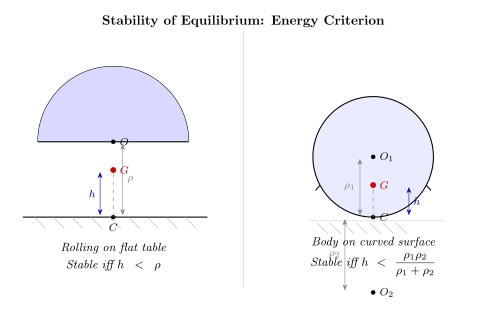
Height criterion for curved surfaces. Let be the height of the centre of gravity above the contact point , let be the radius of curvature of the resting body at , and let be the radius of curvature of the fixed supporting surface at (both measured at the point of contact). After a small rolling displacement by angle , the change in height of to second order is Hence:
| Configuration | Stability condition |
|---|---|
| Curved body on flat table () | |
| Flat base on curved fixed surface () | |
| Both surfaces curved |
The reduced radius is the harmonic mean of the two radii — exactly analogous to the reduced mass in mechanics.
CG of standard solids. The centre of gravity of a solid hemisphere of radius lies at distance from the flat face along the axis. (The shell result is ; the factor arises from .) For a solid cone of height and base radius , the CG is at from the base.
Composite body CG. For two bodies of volumes , and CG heights , measured from a common datum: (Uniform density cancels, so volumes replace masses.)
Cardan circle theorem (R = 2r). A sphere of radius rolling without slip inside a fixed spherical bowl of radius has the special property that every point on the surface of the rolling sphere traces a diameter of the fixed bowl. In particular, the point diametrically opposite to the contact traces the centre of the bowl and the point diametrically opposite to that (i.e., the “top” material point) traces a great circle of the fixed bowl — staying at constant height. This means any weight attached to the top of such a sphere contributes a constant to the potential energy and cannot affect stability.
Question Archetypes
| Archetype | You are seeing this when… |
|---|---|
| stability-of-equilibrium | ”Find the greatest angle/height for stable equilibrium”; “show stability holds regardless of weight” |
stability-of-equilibrium (5 question(s); 2017, 2019, 2022, 2024, 2025)
Test whether the CG is below the critical height set by the curvature of the contact surfaces; or compute the combined CG for a composite body and compare to the criterion.
Recognition Cues
- “A solid hemisphere/sphere/cylinder rests on a … rough [inclined plane / table / sphere].”
- “Find the greatest angle of inclination / greatest height / condition for stable equilibrium.”
- “Show that equilibrium is stable for all values of [weight / angle].”
- Geometry always involves spherical surfaces — radius or height is the unknown.
Solution Template
- Identify the contact surfaces. Read off (curved face of resting body, if flat) and (fixed surface, if flat table).
- Locate the CG. Use for solid hemisphere from flat face; for cone from base; use the composite-body formula if more than one body is present.
- Measure . is the vertical distance of above the contact point when the body is in its reference position.
- Apply the criterion. Stable iff . For a flat base or flat table, replace the appropriate with .
- For equilibrium on an incline: the reaction passes through the centre of the spherical surface, so equilibrium requires to be vertically above — this gives a trigonometric constraint on the inclination angle, and the stability follows from .
- For composite bodies: form the combined CG height in terms of the unknown (cone height , etc.); stable equilibrium requires (below the contact datum, measuring positive upward).
Worked Example 1
2017 Paper 1, 2017-P1-Q6c (17 marks)
A solid hemisphere rests with its curved surface on a rough inclined plane of inclination . Find the greatest value of for equilibrium to be possible. Show that for all positions of equilibrium the equilibrium is stable.
Setup. Let the hemisphere have radius . The curved surface has radius of curvature . The inclined plane is flat, so . CG of solid hemisphere is at from the flat face along the axis, which lies inside the sphere.
Equilibrium condition. The reaction from the rough inclined plane acts along the normal to the inclined plane at the contact point , but since the curved surface is spherical the reaction also passes through the centre of the sphere. Therefore equilibrium requires to lie vertically above .
Let be the angle the axis of the hemisphere makes with the vertical. With the inclined plane at angle :
Taking the contact point at the origin, the centre lies along the inward normal to the incline at distance . Setting the -component of equal to that of (vertical equilibrium):
For a solution to exist, the right side must not exceed 1 in absolute value:
Greatest inclination:
Stability. Since (CG is below the centre of the spherical surface), the criterion is satisfied for every position of equilibrium. Hence equilibrium is stable for all .
Worked Example 2
2019 Paper 1, 2019-P1-Q6a (15 marks)
A solid cone of height and base radius is placed with its base on the flat face of a solid hemisphere of radius , the combined body resting on the flat table. Show that the greatest height of the cone for stable equilibrium is .
Contact surfaces. The combined body rests with the curved surface of the hemisphere on the flat table, so (hemisphere) and (flat table). Criterion: stable iff , where is the height of the combined CG above the contact point (= above the table).
CG computation. Take the flat face of the hemisphere as datum (positive upward toward cone, negative downward into hemisphere):
| Body | Volume | CG from datum |
|---|---|---|
| Solid hemisphere (radius ) | (below flat face) | |
| Solid cone (height , base ) | (above flat face) |
Combined CG above the datum:
The contact point is at the bottom of the hemisphere, distance below the flat face, so .
Stability condition :
The limiting case gives (combined CG at the flat face), exactly at the stability boundary. Hence:
Worked Example 3
2022 Paper 1, 2022-P1-Q7c (15 marks)
A cylinder of radius , height , and mass rests on top of a fixed cylinder of radius . The axes are horizontal and parallel. Show that the equilibrium is stable if and only if .
Setup. Both curved surfaces are cylindrical. Let be a small tilt angle (the upper cylinder rolls through angle on the fixed lower cylinder).
No-slip rolling relations. Arc lengths must match: where is the angle rolled on the upper cylinder and is the tilt. The absolute rotation of the upper cylinder is .
Height of CG after tilt . The centre of the upper cylinder (at distance from the lower cylinder axis in the reference position) rises to:
The CG is at height above the cylinder axis, measured along the (tilted) axis of the upper cylinder; after rotation by :
Change in height of from equilibrium (to second order in ):
using the identity simplifies via when written carefully. Stability requires , i.e.,
This is the general result; is the reduced radius of the two cylinders.
Worked Example 4
2024 Paper 1, 2024-P1-Q5d (10 marks)
A solid hemisphere of radius rests on a fixed solid sphere of radius . Discuss the stability when (i) the curved surface rests on the sphere, and (ii) the flat surface rests on the sphere.
The criterion is , where is the radius of curvature of the resting body at the contact and is the radius of the fixed sphere.
Case (i): curved surface on sphere. (curved face of hemisphere), .
Criterion: .
The contact point is the lowest point of the hemisphere’s curved face. The centre of the curved face is directly above at height . The CG of the solid hemisphere lies at from the flat face, hence at distance from the curved face’s centre — so measured from to .
Compare: . The criterion fails. Equilibrium is UNSTABLE.
Case (ii): flat surface on sphere. (flat base), .
Criterion: .
The contact point is the point of tangency between the flat base and the sphere. The CG lies at above the flat base, so .
Compare: . The criterion is satisfied. Equilibrium is STABLE.
Worked Example 5
2025 Paper 1, 2025-P1-Q7a (15 marks)
A solid sphere of radius and weight rests inside a fixed rough hemispherical bowl of radius . A large weight is attached to the highest point of the sphere. Show that the equilibrium is stable for any value of .
Configuration. The sphere (radius ) rolls inside the bowl (radius ). Let be the angle that the line joining the bowl centre to the sphere centre makes with the vertical.
Sphere centre trajectory. lies on a circle of radius centred at :
Rolling constraint and Cardan theorem. No-slip rolling gives the absolute rotation of the sphere:
The “top” material point of the sphere (the point diametrically opposite to the initial contact) has position:
for all : the attached weight at point moves at constant height. This is the Cardan (La Hire) property of the configuration.
Potential energy. The sphere’s CG coincides with its centre (uniform sphere):
does not appear in at all.
Stability check.
Since regardless of , the equilibrium is a strict local minimum of PE. Hence equilibrium is stable for any value of .
Common Traps
- CG of hemisphere: , not . The value is for a hemispherical shell; UPSC questions always specify a solid hemisphere. Using shifts the CG too high and reverses the stability conclusion.
- Measuring from the right point. In the curved-on-curved case, is measured from the contact point to the CG, not from the axis of the body or from the table. For case (i) of 2024 the contact is at the bottom of the curved face, not at the geometric centre.
- Direction of for composite bodies. Take a consistent datum: for the 2019 problem, the hemisphere’s CG is below the flat face (negative) and the cone’s CG is above it (positive). Mixing up the sign gives an answer of rather than .
- Reduced radius vs. each radius separately. The stability bound is the harmonic mean , which is always less than either or alone. A common error is replacing this by or by .
- The Cardan height is constant, not zero. In the 2025 problem, only because was taken as origin. The key point is that is constant (independent of ), so contributes a constant to and drops out of and . The conclusion holds for any value of .
- Equilibrium on incline: use the moment axis at . On an inclined plane the reaction passes through (centre of spherical surface), so moments about show that must be vertically above — not above .
Marks-Aware Writing
10-mark question (2024 style): State the stability criterion explicitly (), identify , , and numerically for each case, compare, and state the conclusion. Two parts × 5 marks: each part needs the criterion, the arithmetic, and the verdict.
15-mark question (2019/2022/2025 style): A 15-mark answer must show the derivation, not just the criterion. For 2019: set up the composite CG calculation in full, simplify , and extract the inequality. For 2022: derive the expression to second order — the examiner awards marks at each stage (rolling geometry, height formula, stability condition). For 2025: show the rolling constraint, compute explicitly (the Cardan step is the key award point), write , and compute .
17-mark question (2017 style): Two sub-tasks: (a) find the greatest inclination (the trigonometric equilibrium condition, then the constraint , then ) and (b) prove stability (one line: ). Allocate ~12 marks to (a) and ~5 marks to (b).
Practice Set
- 2016-P1-Q6a (15 m) — — Solid hemisphere on top of a solid cylinder; find stability condition using composite CG.
- 2013-P1-Q7c (15 m) — — Paraboloid resting on a plane; use the criterion with the radius of curvature of the paraboloid at its vertex.
- 2021-P1-Q6b (15 m) — — Cone inside a hemisphere; identify which surfaces are in contact and apply the two-curve criterion.