Frequency: 5 sub-parts across 3 of 13 years (2015, 2016, 2021)
Priority tier: T3
Marks (count): 10 (2), 12 (1), 4 (1), 7 (1)
Average solve time: ~5 min
Difficulty mix: easy 3, medium 2
Section: A | Dominant type: computation
Why This Chapter Matters
All five appearances are short, marks-efficient questions in Section A (compulsory or part of Section A optional). The two matrix-power questions reward knowing two algebraic patterns — nilpotency and cyclicity — that let you collapse a high power to something trivial without diagonalising. The trace identity question is a 3-minute proof that shows up as a stepping stone to the “commutator ≠ identity” result. None of these require deep theory; they reward systematic computation and pattern recognition.
Minimum Theory
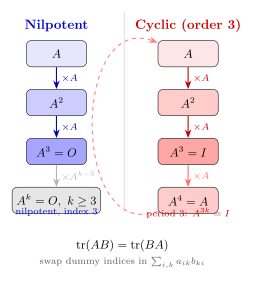
Matrix powers. There are two key patterns: (i) Nilpotent:Ak=O for some k≥1 (the index). Once you establish Am=O, every higher power is also O. (ii) Cyclic of order n:An=I. Powers cycle with period n, so Akn+r=Ar.
Nilpotency test. Compute A2, then A3=A⋅A2, etc., until you reach O. If A is n×n and nilpotent, An=O (Cayley–Hamilton). If you suspect nilpotency: check tr(A)=0, detA=0, tr(A2)=0. These are necessary conditions only; the actual index requires computation.
Trace formula. For n×n matrices A and B:
tr(AB)=∑i=1n∑k=1naikbki=tr(BA).
The key consequence: the commutator [A,B]=AB−BA is always traceless (tr(AB−BA)=0), so AB−BA=cI for any nonzero scalar c.
Determinant limit (multilinearity).det is linear in each row. If row 1 of Δ(x) expands as row 1(0) + x⋅(something) + O(x2), then:
Δ(x)=det(row 1(0),R2,R3)+x⋅det(something,R2,R3)+O(x2).
If row 1(0) = R2 (identical to row 2), the first determinant is 0; if “something” = R3, the second is also 0 — giving Δ(x)=O(x2) and limx→0Δ(x)/x=0.
So A is nilpotent of index 3. For n≥3, An=O. In particular, A14=O.
A14+3A−2I=O+3A−2I=3A−2I=115−634−3918−11.
2015 Paper 1, 2015-P1-Q2a (12 marks)
Find A30 for A=110001010.
Compute small powers:A2=111010001,A3=121001010,A4=122010001.
Pattern (by parity). For even n=2k:
A2k=1kk010001.
Check: A2 (k=1) ✓; A4 (k=2) ✓.
Inductive step. If the formula holds for n=2k, then A2k+2=A2k⋅A2: row 2 gives k+1 in position (2,1), row 3 gives k+1 in position (3,1). ✓
Apply n=30, k=15:A30=11515010001.
Common Traps
Nilpotency index is 3, not 2 in the 2016 example. You must compute A3, not just A2; concluding A2=O is wrong and loses the whole answer.
A is not diagonalisable in the 2015 example (the eigenvalue 1 has algebraic multiplicity 2 but only a 1-dimensional eigenspace). Attempting diagonalisation will fail; the parity-pattern approach is the right route.
tr(A)=0 is a necessary condition for nilpotency but not sufficient. Always verify by computing powers.
matrix-identity-verification (1 question; 2021)
Recognition Cues
“Show A2=A−1” — equivalent to showing A3=I.
“Show Ak=I” for some specific k.
Solution Template
Restate as a power identity:A2=A−1⇔A3=I.
Compute A2, then A3=A⋅A2. Verify A3=I directly.
Conclude:A⋅A2=I⇒A2=A−1.
Worked Example
2021 Paper 1, 2021-P1-Q1a (10 marks)
Show A2=A−1 (without computing A−1) for A=121−1−10100.
Taylor expansion of row 1:f(x+kα)=f(kα)+xf′(kα)+O(x2).
So row 1 = row 2 +x⋅ row 3 +O(x2).
By multilinearity in row 1:
Δ(x)==0det(row 2,row 2,row 3)+x⋅=0det(row 3,row 2,row 3)+O(x2)=O(x2).
Both determinants are 0 because they each have two identical rows. Therefore Δ(x)/x→0.
x→0limxΔ(x)=0.
Common Traps
The O(x) term in Δ(x) has rows (row 3, row 2, row 3) — rows 1 and 3 are identical, giving a second zero. Both cancellations must be observed.
trace-property (1 question; 2021)
Recognition Cues
“Show tr(AB)=tr(BA); hence AB−BA=I.”
The second part always follows from the first by a one-line contradiction.
Solution Template
Prove tr(AB)=tr(BA) via (AB)ii=∑kaikbki; swap dummy indices.
Apply:tr(AB−BA)=tr(AB)−tr(BA)=0, but tr(In)=n=0. Contradiction.
Worked Example
2021 Paper 1, 2021-P1-Q3c-ii (7 marks)
Show tr(AB)=tr(BA); hence AB−BA=I2.
Step 1.(AB)ii=∑kaikbki, so tr(AB)=∑i∑kaikbki. Swap indices i↔k: =∑k∑iakibik=tr(BA). ✓
Step 2. If AB−BA=I2, then tr(AB−BA)=tr(I2)=2. But tr(AB−BA)=tr(AB)−tr(BA)=0. Contradiction. Hence AB−BA=I2.
Common Traps
The proof works for anyn×n matrices, not just 2×2. The conclusion generalises: no finite-dimensional commutator can equal a nonzero multiple of the identity.
Swap the dummy variables explicitly in the proof — don’t just say “by symmetry.”
Marks-Aware Writing
4-mark nilpotent question: Two lines suffice: compute A3=O (show the computation, or state it is easily verified), then write A14=(A3)4A2=O, giving the final expression.
12-mark pattern question: Tabulate A2, A3, A4 explicitly; state the parity formula; prove it by one inductive step; apply. Show each matrix product.
7-mark trace question: Two clearly labelled parts. Part 1: the index-swap computation (3 lines). Part 2: the contradiction argument (2 lines). Total 5–6 lines of clean algebra.
Practice Set
2018-P1-Q1a (10 m) — matrix trace/power variant;
We've mapped all 13 years of this exam. Get new chapters, tools, and solutions as we release them — free.