Solution of system of linear equations
At a Glance
- Frequency: 7 sub-parts across 7 of 13 years (2014, 2016, 2017, 2018, 2019, 2020, 2022)
- Priority tier: T2
- Marks (count): 7 (1), 10 (2), 13 (1), 15 (3)
- Average solve time: ~10 min
- Difficulty mix: medium 5, easy 2
- Section: A | Dominant type: computation
Why This Chapter Matters
Linear systems appear in every year from 2014 to 2022 (7 appearances) with consistent 10–15 marks in Section A. Five distinct archetypes rotate: direct row reduction, parameter-dependent consistency, solution via a given inverse, classifying a fixed system, and deriving a consistency condition. All reduce to one core operation — row-reduction of the augmented matrix — but the question varies from “solve it” to “classify it” to “find the parameter values”. The Rouché–Capelli theorem (rank of vs. rank of vs. number of unknowns) is the organizing principle for three of the five archetypes.
Minimum Theory
Augmented matrix and row reduction. Represent as and apply elementary row operations to reach row-echelon (or reduced row-echelon) form.
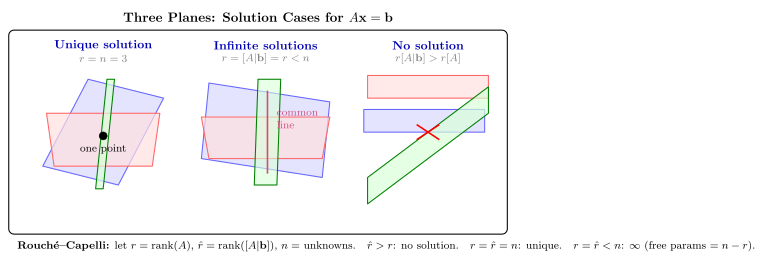
Rouché–Capelli theorem. Let and .
- : no solution (inconsistent — the last nonzero row gives ).
- (number of unknowns): unique solution.
- : infinitely many solutions with free parameters.
Parametric system. If the system contains parameters , the reduced form will have a row whose left side depends on and right side on . Set the left side to zero to find critical ; then check the right side to distinguish no solution from infinite solutions.
Solution via inverse. If is given, then and the system solves to . Match the coefficient matrix of the given system to (not ).
Question Archetypes
Five patterns cover every linear-systems question in the corpus.
| Archetype | You are seeing this when… |
|---|---|
| solve-by-reduction | solve a concrete system; row-reduce the augmented matrix; parameterise any free variables |
| parametric-consistency | system has parameters ; classify as unique/none/infinite based on their values |
| classify-solutions | fixed system; determine whether it has no, one, or infinitely many solutions |
| solve-via-inverse | is established; use to solve |
| consistency-condition | find the condition on the right-hand side that makes a system consistent |
solve-by-reduction (1 question(s); 2022)
Recognition Cues
- “Find all solutions to the system by [Gaussian/row-reduced] method.”
- No free parameters; the matrix has numerical entries only.
Solution Template
- Write the augmented matrix .
- Row-reduce to echelon form; note the rank.
- If rank : back-substitute to get a unique solution.
- If rank : set the free variables as parameters and express the other variables in terms of them.
Worked Example(s)
2022 Paper 1, 2022-P1-Q2a (15 marks)
Solve , , .
Row-reduce :
Rank = 2, three unknowns → one free parameter. Let :
Common Traps
- Track the sign when negating a row ( to get a leading ).
- A row of zeros on both sides means one redundant equation — not no solution.
parametric-consistency (2 question(s); 2014, 2017)
Recognition Cues
- System with parameters ; “investigate the values for which the system has (i) no solution (ii) unique (iii) infinite solutions.”
- Or: “for which does the system have a unique solution? For which does it have more than one?”
Solution Template
- Row-reduce to echelon form; the last row will look like or similar.
- Unique: left-side pivot nonzero (so rank = ). State the condition: .
- No solution: left side zero but right side nonzero: and .
- Infinite: both sides zero: and .
Worked Example(s)
2014 Paper 1, 2014-P1-Q2bi (10 marks)
, , . Classify by .
Row-reduce: last row becomes .
- Unique: (any ).
- No solution: , .
- Infinite: , .
2017 Paper 1, 2017-P1-Q4b (15 marks)
, , . Find for unique; find for infinite.
. Unique: and . Infinite: or .
Common Traps
- Test consistency (last row of augmented) separately from uniqueness (last row of coefficient). "" only rules out uniqueness; you must still check whether the augmented system is consistent.
- State all three cases explicitly even if asked for only one or two.
classify-solutions (1 question(s); 2018)
Recognition Cues
- “Determine which of the following is true: (i) no solution (ii) unique (iii) infinite.”
- The system is fully numerical; classification only, with explanation.
Solution Template
- Compute . If : unique solution; done.
- If : row-reduce . Compare and .
- Equal ranks : infinite. Unequal: no solution.
Worked Example(s)
2018 Paper 1, 2018-P1-Q3a (13 marks)
, , . Classify.
. Row-reduce : last row . Rank Rank.
(i) False. (ii) False. (iii) True — infinitely many solutions.
Common Traps
- means no unique solution; it does not mean no solution at all. Must test augmented matrix.
solve-via-inverse (2 question(s); 2019, 2020)
Recognition Cues
- “Show that ; use this result to solve the system […].”
- The coefficient matrix of the given system matches one of or (usually ).
Solution Template
- Verify by direct matrix multiplication (show each entry).
- Conclude (or ).
- Match the given system to (align rows of with the system’s equations).
- Solve: .
Worked Example(s)
2019 Paper 1, 2019-P1-Q1d (10 marks)
, . Show . Solve , , .
Verify by row-by-row multiplication. The system’s coefficient matrix is ; .
.
Common Traps
- Match the system to , not . If you set up instead, you get , which is wrong.
- Confirm means AND (they are two-sided inverses in finite dimensions).
consistency-condition (1 question(s); 2016)
Recognition Cues
- “Using elementary row operations, find the condition that the system has a solution.”
- The right-hand side contains a free parameter; find the constraint that prevents the last row from giving .
Solution Template
- Row-reduce symbolically.
- Read the last row’s right-side entry after reduction; set it to .
- State the condition.
Common Traps
- Keep the symbolic right-hand side throughout all row operations — students often lose the parameter mid-reduction.
Practice Set
- 2020-P1-Q4a (15 m) — — compute , find , use inverse to solve; combines verification with application.
- 2016-P1-Q1b (7 m) — — consistency condition via row reduction; short but conceptually important.