Subspaces
At a Glance
- Frequency: 6 sub-parts across 6 of 13 years (2014, 2016, 2017, 2020, 2021, 2022)
- Priority tier: T2
- Marks (count): 10 (4), 15 (1), 3 (1)
- Average solve time: ~6 min
- Difficulty mix: easy 4, medium 2
- Section: A | Dominant type: proof
Why This Chapter Matters
Subspaces appear in Section A every few years — 6 of 13 years, always for 3–15 marks — and the questions divide cleanly into two archetypes that each have a mechanical procedure. The first archetype is entirely driven by one formula: ; once you know it, dimension questions become arithmetic. The second archetype is a three-step proof that is identical every time: show , closure under addition, closure under scalar multiplication. Master these two tools and subspace questions are free marks.
Minimum Theory
Subspace definition and test. A non-empty subset of a vector space over is a subspace if and only if for all and all , Equivalently (and most useful for exam proofs): (i) , (ii) is closed under addition (), and (iii) is closed under scalar multiplication (). A subset defined by a system of homogeneous linear equations always passes this test — the zero vector satisfies every homogeneous equation, and linearity ensures closure.
Kernels are subspaces. The solution set of (the null space / kernel of ) is always a subspace of . This is the key structural fact: any set of constraints of the form for a linear map is a subspace. UPSC regularly disguises subspaces as solution sets of systems.
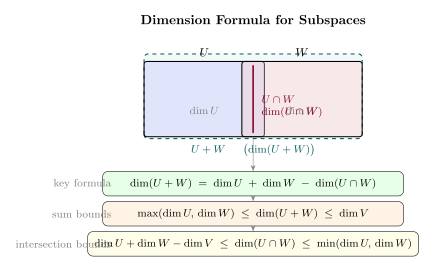
Intersection and sum. If are subspaces of then (vectors in both) is a subspace, and (all sums) is a subspace. Their dimensions satisfy the dimension formula: Rearranging gives bounds on the intersection:
Question Archetypes
| Archetype | Recognition |
|---|---|
| intersection-sum-dimension | Given subspaces ; find or bound or |
| subspace-verification | ”Prove is a subspace”, “show the set is a vector space”, find a basis and dimension |
intersection-sum-dimension (3 question(s); 2014, 2016, 2017)
Compute or bound dim of intersection and sum of subspaces via the dimension formula
Recognition Cues
- The question explicitly mentions intersection () or sum () of two or more named subspaces.
- It asks to find or determine the possible values of a dimension.
- Subspaces are given as spans of vectors, as solution sets of linear systems, or described abstractly (e.g. “a 4-dimensional subspace of a 6-dimensional space”).
Solution Template
- Identify and directly or by row-reduction.
- Find by checking whether fills , or by row-reducing the combined spanning set.
- Apply the formula: .
- For abstract problems: use the bounds to enumerate possible values, then eliminate values ruled out by extra conditions (e.g. distinctness).
- Exhibit an example for each remaining value to confirm it is actually attained.
Worked Example 1
2014 Paper 1, 2014-P1-Q1a (10 marks)
is the -plane in and . Find a vector that generates .
Step 1 — Describe explicitly. A general element of is
Step 2 — Impose membership in . is the -plane, so membership requires the -coordinate to be zero:
Step 3 — Substitute back. With :
Conclusion. is one-dimensional, generated by .
Dimension check: , , (since has a non-zero -component while does not, so ). The formula gives . Consistent.
Worked Example 2
2016 Paper 1, 2016-P1-Q1b-ii (3 marks)
, , . Find and .
Form the matrix of normal vectors and row-reduce:
, so the solution space of all three equations simultaneously has .
For : their normal vectors and are non-parallel, so ; both are 2-dimensional planes in that share a line, hence .
Worked Example 3
2017 Paper 1, 2017-P1-Q2d (10 marks)
and are distinct 4-dimensional subspaces of a 6-dimensional vector space . Find all possible values of .
Step 1 — Apply the dimension formula.
Step 2 — Bound . Since and :
Step 3 — Eliminate the value 4. If , then is a 4-dimensional subspace of ; but , so , forcing . Similarly , giving . This contradicts the hypothesis that and are distinct. So .
Step 4 — Exhibit subspaces for the remaining values.
-
: Take ; , . Then , dimension 3.
-
: Take . Then , dimension 2.
Conclusion. .
Common Traps
- Off-by-one in the formula. The dimension formula is , not a sum. Write it out before plugging in numbers.
- Confusing rank with nullity. When subspaces are given as solution sets of , use the nullity , not the rank itself.
- Forgetting to exhibit examples. For an “all possible values” question, stating the range is not sufficient — you must show each value is actually attained.
- Distinctness eliminates equality. rules out having the same dimension as (or ) whenever they have equal dimension, because that would force .
subspace-verification (3 question(s); 2020, 2021, 2022)
Apply the subspace test (zero vector + closure); find bases and dimension
Recognition Cues
- The question says “show is a subspace”, “prove is a vector space over ”, or “verify the set is a subspace”.
- A set is described explicitly (by a parametric formula or by conditions on coordinates).
- Additional parts ask to “find a basis” and the “dimension”.
Solution Template
- Identify the ambient space (usually or ).
- Check : substitute the zero element and verify all conditions are satisfied.
- Check closure under addition: take arbitrary (satisfying the defining condition) and verify satisfies the same condition. Use linearity.
- Check closure under scalar multiplication: take and ; verify .
- Conclude is a subspace by the subspace criterion.
- Find a basis: write a general element of as a linear combination of a minimal spanning set; identify the vectors in the combination.
- State the dimension as the number of vectors in the basis.
Worked Example 1
2020 Paper 1, 2020-P1-Q1a (10 marks)
Show that the set of all real magic squares is a vector space over . Give two distinct magic squares.
A magic square (in the linear-algebra sense used here) is an real matrix in which all row sums and all column sums are equal. The set of all such matrices is a subset of ; it suffices to show it is a subspace.
Subspace proof. Let (both are magic with equal line sum and respectively) and .
- Zero matrix: The zero matrix has every line sum equal to , so .
- Closure under addition: Each row (and column) of has sum — the same for every row and column, so .
- Closure under scalar multiplication: Each line sum of equals , the same for every row and column, so .
Since is a non-empty subset of the vector space closed under addition and scalar multiplication, is a subspace — hence a vector space over .
Two distinct magic squares. For , a magic square requires all four row and column sums to be equal. Let the common sum be ; then every entry can be taken equal to , giving the constant matrix where is the all-ones matrix. Thus every magic square is a constant matrix:
Both have equal line sums ( and respectively), and .
Worked Example 2
2021 Paper 1, 2021-P1-Q2c (15 marks)
Let . Show that is a subspace of , find two distinct bases for , and determine its dimension.
Part (i) — is a subspace.
- Zero vector: (take ).
- Closure under addition: Let and be in . Then
- Closure under scalar multiplication: For ,
Hence is a subspace of .
Part (ii) — Spanning set. Every element of has the form The two vectors and span and are clearly linearly independent (neither is a scalar multiple of the other). Hence
is a basis for .
Part (iii) — A second basis. Any two linearly independent vectors in form a basis. Take : gives ; take : gives . These are independent (not scalar multiples), so
is a second basis for . (Note since .)
Part (iv) — Dimension. Both bases contain exactly 2 vectors, so .
Worked Example 3
2022 Paper 1, 2022-P1-Q3a-i (10 marks)
Let . Prove that is a subspace of .
is the solution set of the homogeneous linear system with We apply the three-part subspace test directly.
Zero vector. satisfies both equations ( and ), so .
Closure under addition. Let and , so Consider : So .
Closure under scalar multiplication. Let and ; consider : So .
Since satisfies all three conditions, is a subspace of .
Common Traps
- Using the recreational definition of magic squares. The recreational definition (distinct integers 1 through ) does not form a vector space — two such squares do not add to another square with distinct integer entries. The linear-algebra definition (equal line sums, any real entries) is required here.
- Forgetting the constraint. For the third coordinate is tied to the first, not free. Students who write general miss the constraint and obtain incorrectly.
- Testing only two conditions. UPSC expects all three: zero vector, addition, scalar multiplication. Showing only two earns partial credit.
- Not verifying . For solution sets of homogeneous systems this is obvious, but you must still state it explicitly for full marks.
Marks-Aware Writing
For a 10-mark subspace proof: Show all three parts of the subspace test — zero vector, closure under addition, closure under scalar multiplication — as separate, labelled steps. Each step should display the algebra explicitly (do not say “by linearity” and skip the calculation). A correct conclusion with no intermediate algebra earns at most 3–4 marks.
For finding a basis and dimension (part of a 10- or 15-mark question): Write the general element in the form , identify as your spanning set, then state why they are linearly independent. Dimension = number of basis vectors — state this explicitly.
For a 15-mark question: The extra marks reward completeness. Write all parts in full: the subspace proof, both bases with explicit independence arguments, and the dimension statement. A one-sentence basis identification without the independence check will lose marks.
For a 3-mark dimension question: Be concise. Row-reduce the matrix, read off the rank, apply nullity . A single well-annotated row-reduction with the final answer is sufficient.
Practice Set
- 2014-P1-Q2a (15 m) — — Hint: write a general element as a linear combination, identify spanning vectors, prove independence to extract a basis.
- 2025-P1-Q4c-ii (8 m) — — Hint: apply the dimension formula to bound , then check which values are ruled out by any extra constraints given.