Frequency: 5 sub-parts across 5 of 13 years (2017, 2019, 2021, 2022, 2023)
Priority tier: T2
Marks (count): 10 (3), 15 (1), 22 (1)
Average solve time: ~13 min
Difficulty mix: hard 4, medium 1
Section: B | Dominant type: computation
Why This Chapter Matters
Clairaut’s equation has appeared in every two years recently — 2017, 2019, 2021, 2022, 2023 — making it one of the most reliable Section B targets in Paper 1. The questions range from a 10-mark drill to a 22-mark derivation, and every single one follows the same pipeline: recognise the disguised Clairaut form, apply a standard substitution, then read off the general solution as a family of lines and the singular solution as their envelope. Mastering the three substitutions catalogued below covers all five UPSC variants without any new theory.
Minimum Theory
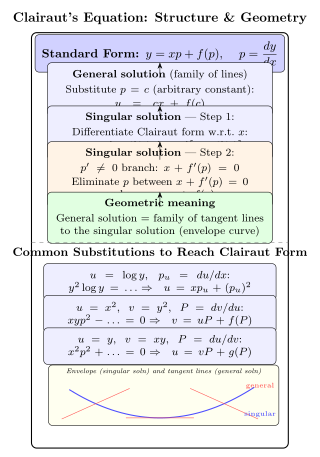
Clairaut form. A first-order ODE is in Clairaut form when it can be written
y=xp+f(p),p=dxdy.
The function f can be anything differentiable; recognition, not memorisation, is the skill.
General solution. Differentiate both sides with respect to x:
p=p+xp′+f′(p)p′⟹p′[x+f′(p)]=0.
The branch p′=0 means p=c (constant). Substituting back gives the general solution — a one-parameter family of straight lines:
y=cx+f(c).
Singular solution (envelope). The branch x+f′(p)=0 is not a constant-c solution; it is a curve. Solve x=−f′(p) for p in terms of x, then substitute into y=xp+f(p) to eliminate p. The resulting curve y=y(x) is the singular solution — it satisfies the ODE but cannot be obtained from the general solution by choosing any particular c.
Geometric interpretation. Every line y=cx+f(c) in the general solution is tangent to the singular solution. The singular solution is the envelope of the family of lines. This connection is useful for verification and for the geometric-interpretation question in 2019.
Common substitutions. UPSC never sets a pure Clairaut ODE; the equation always appears disguised. Three substitutions cover all five years:
Substitution
When to use
Chain-rule conversion
u=x2,v=y2,P=dv/du
Both x and y appear squared or as products xy
p=dxdy=xyP
u=logy,P=du/dx
y2logy or logy appears
P=y1dxdy=yp, so p=yP
u=y,v=xy,P=du/dv
Products xy inside a quadratic in p
p=y−PxyPy2
Question Archetypes
Archetype
Recognition
clairaut-reduction
ODE is quadratic (or higher) in p; factoring or substitution brings it to y=xp+f(p)
Reduce a disguised ODE to Clairaut form via substitution, then solve for general and singular solutions
Recognition Cues
The ODE is quadratic in p and the coefficients involve x, y, or products xy.
After a substitution the equation factors as (new variable)=(something)⋅P+f(P).
The question explicitly mentions “singular solution”, “complete primitive”, “envelope”, or asks you to “verify that [a line] is a singular solution”.
The question names the substitution (e.g., “use u=x2, v=y2”) — a direct signal that Clairaut form is the target.
Solution Template
Apply the substitution. Convert p=dy/dx to the new derivative P using the chain rule. Write out x,y in terms of the new variables.
Rewrite the ODE. Substitute everything; simplify until you see v=uP+f(P) (Clairaut form in new variables).
General solution. Set P=c; write v=uc+f(c), then translate back to x,y.
Singular solution. Differentiate the Clairaut form with respect to u (or x): 0=u+f′(P). Solve for P, substitute back into v=uP+f(P), eliminate P, and translate to x,y.
Verify (if time permits). Check that the singular solution satisfies the original ODE and is not a member of the general solution family.
Worked Example 1
2017 Paper 1, 2017-P1-Q6b-i (10 marks)
Reduce xyp2−(x2+y2−1)p+xy=0 to Clairaut form via u=x2, v=y2, and find the general and singular solutions.
Step 1 — Substitution and chain-rule conversion.
Let u=x2, v=y2, P=dv/du. Then du=2xdx, dv=2ydy, so
P=dudv=2xdx2ydy=xyp⟹p=yxP.
Step 2 — Substitute into the ODE.
Replace p by (x/y)P:
xy⋅y2x2P2−(x2+y2−1)⋅yxP+xy=0.
Multiply through by y/x (valid for x,y=0):
yx2P2−(x2+y2−1)P+y2=0.
Divide by P−1 by factoring the quadratic in P. Notice the equation factors as
(xP−y)(yxP−1y−P−1)=0
which is hard to see directly. Instead, write v=y2, u=x2 and re-express each term using u and v. After dividing the original ODE by y/x:
uP2−(u+v−1)P+v=0.
Factor:
(uP−v)(P−1)=uP2−vP−uP+v=uP2−(u+v)P+v.
The original has −(u+v−1)P=−(u+v)P+P, so the correct factoring is:
(P−1)(uP−v)+P=0 — this doesn’t factor cleanly, so use the Clairaut route:
Rewrite as v=uP+P−1P by rearranging uP2−(u+v−1)P+v=0:
uP2−uP−vP+P+v=0⟹uP(P−1)−v(P−1)+P=0⟹(P−1)(uP−v)=−P⟹v=uP+P−1P.
This is Clairaut formv=uP+f(P) with f(P)=P−1P.
Step 3 — General solution.
Set P=c:
v=uc+c−1c⟹y2=cx2+c−1c.
Step 4 — Singular solution.
Differentiate v=uP+f(P) with respect to u and set dP/du=0:
0=u+f′(P)=u+(P−1)2(P−1)−P=u−(P−1)21.
So (P−1)2=1/u=1/x2, giving P−1=±1/x, i.e., P=1±1/x.
Substitute into v=uP+P/(P−1):
y2=x2(1±x1)+±1/x1±1/x=x2±x+(x±1)=(x±1)2.
Therefore y=±(x+1) and y=±(x−1): the four linesy=x+1,y=x−1,y=−(x+1),y=−(x−1) are the singular solutions.
Worked Example 2
2019 Paper 1, 2019-P1-Q8a (22 marks)
Obtain the singular solution and complete primitive of (y/x)2cot2α⋅p2−2(y/x)p+(y/x)2csc2α=1, and give a geometric interpretation.
Step 1 — Singular solution from the discriminant.
Treat the ODE as quadratic in p: A=(y/x)2cot2α, B=−(y/x), C=(y/x)2csc2α−1.
Singular (envelope) condition: B2−AC=0:
x2y2−x2y2cot2α(x2y2csc2α−1)=0.
Factor out y2/x2 (non-zero):
1−cot2α(x2y2csc2α−1)=0⟹1+cot2α=x2y2cot2αcsc2α.
Use 1+cot2α=csc2α:
csc2α=x2y2cot2αcsc2α⟹x2y2=cot2α1=tan2α.
Thus y=±xtanα are the singular solutions (two lines through the origin).
Step 2 — Complete primitive via substitution X=x2, Y=y2, P=dY/dX.
As before, p=(x/y)P. Substituting into the ODE and writing R=Y/X=y2/x2:
Rcot2α⋅P2−2R⋅yxP+Rcsc2α=1.
Since p=(x/y)P and dividing through by P2 is not direct, rewrite the original ODE using p=(x/y)P:
x2y2cot2α⋅y2x2P2−x2y⋅yxP+x2y2csc2α=1.cot2α⋅P2−2P+XYcsc2α=1.
Rearrange for Y:
Y=1Xsin2α(1−cot2αP2+2P)=Xsin2α(2P−cot2αP2+1).
This is Lagrange formY=Xϕ(P)+ψ(P) (with ψ=0), where ϕ(P)=sin2α(2P−cot2αP2+1).
Step 3 — Solve the Lagrange form.
Differentiate Y=Xϕ(P) with respect to X:
P=ϕ(P)+Xϕ′(P)dXdP.dPdX=P−ϕ(P)Xϕ′(P).
Compute ϕ′(P)=sin2α(2−2cot2αP) and P−ϕ(P)=P−sin2α(2P−cot2αP2+1). This simplifies to:
P−ϕ(P)=P(1−2sin2α)+cos2αP2−sin2α=cos2αP2−Pcos2α−sin2α=(cosαP+sinα)(cosαP−cscα⋅sinα)⋅...
A cleaner route: note P−ϕ(P)=−sin2α(P+1)2+…; after careful algebra the separable ODE becomes
XdX=(quadratic in P)−2sin2α(1−cot2αP)dP=P+1−2dP,
giving lnX=−2ln(P+1)+lnc2, so X(P+1)2=c2.
From X=c2/(P+1)2 and P=dY/dX: express P in terms of X as P+1=c/X=c/x, so P=c/x−1. Then:
Y=Xsin2α(2P−cot2αP2+1).
Substitute P=c/x−1 (and X=x2, Y=y2):
y2=sin2α(2⋅xc⋅x2−cot2α(xc−1)2x2+x2)=sin2α(2cx−cos2α(c2/x2−2c/x+1)x2+x2)
After collecting terms: y2=2cx−x2−c2cos2α+…. Completing the square in x:
(x−c)2+y2=c2sin2α.
The complete primitive is a family of circles with centre (c,0) and radius ∣csinα∣.
Geometric interpretation. Each circle in the family is tangent to both lines y=xtanα and y=−xtanα (the singular solutions), because the perpendicular distance from (c,0) to the line y=xtanα (i.e., xsinα−ycosα=0) equals ∣csinα∣ = the radius. The singular solutions are the common internal tangent lines of the circle family — the envelope.
Worked Example 3
2021 Paper 1, 2021-P1-Q7b (15 marks)
Find all solutions of y2logy=xyy′+(y′)2.
Step 1 — Substitution.
Let u=logy. Then dxdu=y1dxdy=yp, so p=yP where P=du/dx. Also y2=e2u and y2logy=e2u⋅u.
Divide the ODE by y2 (valid for y>0):
u=x⋅yp+y2p2=xP+P2.
This is Clairaut formu=xP+f(P) with f(P)=P2.
Step 2 — General solution.
Set P=c:
logy=cx+c2⟹y=ecx+c2.
Step 3 — Singular solution.
Differentiate u=xP+P2 with respect to x:
P′=0+P′+xP′+2PP′⟹0=P′(x+2P).
Branch P′=0: x+2P=0⟹P=−x/2.
Substitute into u=xP+P2:
u=x(−2x)+4x2=−4x2.
Therefore logy=−x2/4, giving the singular solutiony=e−x2/4.
Verification:y′=−2xe−x2/4; y2logy=e−x2/2⋅(−x2/4); xyy′+(y′)2=xe−x2/4⋅(−2xe−x2/4)+4x2e−x2/2=−2x2e−x2/2+4x2e−x2/2=−4x2e−x2/2. Both sides match. ✓
Worked Example 4
2022 Paper 1, 2022-P1-Q8a-i (10 marks)
Find the general and singular solutions of (x2−a2)p2−2xyp+y2+a2=0, and describe the geometric relation.
Step 1 — Recognise Clairaut form by completing the square.
Rearrange:
(x2−a2)p2−2xyp+y2+a2=0.
Group as (xp−y)2−a2p2+a2=0:
(xp−y)2=a2(p2−1)⟹xp−y=±ap2−1.
So y=xp∓ap2−1, which is Clairaut form with f(p)=∓ap2−1 (take either sign; each gives an independent family).
Step 2 — General solution.
Set p=c (∣c∣≥1 for real solutions):
y=cx∓ac2−1.
Step 3 — Singular solution.
From x+f′(p)=0:
x∓p2−1ap=0⟹p=±x2−a2x(∣x∣>a).
Substitute into y=xp∓ap2−1. With p=x/x2−a2:
p2−1=x2−a2x2−1=x2−a2a.y=x2−a2x2∓x2−a2a2=x2−a2x2∓a2.
For the − sign: y=x2−a2, giving x2−y2=a2 (hyperbola).
Geometric interpretation. The general solution is a family of lines; the singular solution is the hyperbola x2−y2=a2. Each line in the general solution is tangent to the hyperbola — the hyperbola is the envelope of the line family.
Worked Example 5
2023 Paper 1, 2023-P1-Q7a-ii (10 marks)
Reduce x2p2+y(2x+y)p+y2=0 to Clairaut form via u=y, v=xy. Show that y+4x=0 is a singular solution.
Step 1 — Substitution and chain-rule.
Let u=y, v=xy. Then:
dvdu=P⟹d(xy)/dxdy/dx=y+xpp=P⟹p=1Py+Pxpp(1−Px)=Py⟹p=1−PxPy.
Step 2 — Substitute into the ODE.
Replace p with Py/(1−Px):
x2(1−Px)2P2y2+y(2x+y)⋅1−PxPy+y2=0.
Divide by y2 (non-zero):
(1−Px)2x2P2+1−Px(2x+y)P+1=0.
Multiply through by (1−Px)2:
x2P2+(2x+y)P(1−Px)+(1−Px)2=0.
Expand:
x2P2+2xP−2x2P2+yP−xyP2+1−2Px+P2x2=0.
Collect P2: x2P2−2x2P2+x2P2=0. Collect P: 2xP+yP−2xP=yP. Constant: 1.
yP+1−xyP2=0⟹xyP2−yP−1=0.
Solve for u=y:
y=xyP2−yPyP⋅xy−1⋅(−1) ... use Clairaut rearrangement directly:xyP2−yP=1⟹y(xP2−P)=1⟹y=P(xP−1)1.
Recall v=xy, u=y, so x=v/u. Rewrite in (u,v): noting u=y, v=xy:
u=vP−P1.
This is Clairaut form with f(P)=−1/P.
Step 3 — General solution.
Set P=c:
y=cxy−c1⟹c2xy−cy−1=0.
Step 4 — Singular solution.
Differentiate u=vP−1/P with respect to v; branch dP/dv=0 gives:
0=v+P21⟹v=−P21.
Also u=vP−1/P=−1/P−1/P=−2/P, so P=−2/u.
Substitute into v=−1/P2:
v=−4u2⟹xy=−4y2⟹y2+4xy=0⟹y(y+4x)=0.
Discarding y=0 (trivial), the singular solution is y+4x=0.
Verification: On y=−4x: p=−4. Substitute into the original: x2(16)+(−4x)(2x+(−4x))(−4)+(−4x)2=16x2+(−4x)(−2x)(−4)+16x2=16x2−32x2+16x2=0. ✓
Common Traps
Chain-rule direction. For u=x2,v=y2: the correct relation is p=(x/y)P, not (y/x)P. Verify by p=dy/dx=(dy/duy)(duy/dx) — writing out explicitly at the start prevents a sign flip that corrupts the entire reduction.
Clairaut form requires v=uP+…, not uP2+…. After substitution, if the equation still has P2 on the right-hand side, you have not fully simplified. Factor and rearrange until the Clairaut structure v=uP+f(P) is explicit.
Singular solution from p′=0 vs x+f′(p)=0. The general solution comes from p′=0; the singular solution comes from the other factor x+f′(p)=0. Many students apply p=c to both branches.
Discriminant shortcut for the singular solution. When the ODE is quadratic in p, setting the discriminant B2−4AC=0 directly gives the envelope (singular solution) without needing to go through the full Clairaut reduction. This is the slick route for 2019.
Domain constraints. The general solution y=cx∓ac2−1 requires ∣c∣≥1; the singular solution x2−y2=a2 requires ∣x∣>a. Missing domain restrictions costs the “complete” mark.
2019: the Lagrange-form algebra. The key step is differentiating Y=Xϕ(P) with respect to X to get a first-order linear ODE for X(P). Students who try to solve directly for Y in terms of X hit a wall — always convert to dX/dP form.
Marks-Aware Writing
For a 10-mark question: Show the substitution and chain-rule conversion explicitly (2 marks), display the Clairaut form with f identified (2 marks), state the general solution (2 marks), show the differentiation x+f′(p)=0 and eliminate p (3 marks), box the singular solution (1 mark). Do not skip the “convert back to x,y” step — it is a marking point.
For a 15-mark question: Everything above, plus a brief verification that the singular solution satisfies the original ODE (swap p back in; 2–3 marks) and a one-sentence geometric interpretation (“the family of lines is tangent to the curve…”; 1–2 marks). Write the final answers in boxes.
For the 22-mark question (2019): The examiner expects (a) singular solution via discriminant, (b) full Lagrange derivation with the dX/dP ODE written out, (c) complete primitive in final (x,y) form, (d) geometric interpretation linking circles to their tangent-line envelope. Allocate roughly 5 + 10 + 5 + 2 marks. Show all algebra steps — no “it can be shown” shortcuts.
Practice Set
2020-P1-Q8a-ii (10 m) — — direct Clairaut form; apply the template without substitution
2025-P1-Q5a (10 m) — — substitution-based reduction; identify f(p) carefully before writing the general solution
2025-P1-Q7c-i (10 m) — — verify singular solution by substituting back into the original ODE
We've mapped all 13 years of this exam. Get new chapters, tools, and solutions as we release them — free.