Exact equations
At a Glance
- Frequency: 9 sub-parts across 6 of 13 years (2013, 2014, 2015, 2018, 2019, 2023)
- Priority tier: T2
- Marks (count): 10 (5), 12 (3), 15 (1)
- Average solve time: ~9 min
- Difficulty mix: medium 6, easy 3
- Section: B | Dominant type: computation
Why This Chapter Matters
Exact and integrating-factor questions appear in 6 of the last 13 years and are mostly 10–12 marks in Section B — short enough to be attempted under time pressure. Eight of the nine questions require finding an integrating factor; one is directly exact. The standard type (IF depending only on or only on ) is three or four minutes of formula application once you recognise the form. The harder variants — IF of the form , or a function of , or finding for exactness — are less mechanical but still fully algorithmic. Every question reduces to the same three steps: test exactness, identify the IF, integrate the potential.
Minimum Theory
Exactness test. is exact iff throughout a simply-connected domain.
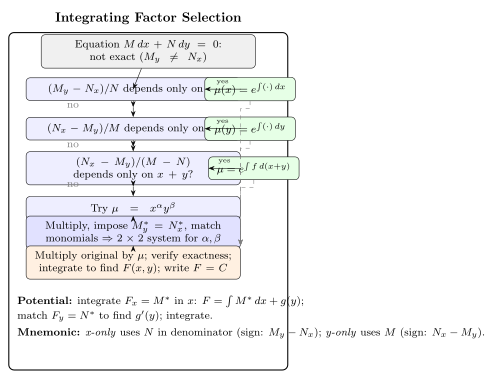
Integrating factor (IF). Multiply through by to make the equation exact. The IF is found by the form it takes:
- only: requires to be a function of alone; then .
- only: requires to be a function of alone; then .
- : requires to be a function of alone; then .
- : multiply through, impose exactness, match coefficients of monomials to get a linear system for .
Integrating the potential. Once exact, find with by integrating one partial, then matching the other to find . General solution: .
Exactness-condition type. Given an equation with an unknown function, impose to find it, then solve the now-exact equation.
Question Archetypes
Three patterns cover every exact/IF question in the corpus.
| Archetype | You are seeing this when… |
|---|---|
| integrating-factor | equation is non-exact; find a special-form IF to make it exact, then solve |
| exact-equation | equation is directly exact (verify, then integrate the potential) |
| exactness-condition | find an unknown function/parameter that makes the equation exact, then solve |
integrating-factor (7 question(s); 2013, 2014, 2014, 2015, 2015, 2018, 2019)
Recognition Cues
- “Solve ” where — you must find an IF.
- “Show the equation is non-exact; find an IF of the form […].”
- Variant: “Find such that is an IF.”
- Variant: “Find the sufficient condition for an IF as a function of ; apply to […].”
Solution Template
- Test exactness. Compute and ; confirm they differ.
- Identify the IF form. In order: try (pure ?); try (pure ?); try (pure ?); else try .
- Compute the IF. Apply the appropriate integral/formula.
- Multiply and verify. After multiplying by , recheck .
- Integrate. Find : integrate in to get ; differentiate in , match to find .
- Write .
Worked Example(s)
2013 Paper 1, 2013-P1-Q6a (10 marks)
Solve .
, . Not exact. — pure . So .
After multiplying by : . Now ✓.
Integrate: . Match : , .
2014 Paper 1, 2014-P1-Q8a (15 marks)
State sufficient condition for IF as function of ; apply to .
Condition: must be a function of only.
Here , . — pure ✓.
. Multiplying: (the cancels). Integrate:
2018 Paper 1, 2018-P1-Q7d (12 marks)
Find such that is an IF of .
Multiply by . Impose exactness; match coefficients of and : Solve: , . With : integrate the exact equation to get
2019 Paper 1, 2019-P1-Q5a (10 marks)
Solve .
… testing simplifies to — pure . Wait: for this case (verify). So .
After multiplying by : integrate in : . Match : .
Common Traps
- Test for -IF and for -IF — the signs are opposite. Swapping them gives the wrong formula and a wrong IF.
- condition uses in the denominator, not or alone. The numerator is (note: same sign as the -only formula’s numerator).
- For : expand and fully before matching coefficients. Keep track of whether has a minus sign in the original equation.
- After multiplying by , always recheck before integrating — a sign error in the IF is easy to miss otherwise.
exact-equation (1 question(s); 2023)
Recognition Cues
- Test exactness and it passes: immediately.
- Often signals itself by having clean cross-partials that are obviously equal.
Solution Template
- Verify: compute and , confirm equality.
- Integrate in : .
- Match : differentiate in , equate to , solve for , integrate.
- Write .
Worked Example(s)
2023 Paper 1, 2023-P1-Q7a-i (10 marks)
Solve .
Rewrite: . — directly exact.
. , so , .
Common Traps
- Always test exactness first — do not assume non-exactness just because the equation looks complicated.
- The term in integrates to , not . Track the constant carefully.
exactness-condition (1 question(s); 2018)
Recognition Cues
- “Find [or , or parameter ] such that is exact.”
- One of contains an unknown function; solve for it using , then integrate.
Solution Template
- Apply : differentiate both sides partially; the unknown function’s derivative appears directly.
- Integrate to find the unknown function (take the simplest antiderivative).
- Solve the now-exact equation using the standard template.
Worked Example(s)
2018 Paper 1, 2018-P1-Q8d (12 marks)
Find so is exact; then solve.
, . Exactness: , . So , giving .
Now integrate: . , so .
Common Traps
- Identify (coefficient of ) and (coefficient of ) correctly — the equation may be written with the term first.
- An additive constant in is harmless and absorbed into .
Practice Set
- 2014-P1-Q5a (10 m) — — show is an IF for a given equation; verify and solve.
- 2015-P1-Q6a (12 m) — — find the value of such that is an IF; solve.