First-order higher-degree ODEs
At a Glance
- Frequency: 5 sub-parts across 4 of 13 years (2015, 2018, 2020, 2025)
- Priority tier: T3
- Marks (count): 10 (3), 13 (2)
- Average solve time: ~13 min
- Difficulty mix: hard 3, medium 2
- Section: B | Dominant type: computation
Why This Chapter Matters
This atom contains the hardest ODE questions on Paper 1 — three of the five appearances are classified hard, and the two 13-mark questions both require a non-standard algebraic manoeuvre before integration begins. The two archetypes split cleanly by the structure of the equation: if you can factor the quadratic in into a perfect square, or if the equation is linear in or , you have the right approach. The payoff for learning both techniques is high: the 2025 paper tested both archetypes (Q5a and Q7c-i), for a combined 20 marks.
Minimum Theory
The problem. A first-order ODE of degree has the form where and is a polynomial of degree in . The standard strategies are:
Solvable for : Factor into linear factors in . Each factor gives a first-order linear ODE; the general solution is the product of individual general solutions.
Solvable for (Lagrange/d’Alembert type): If the equation can be written as , differentiate w.r.t. using to get a linear ODE in (or ) as a function of .
Solvable for : If , differentiate w.r.t. using to get an ODE in vs .
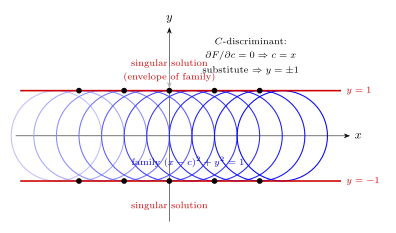
Singular solutions. Besides the general solution (containing an arbitrary constant ), higher-degree ODEs often have singular solutions — solutions that satisfy the ODE but cannot be obtained from the general solution by any choice of . Geometrically, singular solutions are the envelope of the family of curves described by the general solution.
-discriminant method: From , solve for and substitute back into . The resulting relation in gives candidates; test each against the original ODE.
-discriminant method: Eliminate from the general solution and . Test candidates in the ODE.
Question Archetypes
| Archetype | Recognition cue |
|---|---|
| quadratic-in-p-singular | Quadratic in ; “find general and singular solutions” |
| solvable-for-x | Equation linear in or of Lagrange type |
quadratic-in-p-singular (3 questions; 2020, 2025, 2025)
Recognition Cues
- The ODE is degree 2 in , e.g. or .
- The question always asks for both the general solution and the singular solution.
- Look for: a perfect-square factorisation, or a missing (so you can separate directly after solving for ), or a useful substitution .
Solution Template
- Identify the degree-2 structure. Clear fractions; write as .
- Try to factor or simplify. Look for perfect squares; group to reveal .
- Separate and integrate. Once is isolated (or as a substitution), separate variables and integrate. Use standard substitutions (, , ) to clean up the integrand.
- State the general solution. Implicit or explicit.
- Find the singular solution. Use the -discriminant: set , solve for , substitute into . Test each candidate against the original ODE — not all solutions of the discriminant equation are genuine singular solutions.
Worked Example(s)
2020 Paper 1, 2020-P1-Q8a-ii (10 marks)
Find general and singular solutions of .
Solve for : . Separate (taking the branch): Substitute : . Integrate:
General solution:
Singular solution. -discriminant: ; or .
- . Check: ✓.
- : . Rejected.
2025 Paper 1, 2025-P1-Q5a (10 marks)
Solve .
Multiply by : .
Key factorisation: , i.e. .
Rearrange: . Divide both sides and use , :
General solution: .
Singular solution. The discriminant when . Both satisfy the original ODE (direct check with ).
2025 Paper 1, 2025-P1-Q7c-i (10 marks)
General and singular solutions of .
Substitution: , so . After taking cube roots and solving for : Integrate and substitute back : cube both sides to clear the fractional power.
General solution: .
Singular solution. gives , then .
Common Traps
- Always test -discriminant candidates. Not every root of is a singular solution: the value must also satisfy the original ODE. In the 2020 example, fails the ODE test.
- The -discriminant can produce spurious factors. In the 2020 example, differentiating w.r.t. gives , substituting yields : the factors (a node locus) and (the envelope). Only satisfies the ODE.
- Singular solutions are NOT obtained from the general solution for any value of . Verify this is the case before declaring a solution “singular”.
- The substitution (2020) or (2025-Q5a) or (2025-Q7c-i) is the key step that linearises the ODE for integration; practice recognising the right substitution.
solvable-for-x (2 questions; 2015, 2018)
Recognition Cues
- The equation can be written as (solvable for , or equivalently linear in ).
- The equation is degree 2 in but linear in , making direct solution for messy but solution for clean.
- Key phrase: “solvable for ” or “Lagrange/d’Alembert form”.
Solution Template
- Solve for (if the equation is linear in ): .
- Differentiate w.r.t. , using :
- Separate or recognise the linear ODE in or . Solve for (or similar) by separation.
- Eliminate from the relation (or equivalent) and the original .
Worked Example(s)
2018 Paper 1, 2018-P1-Q6a (13 marks)
Solve .
The equation is linear in : , so .
Differentiate w.r.t. , using : After algebra (move to the left):
Substitute into : This is a family of parabolas with axis along the -axis.
2015 Paper 1, 2015-P1-Q7d (13 marks)
Solve .
Differentiate w.r.t. : , giving: Integrating factor . After multiplying and integrating (using ):
Parametric general solution:
Singular solutions from , i.e. : the lines .
Common Traps
- Recognise linearity in , not . Trying to solve the 2018 ODE as a quadratic in gives — messy. The -linearity route gives clean separation.
- The factor cancels in the 2018 derivation; write it explicitly before cancelling.
- The 2015 integral requires ; the result is .
- Final answer is parametric in for the 2015 equation — eliminating in closed form is not expected.
Marks-Aware Writing
10-mark singular-solution question: State the general solution (derived clearly) in 4–5 lines; then apply the discriminant method in 3 lines. Explicitly test each discriminant candidate against the original ODE. Marks are evenly split between general and singular.
13-mark solvable-for- question: The Lagrange differentiation step must be written out in full (2–3 lines). Show that the ODE reduces to a separable equation; state the separation explicitly. Derive the parametric or explicit general solution; state singular solutions if they arise. The examiner awards marks at each step.
Practice Set
- 2023-P1-Q7a-ii (10 m) —
- 2022-P1-Q8a-i (10 m) —
- 2021-P1-Q7b (15 m) —
- 2019-P1-Q8a (15 m) —
- 2017-P1-Q6b-i (10 m) —