Linear ODE with constant coefficients
At a Glance
- Frequency: 4 sub-parts across 4 of 13 years (2017, 2018, 2021, 2023)
- Priority tier: T3
- Marks (count): 10 (1), 15 (2), 7 (1)
- Average solve time: ~10 min
- Difficulty mix: medium 2, easy 1, hard 1
- Section: B | Dominant type: computation
Why This Chapter Matters
Constant-coefficient linear ODEs appear in Section B at 7–15 marks. They always follow the same structure: find the complementary function (CF) from the auxiliary equation, find a particular integral (PI) for the right-hand side, and combine. The CF is determined entirely by the roots of the auxiliary polynomial; the PI technique depends on the form of the forcing. The key decisions are (a) which root type gives which CF form, and (b) whether the forcing term resonates with the CF (requiring a modified PI). Master the resonance rule and these questions become routine.
Minimum Theory
Auxiliary equation and CF. For , substitute to get the auxiliary polynomial . The CF depends on the roots:
| Root type | CF contribution |
|---|---|
| Real distinct root | |
| Repeated real root (mult.\ ) | |
| Complex conjugate pair |
Particular integral — resonance rule. If the forcing contains a term that matches a term in the CF:
- and is a root of multiplicity : multiply the standard PI by .
- Otherwise (no resonance): use the standard PI directly.
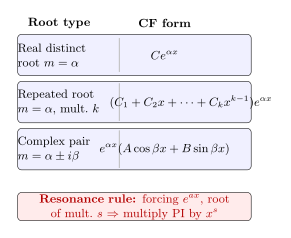
Applying initial conditions. Compute and from the particular integral, then set up equations for the CF constants from the total and .
Substitution to constant coefficients. Some variable-coefficient ODEs can be converted to constant-coefficient by a substitution (e.g. for certain oscillatory coefficients). When the coefficient of involves and the coefficient of involves , try .
Question Archetypes
| Archetype | Recognition |
|---|---|
| constant-coeff-ivp | CF+PI with initial conditions applied |
| higher-order-constant-coeff | Third-order (or higher) auxiliary equation; resonance check for each forcing term |
| reducible-to-constant-coeff | Variable-coefficient ODE that reduces by substitution (e.g. ) |
constant-coeff-ivp (2 question(s); 2017, 2018)
Recognition Cues
- Constant-coefficient homogeneous or non-homogeneous ODE with explicit initial conditions , .
- Usually second-order; 7–10 marks.
Solution Template
- Auxiliary equation: substitute ; solve for roots.
- Write CF from the root type.
- Find PI (if non-homogeneous): standard or operator method.
- Apply ICs: differentiate ; evaluate at ; solve for the constants.
Worked Example 1
2017 Paper 1, 2017-P1-Q6b-ii (7 marks)
Solve , , .
Step 1. Auxiliary: ; discriminant .
Step 2. CF: .
Step 3. Homogeneous; no PI.
Step 4. . Differentiate: .
Worked Example 2
2018 Paper 1, 2018-P1-Q7c (13 marks)
Solve , , .
Step 1. Auxiliary: ; roots .
Step 2. CF: .
Step 3. PI: try . . So .
Step 4. .
- .
- .
Subtracting: ; .
Common Traps
- Include when applying ICs. The derivative of at includes ; in the 2018 example, . Forgetting this shifts the ICs and gives wrong constants.
- Complex roots: include the product rule. When differentiating , use the product rule — the derivative picks up the factor from , giving a cross term that is essential for the IC equation.
higher-order-constant-coeff (1 question(s); 2023)
Recognition Cues
- Third-order or higher equation with multiple forcing terms (, etc.).
- Each forcing term must be checked independently for resonance.
Solution Template
- Find all roots of the auxiliary polynomial (check integer roots by trial).
- For each forcing term, determine whether its frequency matches a root.
- For resonant terms, multiply the PI by (where = multiplicity of the matching root).
- Combine all PIs; write the general solution.
Worked Example
2023 Paper 1, 2023-P1-Q6a (15 marks)
Solve .
Step 1. Auxiliary: . Try : ✓. Factor: . Roots: and .
Step 2. CF: .
Step 3. Check resonance:
- For : is a simple root → multiply PI by . Since (after applying the operator), we get .
- For : are NOT roots (roots are , not ) → no resonance. Standard ansatz .
Substituting : coefficient matching gives , .
Step 4.
Common Traps
- are not . The roots of are , not . Confusing these leads to incorrectly declaring resonance for (which has frequency ).
- Resonance multiplicity. is a simple root, so multiply PI by (not ). Multiplying by when the root has multiplicity 1 gives the wrong coefficient.
reducible-to-constant-coeff (1 question(s); 2021)
Recognition Cues
- Variable-coefficient equation where the coefficient of involves and the coefficient of involves .
- The substitution reduces it to a constant-coefficient equation.
Solution Template
- Try (suggested by the coefficient structure): .
- Compute .
- Substitute; the cross terms involving cancel.
- Divide by to obtain a constant-coefficient ODE in .
- Solve and convert back to .
Worked Example
2021 Paper 1, 2021-P1-Q6b (15 marks)
Solve .
Step 1–3. Substitute ; . The from and the from cancel, giving:
Step 4. Divide by : (using ).
Step 5. Auxiliary: ; CF . PI: — matching coefficients gives , , .
Convert back ():
Common Traps
- The cancellation is the key. The from must cancel with from . If they don’t cancel, the substitution is wrong.
- RHS in terms of . After dividing by , write on the right side.
Marks-Aware Writing
For 7-mark IVP: show the auxiliary equation, state all roots, write the CF, differentiate once, apply ICs in two steps. No steps can be skipped.
For 15-mark problems: show the full operator working for each PI separately, and verify each PI by substitution (or state the operator result). The ICs must be applied to , not just .
For the reducible case: the cancellation step (showing the terms cancel) is the “demonstration” the question asks for — show it explicitly.
Practice Set
- 2018-P1-Q5c (10 m) — — Hint: auxiliary ; resonates with multiplicity 3; multiply PI by .
- 2023-P1-Q6a already worked above.