Orthogonal trajectories (cartesian and polar)
At a Glance
- Frequency: 7 sub-parts across 7 of 13 years (2013, 2016, 2017, 2020, 2021, 2022, 2024)
- Priority tier: T2
- Marks (count): 10 (7)
- Average solve time: ~7 min
- Difficulty mix: medium 5, easy 2
- Section: B | Dominant type: computation
Why This Chapter Matters
Orthogonal trajectories are a Q5 staple — they appear in 7 of 13 years, always as 10-mark questions. The task is mechanical: find the ODE of the family, apply one rule to get the ODE of the perpendicular family, and solve. The only skill tested is recognising which of three procedures to apply (Cartesian, polar, or self-orthogonality proof) and solving a first-order ODE. A well-drilled student finishes in 6–8 minutes.
Minimum Theory
Orthogonality condition. Two smooth curves crossing at a point are orthogonal if their tangent lines at that point are perpendicular, i.e., if their slopes satisfy . In polar coordinates, the angle a curve makes with the radial direction satisfies ; two polar curves are orthogonal where .
Cartesian recipe. Given a one-parameter family :
- Differentiate w.r.t. (implicitly) and eliminate to get the family ODE .
- Replace (orthogonality) to get .
- Solve the new ODE.
Polar recipe. Given a polar family :
- Differentiate to get ; eliminate to get the family ODE.
- Replace (equivalently, ).
- Rewrite as and solve the separable equation in and .
Self-orthogonality. A family is self-orthogonal if every pair of members through a common point cross at right angles; equivalently, the family ODE is unchanged (up to a sign factor) when . To prove it: form the ODE, substitute (clearing denominators), and verify that the resulting equation is algebraically identical to the original.
Question Archetypes
| Archetype | Recognition |
|---|---|
| orthogonal-trajectories | ”Find the orthogonal trajectories of the family …“ |
| self-orthogonal | ”Show the family … is self-orthogonal” / “the orthogonal trajectories belong to the same family” |
orthogonal-trajectories (4 question(s); 2013, 2017, 2020, 2024)
Find the orthogonal trajectories of a curve family
Recognition Cues
The question says “find the orthogonal trajectories” or “find the equipotential lines.” Cartesian families are given in form; polar families specify . The key cue for polar is the presence of with a constant parameter.
Solution Template
Cartesian:
- From : differentiate, eliminate → ODE .
- ODE of orthogonal family: .
- Solve.
Polar:
- Differentiate w.r.t. ; divide by to form ; eliminate .
- Replace and rearrange as → new .
- Solve (usually separable).
Worked Example 1
2017 Paper 1, 2017-P1-Q5b (10 marks)
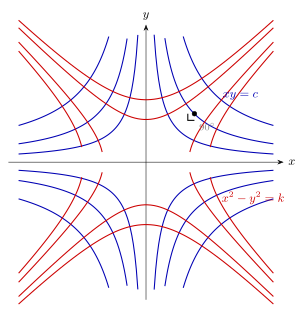
The streamlines of a fluid flow are . Find the equipotential lines (orthogonal trajectories).
Step 1 — ODE of streamlines. Differentiate : (Parameter is already eliminated.)
Step 2 — Orthogonal slope. Replace :
Step 3 — Solve (separable). The equipotential lines are the family of rectangular hyperbolas .
Verification: slope of at is ; slope of is ; product ✓.
Worked Example 2
2013 Paper 1, 2013-P1-Q5b (10 marks)
Find the orthogonal trajectories of .
Step 1 — ODE of family. Differentiate : Eliminate :
Step 2 — Polar orthogonality substitution. Replace :
Step 3 — Integrate. The orthogonal trajectories are the same family shape with (rotated by ).
Worked Example 3
2024 Paper 1, 2024-P1-Q5a (10 marks)
Find the orthogonal trajectories of .
Step 1. Differentiate : (The factor is recognised immediately.)
Step 2. Replace :
Step 3. Separate and integrate:
Worked Example 4
2020 Paper 1, 2020-P1-Q5b (10 marks)
Find the orthogonal trajectories of the family of circles through and .
Step 1 — Family equation. Circles through have centres on the -axis (perpendicular bisector of the chord). General form: (one parameter ; check: setting gives ✓).
Step 2 — Eliminate . Differentiate: , so . Substitute: ODE: .
Step 3 — Orthogonal ODE. Replace :
Step 4 — Solve (substitute , linear in with independent): Integrating: , i.e., . (coaxial circles with centres on the -axis, conjugate to the original system).
Common Traps
- Polar orthogonality formula. The substitution is , NOT . The factor is easy to miss; a quick sanity check: units of are , matching .
- Do not re-introduce the constant. The parameter must be fully eliminated before applying the orthogonality substitution. If persists, the substitution gives a relation between families, not a single ODE.
- Integrating factor for coaxial circles. The ODE for the 2020 problem is not separable — it requires the substitution to become linear in with integrating factor .
self-orthogonal (3 question(s); 2016, 2021, 2022)
Show a family is self-orthogonal (invariant under )
Recognition Cues
The question says “show the orthogonal trajectories belong to the same family” or “show the family is self-orthogonal.” Confocal conics () and certain parabola families are the classic examples.
Solution Template
- Form the ODE of the family (eliminate the parameter or ).
- Substitute into the ODE (clearing denominators by multiplying by ).
- Show the result is algebraically identical to the original ODE (possibly up to a global sign, which does not change the family of solutions).
Worked Example 1
2016 Paper 1, 2016-P1-Q5d (10 marks)
Show that the family is self-orthogonal.
Step 1 — ODE. Differentiate: , so . Substitute: ODE: .
Step 2 — Substitute . Replace by and multiply by : After substitution and clearing: , i.e., .
Step 3. The resulting ODE is identical to the original. Hence the family is self-orthogonal.
Worked Example 2
2022 Paper 1, 2022-P1-Q5b (10 marks)
Show that the orthogonal trajectories of belong to the same system.
Step 1 — ODE. Differentiate : , so . Substitute: After clearing: .
Step 2. Replace and multiply by : i.e., — identical to .
The orthogonal trajectories satisfy the same ODE, so they belong to the same family of parabolas.
Worked Example 3 (statement only)
2021 Paper 1, 2021-P1-Q8a-i (10 marks)
Show is self-orthogonal.
This is the classical confocal conic family. At any point , two values of satisfy the conic equation (roots of a quadratic in ). By Vieta, the two roots satisfy a relation that forces the product of the slopes of the two conics at that point to equal . Hence every ellipse in the family is perpendicular to every hyperbola in the same family through the same point — the family is self-orthogonal.
Common Traps
- “Same family” means same ODE. To complete the proof, explicitly state that the orthogonal ODE is identical to the original ODE, so the same family of curves is the solution.
- Self-orthogonal vs self-intersecting. Self-orthogonal means two different members of the family through the same point are perpendicular — not that a single curve crosses itself at right angles.
- Multiply by first. When substituting in a quadratic ODE , multiply through by before substituting, to avoid fractions. The result is self-identical iff (here , , so ✓).
Marks-Aware Writing
For a 10-mark “find orthogonal trajectories” question: Show the differentiation step (1 mark), the elimination of (1–2 marks), the substitution (1 mark), the solution ODE written out (1–2 marks), and the integrated family (2–3 marks). A boxed answer with no working earns very few marks.
For a 10-mark “show self-orthogonal” question: Derive the ODE (3 marks), perform the substitution explicitly (3 marks), and compare (2 marks) with a clear statement that the two ODEs are identical (2 marks). Skipping the comparison loses the proof’s logical conclusion.
Practice Set
No additional worked examples in this practice set — all 7 past questions are covered as worked examples or referenced above. Attempt 2013 (polar), 2016 (self-orthogonal), 2017 (Cartesian separable), 2020 (Cartesian non-separable), and 2024 (polar with trig) as timed practice.