Curl: definition, physical meaning, computation
At a Glance
- Frequency: 4 sub-parts across 3 of 13 years (2015, 2017, 2020, 2022)
- Priority tier: T3
- Marks (count): 10 (3), 12 (1)
- Average solve time: ~6 min
- Difficulty mix: easy 4
- Section: B | Dominant type: computation
Why This Chapter Matters
All four appearances of this atom are classified easy — this is guaranteed-mark territory. Every question follows an identical two-step pattern: set each component of to zero to find unknown parameters, then integrate to recover the scalar potential. The 2017 question adds the minor twist of expressing the divergence in cylindrical coordinates (but since divergence is a scalar invariant, the value is just the Cartesian answer). Investing 15 minutes to internalize the curl formula and the potential-recovery algorithm pays off on four separate years.
Minimum Theory
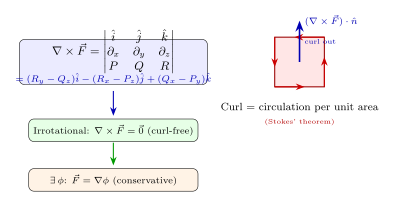
Curl. For : Remembered as the determinant with rows , , .
Irrotational field. (all three components vanish). This is the necessary and sufficient condition (on a simply connected domain) for the existence of a scalar potential with .
Potential recovery. Given :
- Integrate with respect to → .
- Differentiate w.r.t. and match → determine , integrate → .
- Differentiate w.r.t. and match → determine , integrate.
Question Archetypes
| Archetype | Recognition cue |
|---|---|
| irrotational-potential | ”Verify is irrotational; find scalar potential .“ |
| find-params-irrotational | ”For what values of is irrotational?“ |
irrotational-potential (2 questions; 2015, 2022)
Recognition Cues
- “Show/verify that is irrotational” — compute curl, show all components vanish.
- “Find such that ” — integrate successively.
Solution Template
- Compute curl components. Three partial-derivative differences: , , . Show each is 0.
- Integrate w.r.t. : .
- Match : differentiate the result w.r.t. ; solve for ; integrate to get .
- Match : differentiate w.r.t. ; solve for ; integrate.
- State with arbitrary constant .
Worked Example(s)
2022 Paper 1, 2022-P1-Q5e (10 marks)
Show is irrotational; find .
Curl:
- : ✓
- : ✓
- : ✓
Potential:
- .
- .
- .
2015 Paper 1, 2015-P1-Q7c (12 marks)
Verify is irrotational; find scalar potential.
2D field (no -component, no -dependence): only the curl component matters.
: ✓. Irrotational.
Potential:
- .
- .
Common Traps
- For a 2D field, the curl has only one non-zero component: the term . Only this needs to be checked.
- The potential is defined up to an additive constant — always include it.
- When integrating in , the “constant of integration” is a function , not a scalar.
find-params-irrotational (2 questions; 2017, 2020)
Recognition Cues
- “For what values of is irrotational?”
- The field has unknown parameters; setting curl components to zero gives 2–3 linear equations in .
Solution Template
- Write the three curl components as functions of .
- Set each to zero to get 3 equations.
- Solve (usually one equation per parameter).
- State the potential by integrating the field with the found parameters.
Worked Example(s)
2020 Paper 1, 2020-P1-Q5c (10 marks)
Find for to be irrotational.
Curl components:
- : .
- : .
- : .
Potential: with these values, integrate as in the template:
2017 Paper 1, 2017-P1-Q5d (10 marks)
Find for to be irrotational; find the divergence in cylindrical coordinates.
Curl:
- : .
- : .
- : .
Divergence in cylindrical coordinates. The divergence is a scalar invariant — its value is independent of the coordinate system. In Cartesian: In cylindrical coordinates, the divergence formula gives the same constant .
Common Traps
- Signs matter. The component of curl is (not ). Missing a sign gives wrong parameters.
- Divergence is coordinate-invariant. The question asks for the divergence “in cylindrical coordinates” — but since the answer is a constant (), no transformation is needed. State the invariance explicitly.
- Setting (since ): a sign slip here gives instead of .
Marks-Aware Writing
10-mark irrotational + potential: Show three curl components vanish (3 lines). Then three integration steps for the potential (3 lines). State the answer. Total ~7 lines.
10-mark find-params + divergence: Three one-line equations from curl = 0 (immediate). State the divergence (one line) and note coordinate invariance (one sentence).
Practice Set
- 2024-P1-Q7c (20 m) — curl and line integral;
- 2018-P1-Q8b (13 m) — irrotational field;
- 2017-P1-Q8c-ii (8 m) —