This atom lands in Section B at 12–16 marks, making it one of the highest-value vector-analysis questions in Paper 1. UPSC has set it in six of the last eleven years, always asking for a direct computation — curvature vector, torsion, or polar radius of curvature — with no open-ended theory. Three formulas (the cross-product formula for κ, the triple-product formula for τ, and the polar ρ formula) handle every variant that has appeared; mastering the algebra around these three formulas is sufficient to score full marks.
Minimum Theory
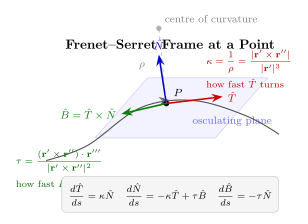
Frenet–Serret vocabulary. For a curve r(t), let primes denote derivatives with respect to t and s denote arc length. The unit tangent is T^=r′/∣r′∣. The curvature vector is κ=dT^/ds; its magnitude κ=∣κ∣ is the curvature. The principal normalN^ points in the direction of dT^/ds. The binormalB^=T^×N^ completes the right-handed Frenet frame. The torsionτ measures how fast B^ rotates out of the osculating plane: dB^/ds=−τN^. The figure below shows the three frame vectors at a point on a space curve.
Working formulas (all derivatives w.r.t.\ t).
κ=∣r′∣3∣r′×r′′∣,τ=∣r′×r′′∣2(r′×r′′)⋅r′′′.
The curvature vector itself is κ=dT^/ds=[(r′×r′′)×r′]/∣r′∣4.
Compute the curvature vector and/or magnitude of a parametric curve (and possibly a related locus)
Recognition Cues
The question asks for the “curvature vector” or “curvature” of a curve given by explicit parametric equations in two or three components. In 2017 a secondary sub-task asks you to show that the locus of feet of perpendiculars from the origin to the tangent lines lies on a specific surface — that is an additional step beyond computing κ.
Solution Template
Differentiate r(t) to get r′ and r′′; compute ∣r′∣.
Compute r′×r′′; find ∣r′×r′′∣.
Curvature magnitude: κ=∣r′×r′′∣/∣r′∣3.
Curvature vector: κ=[(r′×r′′)×r′]/∣r′∣4.
(If a locus is required) Write the general point on the tangent as r(t)+λr′(t); impose the foot-of-perpendicular condition OQ⋅r′=0 to find λ; then verify the claimed surface equation by direct substitution.
Worked Example 1
2014 Paper 1, 2014-P1-Q5e (10 marks)
Find the curvature vector and its magnitude for r(t)=(tcost,tsint,0).
Step 2 — cross product. Both vectors have zero z-component, so
r′×r′′=(0,0,(cost−tsint)(2cost−tsint)−(sint+tcost)(−2sint−tcost)).
Expanding the z-component:
=2cos2t−tsintcost−2tsintcost+t2sin2t+2sin2t+tsintcost+2tsintcost+t2cos2t
=2(cos2t+sin2t)+t2(sin2t+cos2t)=2+t2.
So r′×r′′=(0,0,2+t2) and ∣r′×r′′∣=2+t2.
=(−(2+t2)(sint+tcost),(2+t2)(cost−tsint),0).
Divide by ∣r′∣4=(1+t2)2:
κ=(1+t2)22+t2(−(sint+tcost)^+(cost−tsint)^).
Worked Example 2
2017 Paper 1, 2017-P1-Q7a (16 marks)
Find the curvature vector and its magnitude for the helix r=(acosθ,asinθ,aθ). Show that the locus of the feet of perpendiculars from the origin to the tangent lines lies on the hyperboloid x2+y2−z2=a2.
Part 1 — curvature vector.
r′=(−asinθ,acosθ,a), so ∣r′∣=a2.
Unit tangent: T^=(−sinθ,cosθ,1)/2.
Differentiate w.r.t.\ arc length s using ds/dθ=a2:
κ=dsdT^=a21dθdT^=a21⋅2(−cosθ,−sinθ,0)=2a(−cosθ,−sinθ,0).
∣κ∣=κ=2a1.
Part 2 — locus of feet of perpendiculars.
The tangent line at parameter θ is r(θ)+λr′(θ). For the foot Q of the perpendicular from the origin:
OQ⋅r′=0⟹(r+λr′)⋅r′=0.
r⋅r′=a2(−cosθsinθ+sinθcosθ+θ)=a2θ.
∣r′∣2=2a2.
So λ=−r⋅r′/∣r′∣2=−θ/2.
The foot is:
Q=r−2θr′=2a(2cosθ+θsinθ,2sinθ−θcosθ,θ).
Let (x,y,z)=Q. Then z=aθ/2, so θ=2z/a. Also:
x2+y2=4a2[(2cosθ+θsinθ)2+(2sinθ−θcosθ)2]
=4a2[4+θ2]=a2+4a2θ2=a2+z2.
x2+y2−z2=a2.
Worked Example 3
2024 Paper 1, 2024-P1-Q5e-i (5 marks)
For a plane curve r=(f(t),g(t),0), prove that κ=∣f′g′′−g′f′′∣/(f′2+g′2)3/2. Deduce the torsion τ.
Cross product.r′=(f′,g′,0), r′′=(f′′,g′′,0). Then
r′×r′′=(g′⋅0−0⋅g′′,0⋅f′′−f′⋅0,f′g′′−g′f′′)=(0,0,f′g′′−g′f′′).
So ∣r′×r′′∣=∣f′g′′−g′f′′∣ and ∣r′∣3=(f′2+g′2)3/2. Dividing:
κ=(f′2+g′2)3/2∣f′g′′−g′f′′∣.
Torsion.r′′′=(f′′′,g′′′,0), which has zero z-component. Therefore
(r′×r′′)⋅r′′′=(0,0,f′g′′−g′f′′)⋅(f′′′,g′′′,0)=0,
giving τ=0. A plane curve has zero torsion — it does not twist out of its own plane.
Common Traps
Curvature vector vs.\ magnitude. UPSC often asks for both κ and κ; omitting the vector expression costs marks. The curvature vector is [(r′×r′′)×r′]/∣r′∣4, not merely ∣r′×r′′∣/∣r′∣3.
Sign of the cross product. In the 2014 problem, expanding r′×r′′ carefully shows the z-component is 2+t2>0; a sign slip yields −(2+t2) and then a negative “magnitude,” which is impossible.
Foot-of-perpendicular condition. The condition OQ⋅r′=0 involves the full vector OQ=r+λr′, not just r. Missing the λ∣r′∣2 term gives the wrong λ.
Planar τ=0 proof. Simply noting ”r′′′ has no z-component” is the complete argument; there is no need to expand f′′′ or g′′′.
curvature-torsion (2 question(s); 2018, 2019)
Compute both curvature κ and torsion τ (or their reciprocals ρ, σ) for a space curve
Recognition Cues
The question gives a parametric space curve and asks for “curvature and torsion” or “radius of curvature and radius of torsion.” Both the cross-product formula (for κ) and the triple-product formula (for τ) are needed. The 2019 question uses the helix z=autanα, making it slightly different from the standard z=au helix of other questions.
Solution Template
Compute r′, r′′, r′′′.
Find ∣r′∣2; simplify using trigonometric identities where possible.
Compute r′×r′′ component by component.
Compute ∣r′×r′′∣2 and take the square root.
Curvature: κ=∣r′×r′′∣/∣r′∣3.
Evaluate the scalar triple product (r′×r′′)⋅r′′′.
Torsion: τ=(r′×r′′)⋅r′′′/∣r′×r′′∣2.
Invert to get ρ=1/κ and σ=1/∣τ∣ if requested.
Worked Example 1
2018 Paper 1, 2018-P1-Q7b (12 marks)
Find the curvature and torsion of r=(a(u−sinu),a(1−cosu),bu).
Torsion and radius of torsion.∣τ∣=a4sec2αa3tanα=asec2αtanα=asinαcosα=2asin2α.
σ=∣τ∣1=sin2α2a.
Common Traps
k-component of r′×r′′ for the cycloid. The k-component simplifies as cosu−cos2u−sin2u=cosu−1, not +1. A sign error here flips the sign of the triple product and hence the sign of τ.
Triple product is constant for the cycloid. The −a2b result is independent of u; if your answer for the triple product still contains u, recheck the dot product.
1+tan2α=sec2α shortcut. This collapses both ∣r′∣ and ∣r′×r′′∣ to simple forms for the tilted helix. Without it, the algebra is unwieldy.
Sign of τ. Torsion can be negative (the −b in the cycloid answer reflects a left-handed twist); the radius of torsion σ=1/∣τ∣ is always positive.
radius-of-curvature-polar (1 question(s); 2016)
Find the polar radius of curvature of a curve (e.g.\ cardioid) and verify a proportionality relation
Recognition Cues
The curve is given in polar form r=r(θ). The question asks to “show ρ2 is proportional to r” or to evaluate ρ at specific angles. The keyword “cardioid” or “lemniscate” in combination with a polar equation signals this archetype.
Solution Template
Compute r1=dr/dθ and r2=d2r/dθ2.
Evaluate r2+r12 (numerator base) and r2+2r12−rr2 (denominator expression).
Simplify both using the original curve equation; factor out common factors.
Apply ρ=(r2+r12)3/2/∣r2+2r12−rr2∣.
To show proportionality, express ρ2 in terms of r only (eliminating θ).
Substitute the specific θ values to get numerical answers.
Worked Example
2016 Paper 1, 2016-P1-Q8d (15 marks)
For the cardioid r=a(1+cosθ), show that ρ2 is proportional to r. Find ρ at θ=0, θ=π/4, and θ=π/2.
Radius of curvature.ρ=3ar(2ar)3/2=3ar22a1/2r3/2=322ar⋅a=322ar.
Wait — let us be careful:
ρ=3ar(2ar)3/2=3ar23/2a3/2r3/2=322a1/2r1/2.
Proportionality.ρ2=98ar, which is proportional to r. ✓
Equivalently, ρ=322ar=322ar.
Values at specific angles. Use r=a(1+cosθ):
θ
r
ρ=322ar
0
2a
324a2=34a
π/4
a(1+21)
322a2(1+21)=32a2+2
π/2
a
322a2=32a2
ρθ=0=34a,ρθ=π/4=32a2+2,ρθ=π/2=32a2.
Common Traps
Sign of −rr2. For the cardioid, r2=−acosθ, so −rr2=+a(1+cosθ)⋅acosθ>0 for θ<π/2. Students often drop this term or give it the wrong sign, wrecking the denominator.
Numerator exponent. The formula has (r2+r12)3/2 in the numerator; writing it as (r2+r12)1/2 (forgetting the cube) is a common error that makes ρ dimensionally wrong.
Proportionality check. Once ρ=(22/3)ar, compute ρ2=8ar/9; the factor 8/9 need not be simplified further — “proportional to r” is established.
θ=0 endpoint. At θ=0, r=2a (not r=a); substituting r=a instead gives ρ=22a/3, which is the θ=π/2 answer.
Marks-Aware Writing
For a 10–12 mark curvature question: Write r′, r′′, and ∣r′∣ explicitly. Display r′×r′′ as a 3×3 determinant, even if two rows are obvious — the examiner awards a process mark here. State the formula κ=∣r′×r′′∣/∣r′∣3 before substituting. Box the final answer.
For a 15–16 mark question: The same requirements apply, plus you must show the locus derivation (2017) or both ρ and σ (2019) fully worked. For the locus problem, set up the foot-of-perpendicular condition in vector form, find λ explicitly, then verify the surface identity by expanding and cancelling. Skipping the “verify by algebra” step loses 3–4 marks even if the setup is correct.
For the 5-mark proof (2024): A three-step proof (write r′×r′′ for a planar curve, note the z-component equals f′g′′−g′f′′, divide) is all that is needed. Do not pad with unnecessary theory; the mark scheme rewards conciseness.
General principle: Every intermediate vector — the cross product, its magnitude, the triple product — must appear on the page. Examiners mark the process as much as the result.
Practice Set
2024-P1-Q5e-ii (5 m) — — second part of the 2024 question; find the curvature of a specific planar curve using the formula just proved
2023-P1-Q7c (15 m) — — full curvature-torsion computation for a space curve; test whether the methods from 2018/2019 transfer directly
We've mapped all 13 years of this exam. Get new chapters, tools, and solutions as we release them — free.