Differentiation of a vector function of a scalar variable
At a Glance
Frequency: 4 sub-parts across 4 of 13 years (2013, 2017, 2023, 2024)
Priority tier: T3
Marks (count): 10 (4)
Average solve time: ~8 min
Difficulty mix: easy 2, medium 2
Section: B | Dominant type: computation
Why This Chapter Matters
Differentiation of vector functions appears in Section B compulsory (Q5) at 10 marks. The three archetypes are: (a) angle between tangent vectors at two points — straightforward dot product; (b) acceleration components along velocity and perpendicular to the plane of (r,v) — projects onto v and r×v; (c) differentiating a cross or triple product with respect to a parameter — use the product rule. All three reduce to differentiating component-wise and combining.
Minimum Theory
Vector function of a scalar. If r(t)=f(t)i^+g(t)j^+h(t)k^, then r′(t)=f′(t)i^+g′(t)j^+h′(t)k^ (differentiate each component).
Tangent and angle. The tangent vector at parameter t is r′(t). The angle θ between tangents at t1 and t2 satisfies
cosθ=∣r′(t1)∣∣r′(t2)∣r′(t1)⋅r′(t2).
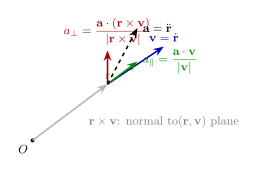
Acceleration components. For a particle with position r(t), velocity v=r˙, and acceleration a=r¨:
Alongv: scalar projection ∣v∣a⋅v.
Perpendicular to the plane of r and v: the plane’s normal is r×v; the component is ∣r×v∣a⋅(r×v).
Product rule for vector products.dtd(a×b)=a′×b+a×b′. Similarly for dot and triple products. When the vectors depend on a parameter θ, differentiate component-by-component.
Question Archetypes
Archetype
Recognition
tangent-angle
”Find the angle between tangents to curve r(t) at t=t1 and t=t2“
motion-components
”Find the components of acceleration parallel to velocity and perpendicular to the plane of r and v“
vector-derivative
”Find d/dt of a cross or triple product; evaluate at a specific t“
tangent-angle (1 question(s); 2013)
Recognition Cues
A space curve r(t) is given; asked for “angle between tangents” at two named values of t.
Solution Template
Compute r′(t); evaluate at t1 and t2.
Dot product r′(t1)⋅r′(t2); magnitudes ∣r′(t1)∣ and ∣r′(t2)∣.
cosθ=dot/(mag1×mag2); state θ=cos−1(…).
Worked Example
2013 Paper 1, 2013-P1-Q8b (10 marks)
Angle between tangents to r=(t2,2t,−t3) at t=+1 and t=−1.
Step 1.r′=(2t,2,−3t2). At t=1: (2,2,−3). At t=−1: (−2,2,−3).
Tangents at t and −t are not negatives. Here the i^-component 2t is odd but j^=2 (even) and k^=−3t2 (even), so the two tangent vectors are not antiparallel.
motion-components (1 question(s); 2017)
Recognition Cues
A position vector r(t) is given.
Asked for the component of acceleration (a) “parallel to velocity” and (b) “perpendicular to the plane of r and v.”
“Perpendicular to the plane of r and v” means project onto r×v, not onto the principal normal.
Solution Template
Compute v=r˙ and a=r¨; evaluate at the given t.
Component along v: (a⋅v)/∣v∣.
Compute r×v at the given t; its magnitude ∣r×v∣.
Component along r×v: (a⋅(r×v))/∣r×v∣.
Worked Example
2017 Paper 1, 2017-P1-Q5e (10 marks)
r=(sint,cos2t,t2+2t). Find components of a parallel to v and perpendicular to the plane (r,v) at t=0.
Step 1.v=(cost,−2sin2t,2t+2), a=(−sint,−4cos2t,2). At t=0:
r0=(0,1,0),v0=(1,0,2),a0=(0,−4,2).
Step 2.a0⋅v0=0+0+4=4. ∣v0∣=5. Component along v: 4/5=45/5.
“Perpendicular to the plane of r and v” ≠ “principal normal.” The principal normal is dT^/ds, which is in the osculating plane. The direction perpendicular to the plane of r and v is r×v.
Differentiate cos2t with the chain rule: derivative is −2sin2t, so at t=0 it is 0, and the double derivative −4cos2t at t=0 is −4.
Report the signed component. The problem asks for the component in the direction of r×v; the signed value −2/5 indicates a points opposite to r×v.
vector-derivative (2 question(s); 2023, 2024)
Recognition Cues
A vector expression a×(b×c) or a scalar triple product depends on a parameter θ.
Asked for d/dθ at a specific value of θ.
Or: the parallelogram/parallelepiped involves time-varying vectors; find rate of change of area or volume.
Solution Template
Compute the cross product or triple product explicitly (component-by-component).
Differentiate the resulting vector or scalar with respect to the parameter.
Evaluate at the specified value.
Worked Example
2024 Paper 1, 2024-P1-Q5c (10 marks)
αˉ=ti^+(t+1)j^+(2t+1)k^, βˉ=2ti^+(3t−1)j^+tk^, γˉ=i^+3tj^+k^.
Find (a) dtd(αˉ×γˉ) and (b) dtdV at t=1.
Part (a).αˉ×γˉ=i^t1j^t+13tk^2t+11:
i^: (t+1)−3t(2t+1)=−6t2−2t+1
j^: −(t−(2t+1))=t+1
k^: 3t2−(t+1)
A(t)=(−6t2−2t+1,t+1,3t2−t−1).
dtdA=(−12t−2,1,6t−1).
Part (b).V=αˉ⋅(βˉ×γˉ); expand the 3×3 determinant to get V(t)=9t3+2t2−3t+1 (computation omitted for brevity). Then dV/dt=27t2+4t−3; at t=1: 28.
Common Traps
Cross product gives a vector; differentiate component-wise. Don’t try to differentiate ∣αˉ×γˉ∣ unless specifically asked for the scalar area.
Scalar triple product is a scalar. Differentiating the determinant formula gives dV/dt=αˉ˙⋅(βˉ×γˉ)+αˉ⋅(βˉ˙×γˉ)+αˉ⋅(βˉ×γˉ˙) — but computing V(t) explicitly as a polynomial and differentiating is usually faster.
Marks-Aware Writing
For tangent-angle (10 marks): show r′ at both points, display the dot product and magnitudes, state cosθ and θ. Three steps suffice.
For motion-components (10 marks): write v and a from derivatives, evaluate at t=0, then show the two projections separately — including the cross product r×v displayed as a determinant.
For vector-derivative (10 marks): show the cross product or determinant explicitly with each cofactor computed. For the volume part, expanding the determinant fully and then differentiating is clearer than using the product-rule formula.
Practice Set
2023-P1-Q5e (10 m) — — Hint: compute a×(b×c) component-by-component at the two θ values; track which components depend on θ.
We've mapped all 13 years of this exam. Get new chapters, tools, and solutions as we release them — free.