The math optional, made finite. Daily Practice

Gauss divergence theorem

At a Glance

Why This Chapter Matters

The Gauss divergence theorem appears in 9 of the last 13 years, almost always as a 15-mark Section B question. It transforms a hard surface integral into an easy volume integral — and UPSC designs every question so the volume side is straightforward (constant or separable divergence, standard region). The flux (evaluation) variant is one of the fastest high-mark problems in the paper: compute a divergence, multiply by a volume, and you’re done. The verification variant asks you to do both sides, but the method is completely mechanical once you’ve seen the pattern.

Minimum Theory

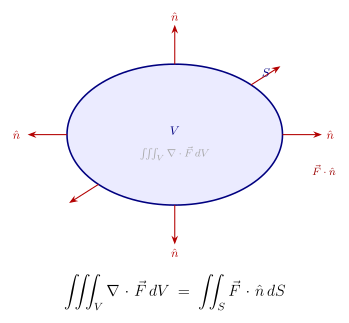
Gauss’s divergence theorem. Let VV be a closed bounded region in R3\mathbb{R}^3 with piecewise-smooth boundary surface SS and outward unit normal n^\hat n. If F\vec F is continuously differentiable on VV, then V(F)dV=SFn^dS.\iiint_V(\nabla\cdot\vec F)\,dV=\iint_S\vec F\cdot\hat n\,dS.

Divergence in coordinates. For F=(F1,F2,F3)\vec F=(F_1,F_2,F_3): F=F1x+F2y+F3z.\nabla\cdot\vec F=\frac{\partial F_1}{\partial x}+\frac{\partial F_2}{\partial y}+\frac{\partial F_3}{\partial z}. Compute each term independently; terms with no dependence on the differentiation variable vanish.

Closed vs open surfaces. The divergence theorem requires a closed surface (no boundary curve). If SS is open (e.g., only the hemisphere, without the disk), close it by adding the missing piece, apply the theorem to the closed surface, then subtract the integral over the added piece.

Standard volume elements. Cylinder: dV=rdrdθdzdV=r\,dr\,d\theta\,dz; half-disc cross-section r[0,R]r\in[0,R]. Sphere/half-ball: dV=r2sinϕdrdϕdθdV=r^2\sin\phi\,dr\,d\phi\,d\theta.

Gauss divergence theorem: flux of \vec F out of closed surface S equals \iiint_V\nabla\cdot\vec F\,dV

Question Archetypes

Two patterns cover all divergence theorem questions.

ArchetypeYou are seeing this when…
divergence-fluxevaluate a flux or surface integral — use the theorem to convert to a volume integral
divergence-verification”verify Gauss’s divergence theorem” — compute both sides independently

divergence-flux (4 question(s); 2013, 2017, 2018, 2024)

Recognition Cues

Solution Template

  1. Compute F\nabla\cdot\vec F — check each partial derivative separately.
  2. Identify the closed region VV bounded by SS.
  3. Evaluate VFdV\iiint_V\nabla\cdot\vec F\,dV. Separate the integral if the divergence is constant or factors. Use cylindrical/spherical coordinates as appropriate.
  4. State the result.

Worked Example(s)

2024 Paper 1, 2024-P1-Q8b (15 marks)

Evaluate S(y2i^+xz3j^+(z1)2k^)n^dS\iint_S(y^2\hat i+xz^3\hat j+(z-1)^2\hat k)\cdot\hat n\,dS over the cylinder x2+y2=16x^2+y^2=16, z[1,5]z\in[1,5].

Divergence. x(y2)+y(xz3)+z((z1)2)=0+0+2(z1)=2(z1)\partial_x(y^2)+\partial_y(xz^3)+\partial_z((z-1)^2)=0+0+2(z-1)=2(z-1).

Volume integral. In cylindrical: r[0,4]r\in[0,4], θ[0,2π]\theta\in[0,2\pi], z[1,5]z\in[1,5]: V2(z1)dV=2πdθ804rdr16152(z1)dz=256π.\iiint_V 2(z-1)\,dV=\underbrace{2\pi}_{\int d\theta}\cdot\underbrace{8}_{\int_0^4 r\,dr}\cdot\underbrace{16}_{\int_1^5 2(z-1)\,dz}=256\pi.

  SFn^dS=256π.  \boxed{\;\iint_S\vec F\cdot\hat n\,dS=256\pi.\;}


2018 Paper 1, 2018-P1-Q6d (12 marks)

Evaluate S[(x+z)dydz+(y+z)dzdx+(x+y)dxdy]\iint_S[(x+z)\,dy\,dz+(y+z)\,dz\,dx+(x+y)\,dx\,dy] over the sphere x2+y2+z2=a2x^2+y^2+z^2=a^2.

Identify. F=(x+z,y+z,x+y)\vec F=(x+z,y+z,x+y).

Divergence. 1+1+0=21+1+0=2. (The third component x+yx+y has no zz-dependence, so its z=0\partial_z=0.)

Volume integral. Constant divergence over the ball of radius aa: 243πa3=  83πa3.  2\cdot\frac{4}{3}\pi a^3=\boxed{\;\frac{8}{3}\pi a^3.\;}


2017 Paper 1, 2017-P1-Q8c-i (9 marks)

Evaluate the flux of F=3xy2i^+(yx2y3)j^+3zx2k^\vec F=3xy^2\hat i+(yx^2-y^3)\hat j+3zx^2\hat k over y2+z24y^2+z^2\le4, 3x3-3\le x\le3.

Divergence. 3y2+(x23y2)+3x2=4x23y^2+(x^2-3y^2)+3x^2=4x^2 (the ±3y2\pm3y^2 cancel).

Volume. Cylinder axis along xx; disc y2+z24y^2+z^2\le4 has area 4π4\pi: 334x24πdx=16π18=  288π.  \int_{-3}^{3}4x^2\cdot4\pi\,dx=16\pi\cdot18=\boxed{\;288\pi.\;}


2013 Paper 1, 2013-P1-Q8c (15 marks)

Evaluate S(a2x2+b2y2+c2z2)1/2dS\iint_S(a^2x^2+b^2y^2+c^2z^2)^{-1/2}\,dS on the ellipsoid ax2+by2+cz2=1ax^2+by^2+cz^2=1.

Key insight. The outward unit normal on the ellipsoid F=ax2+by2+cz21=0F=ax^2+by^2+cz^2-1=0 is n^=(ax,by,cz)/a2x2+b2y2+c2z2\hat n=(ax,by,cz)/\sqrt{a^2x^2+b^2y^2+c^2z^2}. Therefore rn^=(ax2+by2+cz2)/a2x2+b2y2+c2z2=1/a2x2+b2y2+c2z2\vec r\cdot\hat n=(ax^2+by^2+cz^2)/\sqrt{a^2x^2+b^2y^2+c^2z^2}=1/\sqrt{a^2x^2+b^2y^2+c^2z^2} (using the surface equation). So the integrand equals rn^\vec r\cdot\hat n for F=(x,y,z)\vec F=(x,y,z).

Divergence theorem. r=3\nabla\cdot\vec r=3; volume of ellipsoid ax2+by2+cz21ax^2+by^2+cz^2\le1 is 4π3abc\tfrac{4\pi}{3\sqrt{abc}}: I=34π3abc=  4πabc.  I=3\cdot\frac{4\pi}{3\sqrt{abc}}=\boxed{\;\frac{4\pi}{\sqrt{abc}}.\;}

Common Traps


divergence-verification (5 question(s); 2019, 2021, 2022, 2023, 2025)

Recognition Cues

Solution Template

  1. State the theorem (required when the question says “state and verify”).
  2. Volume side. Compute F\nabla\cdot\vec F; integrate over VV in the most convenient coordinates; use symmetry to kill odd-function integrals.
  3. Surface side. Identify all faces of SS; for each face write the outward n^\hat n and compute Fn^\vec F\cdot\hat n; integrate. Set up a table if many faces.
  4. State equality and conclude.

For open surfaces (hemisphere): close with the flat disk, apply the theorem to the closed surface, subtract the disk’s contribution.

Worked Example(s)

2019 Paper 1, 2019-P1-Q8c-i (15 marks)

State and verify Gauss’s theorem for F=4xi^2y2j^+z2k^\vec F=4x\hat i-2y^2\hat j+z^2\hat k over x2+y24x^2+y^2\le4, 0z30\le z\le3.

Volume. F=44y+2z\nabla\cdot\vec F=4-4y+2z. In cylindrical: the 4y=4rsinθ-4y=-4r\sin\theta term integrates to zero over θ[0,2π]\theta\in[0,2\pi]: V(4+2z)dV=02rdr02πdθ03(4+2z)dz=22π21=84π.\iiint_V(4+2z)\,dV=\int_0^2r\,dr\cdot\int_0^{2\pi}d\theta\cdot\int_0^3(4+2z)\,dz=2\cdot2\pi\cdot21=84\pi.

Surface (3 faces):

Total flux=36π+0+48π=84π=VFdV.\text{Total flux}=36\pi+0+48\pi=84\pi=\iiint_V\nabla\cdot\vec F\,dV.\quad\text{✓}

  Both sides=84π.  \boxed{\;\text{Both sides}=84\pi.\;}


2022 Paper 1, 2022-P1-Q8c (15 marks)

Verify divergence theorem for F=xi^yj^+(z21)k^\vec F=x\hat i-y\hat j+(z^2-1)\hat k over x2+y24x^2+y^2\le4, z[0,1]z\in[0,1].

Volume. F=1+(1)+2z=2z\nabla\cdot\vec F=1+(-1)+2z=2z: V2zdV=2 ⁣01zdz4π=4π.\iiint_V 2z\,dV=2\!\int_0^1z\,dz\cdot4\pi=4\pi.

Surface (3 faces):

Total flux=4π+0+0=4π=VFdV.\text{Total flux}=4\pi+0+0=4\pi=\iiint_V\nabla\cdot\vec F\,dV.\quad\text{✓}

  Both sides=4π.  \boxed{\;\text{Both sides}=4\pi.\;}


2021 Paper 1, 2021-P1-Q7a (20 marks)

Verify divergence theorem for F=2x2yi^y2j^+4xz2k^\vec F=2x^2y\hat i-y^2\hat j+4xz^2\hat k over first-octant region y2+z29y^2+z^2\le9, x[0,2]x\in[0,2].

Volume. F=4xy2y+8xz\nabla\cdot\vec F=4xy-2y+8xz. In cylindrical (y=rcosϕy=r\cos\phi, z=rsinϕz=r\sin\phi, r3r\le3, ϕ[0,π/2]\phi\in[0,\pi/2]): VFdV=902[(4x2)+8x]dx=902(12x2)dx=9(244)=180.\iiint_V\nabla\cdot\vec F\,dV=9\int_0^2[(4x-2)+8x]\,dx=9\int_0^2(12x-2)\,dx=9(24-4)=180.

Surface (5 faces):

Total=72+0+0+0+108=180=VFdV.\text{Total}=72+0+0+0+108=180=\iiint_V\nabla\cdot\vec F\,dV.\quad\text{✓}

  Both sides=180.  \boxed{\;\text{Both sides}=180.\;}


2023 Paper 1, 2023-P1-Q6c (20 marks)

Evaluate S(3y2z2,4z2x2,z2y2)n^dS\iint_S(3y^2z^2,4z^2x^2,z^2y^2)\cdot\hat n\,dS on the upper hemisphere x2+y2+z2=1/4x^2+y^2+z^2=1/4, z0z\ge0; hence verify the divergence theorem.

Close the surface. SS is the hemisphere alone (open). Add disk DD at z=0z=0: n^=k^\hat n=-\hat k on DD. Apply the theorem to SDS\cup D:

Volume. F=2zy2\nabla\cdot\vec F=2zy^2. In spherical with r1/2r\le1/2: V2zy2dV=21384r5dr14cosψsin3ψπsin2ϕ=π768.\iiint_V 2zy^2\,dV=2\cdot\underbrace{\frac{1}{384}}_{r^5\,dr}\cdot\underbrace{\frac14}_{\cos\psi\sin^3\psi}\cdot\underbrace{\pi}_{\sin^2\phi}=\frac{\pi}{768}.

Disk DD (z=0z=0, n^=k^\hat n=-\hat k): Fn^=z2y2z=0=0\vec F\cdot\hat n=-z^2y^2|_{z=0}=0.

S=π7680=  π768.  \iint_S=\frac{\pi}{768}-0=\boxed{\;\frac{\pi}{768}.\;}

Divergence theorem verified: both sides =π/768=\pi/768.


2025 Paper 1, 2025-P1-Q8b (15 marks)

Verify Gauss’s theorem for F=(x2yz,y2zx,z2xy)\vec F=(x^2-yz,y^2-zx,z^2-xy) over the box 0xa0\le x\le a, 0yb0\le y\le b, 0zc0\le z\le c.

Volume. F=2x+2y+2z\nabla\cdot\vec F=2x+2y+2z: V(2x+2y+2z)dV=a2bc+ab2c+abc2=abc(a+b+c).\iiint_V(2x+2y+2z)\,dV=a^2bc+ab^2c+abc^2=abc(a+b+c).

Surface (6 faces). The yz-yz, zx-zx, xy-xy cross-terms cancel in face-pairs (e.g., face x=ax=a: (a2yz)dydz=a2bcb2c2/4\int(a^2-yz)\,dy\,dz=a^2bc-b^2c^2/4; face x=0x=0: (0yz)(1)dydz=+b2c2/4\int(0-yz)\cdot(-1)\,dy\,dz=+b^2c^2/4; sum =a2bc=a^2bc). By symmetry across the three pairs: Total flux=a2bc+ab2c+abc2=abc(a+b+c).\text{Total flux}=a^2bc+ab^2c+abc^2=abc(a+b+c).\quad\text{✓}

  Both sides=abc(a+b+c).  \boxed{\;\text{Both sides}=abc(a+b+c).\;}

Common Traps


Marks-Aware Writing

9-12-mark questions (2017, 2018): Compute divergence (one line), state the theorem, evaluate the volume integral (two lines), box the answer. No surface integral needed for a pure-flux question.

15-mark questions (2013, 2019, 2022, 2024, 2025): For flux: divergence + separable volume integral, clearly written. For verification: state the theorem, labelled volume integral (show symmetry argument for odd terms), all faces listed in a short table (face | n^\hat n | Fn^\vec F\cdot\hat n | integral), state equality.

20-mark questions (2021, 2023): Full verification with 4–5 boundary faces, coordinate transformation written out, every Wallis-type integral cited. For 2023: close-the-surface argument written explicitly, spherical coordinates with all limits stated, disk contribution checked.

Practice Set

YearPaper/QMarksArchetypeOne-line hint
2025P1-Q8b15divergence-verificationdiv=2(x+y+z)\text{div}=2(x+y+z); cross-terms cancel in face-pairs; both sides =abc(a+b+c)=abc(a+b+c)
2024P1-Q8b15divergence-fluxdiv=2(z1)\text{div}=2(z-1); cylindrical; factors to 2π816=256π2\pi\cdot8\cdot16=256\pi
2023P1-Q6c20divergence-verificationOpen hemisphere — close with disk; div=2zy2\text{div}=2zy^2; disk contributes 0; result π/768\pi/768
2022P1-Q8c15divergence-verificationdiv=2z\text{div}=2z; bottom gives 4π4\pi; top and lateral give 0; both sides 4π4\pi
2021P1-Q7a20divergence-verification5 faces; x=0,y=0,z=0x=0,y=0,z=0 faces contribute 0; x=2x=2 face ++ curved cylinder =72+108=180=72+108=180
2019P1-Q8c-i15divergence-verificationdiv=44y+2z\text{div}=4-4y+2z; 4y-4y vanishes by symmetry; three faces 36π+0+48π=84π36\pi+0+48\pi=84\pi
2018P1-Q6d12divergence-fluxdiv=2\text{div}=2 (third component has no zz); flux =243πa3=83πa3=2\cdot\tfrac43\pi a^3=\tfrac83\pi a^3
2017P1-Q8c-i9divergence-flux±3y2\pm3y^2 cancel; div=4x2\text{div}=4x^2; disc area 4π4\pi; 33x2dx=18\int_{-3}^3x^2\,dx=18; flux =288π=288\pi
2013P1-Q8c15divergence-fluxRecognise rn^\vec r\cdot\hat n structure; div(r)=3\text{div}(\vec r)=3; ellipsoid volume =4π/(3abc)=4\pi/(3\sqrt{abc}); flux =4π/abc=4\pi/\sqrt{abc}

We've mapped all 13 years of this exam. Get new chapters, tools, and solutions as we release them — free.