The math optional, made finite. Daily Practice

Gradient: definition, geometric meaning, computation

At a Glance

Why This Chapter Matters

Gradient questions are guaranteed marks — every question in this atom is classified easy, and six of them have appeared across four years. The questions are short: compute the gradient, evaluate at a point, take a dot product with a unit vector, or check perpendicularity. The only pitfall is forgetting to normalise the direction vector. Mastering the four gradient archetypes here also underlies all of divergence, curl, Stokes, and divergence theorem, so the 30 minutes you spend here pays off across the whole vector calculus chapter.

Minimum Theory

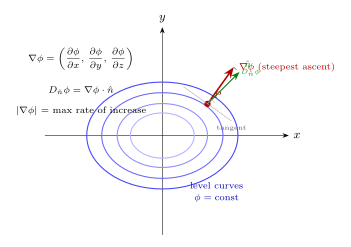
Gradient. For a scalar field ϕ(x,y,z)\phi(x,y,z): ϕ=ϕxi^+ϕyj^+ϕzk^.\nabla\phi = \frac{\partial\phi}{\partial x}\,\hat i + \frac{\partial\phi}{\partial y}\,\hat j + \frac{\partial\phi}{\partial z}\,\hat k. ϕ\nabla\phi at a point PP is perpendicular to the level surface ϕ=const\phi = \text{const} through PP, and points in the direction of steepest increase of ϕ\phi.

Directional derivative. The rate of change of ϕ\phi in the direction of a unit vector n^\hat n: Dn^ϕ=ϕn^.D_{\hat n}\phi = \nabla\phi \cdot \hat n. If the direction is given as a non-unit vector v\vec v, always normalise first: n^=v/v\hat n = \vec v / |\vec v|.

Radial gradient. For a function f(r)f(r) where r=r=x2+y2+z2r = |\vec r| = \sqrt{x^2+y^2+z^2}: f(r)=f(r)r^=f(r)rr.\nabla f(r) = f'(r)\,\hat r = f'(r)\,\frac{\vec r}{r}. To recover ff from f=g(r)r^\nabla f = g(r)\,\hat r: solve f(r)=rg(r)f'(r) = r\,g(r) and integrate.

Gradient perpendicular to level curves; directional derivative is the projection of \nabla\phi onto \hat n.

Question Archetypes

ArchetypeRecognition cue
directional-derivative”Find the directional derivative … along the tangent to the curve …“
angle-between-surfaces”Find the angle between surfaces … at …“
orthogonal-surfaces”Find λ\lambda, μ\mu so the surfaces intersect orthogonally”
recover-scalar-field”Find f(r)f(r) such that f=r/rn\nabla f = \vec r/r^n
gradient-coplanarity”Show grad uu, grad vv, grad ww are coplanar”

directional-derivative (2 questions; 2019, 2025)

Recognition Cues

Solution Template

  1. Compute ϕ\nabla\phi. Differentiate ϕ\phi with respect to xx, yy, zz.
  2. Evaluate ϕ\nabla\phi at the given point PP. Substitute the coordinates.
  3. Find the tangent direction. Compute r(t)=(x(t),y(t),z(t))\vec r\,'(t) = (x'(t), y'(t), z'(t)). Identify the value of tt at which the curve passes through PP.
  4. Normalise: T^=r(t0)/r(t0)\hat T = \vec r\,'(t_0) / |\vec r\,'(t_0)|.
  5. Dot product: DT^ϕ=ϕPT^D_{\hat T}\phi = \nabla\phi|_P \cdot \hat T.

Worked Example(s)

2019 Paper 1, 2019-P1-Q5e (10 marks)

Find the directional derivative of ϕ=xy2+yz2+zx2\phi = xy^2+yz^2+zx^2 along the tangent to x=t,y=t2,z=t3x=t, y=t^2, z=t^3 at (1,1,1)(1,1,1).

Step 1 — Gradient: ϕ=(y2+2zx,  2xy+z2,  2yz+x2).\nabla\phi = (y^2+2zx,\; 2xy+z^2,\; 2yz+x^2). At (1,1,1)(1,1,1): ϕ=(1+2,  2+1,  2+1)=(3,3,3)\nabla\phi = (1+2,\; 2+1,\; 2+1) = (3,3,3).

Step 2 — Tangent. r(t)=(1,2t,3t2)\vec r\,'(t) = (1, 2t, 3t^2). The point (1,1,1)(1,1,1) corresponds to t=1t=1, so r(1)=(1,2,3)\vec r\,'(1) = (1,2,3), r(1)=14|\vec r\,'(1)| = \sqrt{14}.

Step 3 — Directional derivative: DT^ϕ=(3,3,3)(1,2,3)14=3+6+914=1814=9147.D_{\hat T}\phi = (3,3,3) \cdot \frac{(1,2,3)}{\sqrt{14}} = \frac{3+6+9}{\sqrt{14}} = \frac{18}{\sqrt{14}} = \frac{9\sqrt{14}}{7}.

1814=91474.81.\boxed{\frac{18}{\sqrt{14}} = \frac{9\sqrt{14}}{7} \approx 4.81.}


2025 Paper 1, 2025-P1-Q6c-i (10 marks)

Find Dn^ϕ|D_{\hat n}\phi| for ϕ=x2y2z2\phi = x^2y^2z^2 at (1,1,1)(1,1,-1), direction = tangent to x=et,y=2sint+1,z=tcostx=e^t, y=2\sin t+1, z=t-\cos t at t=0t=0.

Gradient: ϕ=(2xy2z2,2x2yz2,2x2y2z)\nabla\phi = (2xy^2z^2, 2x^2yz^2, 2x^2y^2z). At (1,1,1)(1,1,-1): (2,2,2)(2,2,-2).

Tangent at t=0t=0: r(t)=(et,2cost,1+sint)\vec r\,'(t) = (e^t, 2\cos t, 1+\sin t), so r(0)=(1,2,1)\vec r\,'(0) = (1,2,1). Verify: r(0)=(1,1,1)\vec r(0) = (1,1,-1) ✓. Unit tangent: (1,2,1)/6(1,2,1)/\sqrt{6}.

Directional derivative: DT^ϕ=(2,2,2)(1,2,1)6=2+426=46=2631.63.D_{\hat T}\phi = (2,2,-2)\cdot\frac{(1,2,1)}{\sqrt{6}} = \frac{2+4-2}{\sqrt{6}} = \frac{4}{\sqrt{6}} = \frac{2\sqrt{6}}{3} \approx 1.63.

DT^ϕ=263.\boxed{\left|D_{\hat T}\phi\right| = \frac{2\sqrt{6}}{3}.}

Common Traps


angle-between-surfaces (1 question; 2015)

Recognition Cues

Solution Template

  1. Verify PP lies on both surfaces (quick check; one mark).
  2. Compute FP\nabla F|_P and GP\nabla G|_P.
  3. cosθ=FG/(FG)\cos\theta = |\nabla F \cdot \nabla G| / (|\nabla F|\,|\nabla G|) (use absolute value for the acute angle).

Worked Example

2015 Paper 1, 2015-P1-Q5e (10 marks)

Angle between x2+y2+z2=9x^2+y^2+z^2 = 9 and z=x2+y23z = x^2+y^2-3 at (2,1,2)(2,-1,2).

Verify: 4+1+4=94+1+4 = 9 ✓; 241+3=02-4-1+3 = 0 ✓.

Normals. (x2+y2+z29)(2,1,2)=(4,2,4)\nabla(x^2+y^2+z^2-9)|_{(2,-1,2)} = (4,-2,4); (zx2y2+3)(2,1,2)=(4,2,1)\nabla(z-x^2-y^2+3)|_{(2,-1,2)} = (-4,2,1).

Angle: cosθ=(4,2,4)(4,2,1)(4,2,4)(4,2,1)=164+4621=16621=8321.\cos\theta = \frac{|(4,-2,4)\cdot(-4,2,1)|}{|(4,-2,4)|\,|(-4,2,1)|} = \frac{|-16-4+4|}{6\cdot\sqrt{21}} = \frac{16}{6\sqrt{21}} = \frac{8}{3\sqrt{21}}. θ=cos1 ⁣(8321)54.4.\boxed{\theta = \cos^{-1}\!\left(\frac{8}{3\sqrt{21}}\right) \approx 54.4^\circ.}

Common Traps


orthogonal-surfaces (1 question; 2015)

Recognition Cues

Solution Template

  1. Equation (i): point on Surface 1. Substitute the coordinates; this gives one equation in the unknowns.
  2. Equation (ii): F1PF2P=0\nabla F_1|_P \cdot \nabla F_2|_P = 0. Compute both gradients at PP using values from step 1; set the dot product to zero; solve for the remaining unknown.

Worked Example

2015 Paper 1, 2015-P1-Q6c (12 marks)

Find λ\lambda, μ\mu so λx2μyz=(λ+2)x\lambda x^2 - \mu yz = (\lambda+2)x and 4x2y+z3=44x^2y+z^3=4 intersect orthogonally at (1,1,2)(1,-1,2).

Step 1 — Point on Surface 1: λ(1)μ(1)(2)(λ+2)(1)=λ+2μλ2=2μ2=0μ=1\lambda(1) - \mu(-1)(2) - (\lambda+2)(1) = \lambda + 2\mu - \lambda - 2 = 2\mu - 2 = 0 \Rightarrow \mu = 1.

Step 2 — Orthogonality. With μ=1\mu = 1: F1(1,1,2)=(2λ(λ+2),  2,  1)=(λ2,  2,  1).\nabla F_1|_{(1,-1,2)} = (2\lambda - (\lambda+2),\; -2,\; 1) = (\lambda-2,\; -2,\; 1). F2(1,1,2)=(8xy,  4x2,  3z2)(1,1,2)=(8,  4,  12).\nabla F_2|_{(1,-1,2)} = (8xy,\; 4x^2,\; 3z^2)|_{(1,-1,2)} = (-8,\; 4,\; 12). (λ2)(8)+(2)(4)+(1)(12)=0    8λ+168+12=0    λ=52.(\lambda-2)(-8) + (-2)(4) + (1)(12) = 0 \;\Rightarrow\; -8\lambda + 16 - 8 + 12 = 0 \;\Rightarrow\; \lambda = \tfrac{5}{2}.

λ=52,  μ=1.\boxed{\lambda = \tfrac{5}{2},\; \mu = 1.}

Common Traps


recover-scalar-field (1 question; 2016)

Recognition Cues

Solution Template

  1. Use the radial gradient formula. f(r)=f(r)r^=f(r)r/r\nabla f(r) = f'(r)\hat r = f'(r)\,\vec r/r. Equate to r/rn\vec r / r^n to get f(r)=r1n/1=r1nf'(r) = r^{1-n}/1 = r^{1-n}.

    More precisely: f=f(r)r/r\nabla f = f'(r)\,\vec r/r and r/rn=(1/rn1)r/r\vec r/r^n = (1/r^{n-1})\,\vec r/r, so f(r)=r1nf'(r) = r^{1-n}.

  2. Integrate: f(r)=r1ndrf(r) = \int r^{1-n}\,dr; simplify.

  3. Apply the boundary condition to find the integration constant.

Worked Example

2016 Paper 1, 2016-P1-Q8a (10 marks)

Find f(r)f(r) with f=r/r5\nabla f = \vec r/r^5 and f(1)=0f(1)=0.

f=f(r)r^\nabla f = f'(r)\hat r and r/r5=r4r^\vec r/r^5 = r^{-4}\hat r, so f(r)=r4f'(r) = r^{-4}.

f(r)=r4dr=13r3+C.f(r) = \int r^{-4}\,dr = -\frac{1}{3r^3} + C.

f(1)=0C=1/3f(1) = 0 \Rightarrow C = 1/3.

f(r)=13 ⁣(11r3).\boxed{f(r) = \frac{1}{3}\!\left(1 - \frac{1}{r^3}\right).}

Common Traps


gradient-coplanarity (1 question; 2025)

Recognition Cues

Solution Template

  1. Compute the three gradient vectors explicitly.
  2. Form the 3×33\times3 matrix MM with rows u\nabla u, v\nabla v, w\nabla w.
  3. Show detM=0\det M = 0 (use row operations to reveal a linear dependence).

Worked Example

2025 Paper 1, 2025-P1-Q5e (10 marks)

If u=x+y+zu=x+y+z, v=x2+y2+z2v=x^2+y^2+z^2, w=xy+yz+zxw=xy+yz+zx, show u\nabla u, v\nabla v, w\nabla w are coplanar.

Gradients: u=(1,1,1),v=(2x,2y,2z),w=(y+z,z+x,x+y).\nabla u = (1,1,1),\quad \nabla v = (2x,2y,2z),\quad \nabla w = (y+z, z+x, x+y).

Scalar triple product (= det MM): 1112x2y2zy+zz+xx+y=2111xyzy+zz+xx+y.\begin{vmatrix}1 & 1 & 1 \\ 2x & 2y & 2z \\ y+z & z+x & x+y\end{vmatrix} = 2\begin{vmatrix}1 & 1 & 1 \\ x & y & z \\ y+z & z+x & x+y\end{vmatrix}. Apply R3R3+R2R_3 \to R_3 + R_2: the new third row is (x+y+z,x+y+z,x+y+z)=(x+y+z)(1,1,1)(x+y+z, x+y+z, x+y+z) = (x+y+z)(1,1,1).

Factor out (x+y+z)(x+y+z): =2(x+y+z)111xyz111=0,= 2(x+y+z)\begin{vmatrix}1 & 1 & 1 \\ x & y & z \\ 1 & 1 & 1\end{vmatrix} = 0, since rows 1 and 3 are identical.

Therefore the scalar triple product is zero, so u\nabla u, v\nabla v, w\nabla w are coplanar. (Explicit linear relation: v=u22wv = u^2 - 2w, so v=2uu2w\nabla v = 2u\,\nabla u - 2\,\nabla w.)

Common Traps

Marks-Aware Writing

10-mark directional derivative: Five steps, each one line: gradient → evaluate at P → tangent vector → normalise → dot product. Write the intermediate vectors explicitly; the examiner checks each step. Final answer in rationalised surd form.

12-mark orthogonal surfaces: Two clearly labelled conditions (i) and (ii), each yielding one equation. Show the algebra to find μ\mu from (i) before substituting into (ii).

Practice Set

We've mapped all 13 years of this exam. Get new chapters, tools, and solutions as we release them — free.