Stokes’ theorem
At a Glance
- Frequency: 10 sub-parts across 9 of 13 years (2013, 2014, 2016, 2018, 2019, 2020, 2021, 2022, 2024)
- Priority tier: T1
- Marks (count): 5 (1), 10 (1), 13 (1), 15 (3), 20 (4)
- Average solve time: ~13 min
- Difficulty mix: medium 4, hard 3, easy 3
- Section: B | Dominant type: computation
Why This Chapter Matters
Stokes’ theorem appears in 9 of the last 12 years with a strong lean toward 15- and 20-mark questions. In every case the method is the same: replace a hard integral on one side of the equation with an easier one on the other side. Six of the ten questions ask for a pure evaluation (line integral → surface integral or vice versa); three ask for verification (compute both sides); one is an identity proof. Getting the orientation right via the right-hand rule is the single most common source of sign errors and lost marks.
Minimum Theory
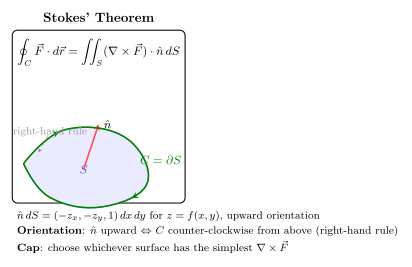
Stokes’ theorem. Let be a piecewise-smooth oriented surface with boundary traversed with the orientation induced by the right-hand rule: curl the fingers of the right hand in the direction of and the thumb points in the direction of . Then for any vector field ,
Computing . For : , where subscripts denote partial derivatives.
Surface element for a graph. For with upward orientation, the vector area element is The projection of onto the -plane gives the domain for the double integral.
Key facts. (1) Stokes’ theorem is independent of the choice of surface: any surface with boundary gives the same value. Choose the simplest cap. (2) If everywhere in a simply connected domain, the line integral over any closed curve is zero. (3) Exact differentials: on the boundary implies the integral is zero.
Question Archetypes
Three patterns cover all Stokes’ theorem questions.
| Archetype | You are seeing this when… |
|---|---|
| stokes-evaluation | evaluate a line or surface integral using Stokes’ theorem (one side is given) |
| stokes-verification | ”verify Stokes’ theorem” — compute both sides and show they agree |
| stokes-identity-proof | ”prove the identity ” (or similar) |
stokes-evaluation (6 question(s); 2013, 2014, 2018, 2019, 2020, 2021)
Recognition Cues
- “Evaluate the line integral … by Stokes’ theorem” — convert to a surface integral.
- “Evaluate the surface integral ” — use Stokes to convert to a line integral on the boundary.
- C is described as the intersection of two surfaces (cylinder + plane, sphere + plane, paraboloid + -plane).
Solution Template
Line integral → surface integral:
- Identify from .
- Compute .
- Choose a capping surface (usually the flat portion of a plane enclosed by ). Project onto the -plane for the domain .
- Determine and orientation (right-hand rule: CCW boundary → upward ).
- Compute and integrate over (often in polar coordinates).
Surface integral → line integral (via Stokes):
- Identify the boundary (the curve where meets the bounding plane or cylinder).
- Simplify restricted to (often or kills terms).
- Evaluate directly (look for exact differentials or trig integrals).
Worked Example(s)
2013 Paper 1, 2013-P1-Q8d (15 marks)
Evaluate where is the intersection of and , via Stokes.
Curl. ; .
Surface. Cap = disk in the plane projected to the unit disk . Plane normal: . Surface element: .
Flux. .
Polar. .
2018 Paper 1, 2018-P1-Q8b (13 marks)
Evaluate for = cylinder plane (CCW in -plane).
Same as 2013 except . The curl is identical: . CCW in the -plane fixes the upward normal, giving vector area element . Since only the -component of the curl is non-zero, the answer is the same:
2014 Paper 1, 2014-P1-Q6c (20 marks)
Evaluate where is , starting from going below the -plane.
Identify. The sphere has centre , radius . The plane passes through the centre: is a great circle with radius , area .
Curl. ; .
Normal to plane : .
Orientation. “Going below the -plane” at corresponds to (right-hand rule verified by parametrisation).
2019 Paper 1, 2019-P1-Q8c-ii (5 marks)
Evaluate where , .
Curl. ; . By Stokes, the integral over any surface bounded by is zero. Alternatively, is conservative.
2020 Paper 1, 2020-P1-Q8b (15 marks)
Evaluate for , = upper hemisphere , .
Apply Stokes. Boundary = circle , . On this circle , : and . Since is single-valued, .
2021 Paper 1, 2021-P1-Q8c (15 marks)
Evaluate for , = paraboloid above -plane.
Boundary. = circle , . Parametrise: , , .
.
With : ; .
.
Integrate over : (odd powers), :
Common Traps
- Orientation is the most common lost mark. State explicitly: upward ↔ CCW boundary when viewed from above. Reversed orientation flips the sign.
- The factor from and the from multiply to for the plane — effectively giving the flat area element with no extra factor (2013, 2018).
- When applying Stokes to the hemisphere (2020, 2021): the boundary is the circle, not the hemisphere’s “top”. On , all -dependent terms in may simplify or vanish.
- For the exact-differential test (2019, 2020): if on the boundary curve, the integral is zero without further computation.
- On the great-circle problem (2014): the area is where is the great-circle radius, and the curl dotted with the plane’s normal is the only factor needed.
stokes-verification (3 question(s); 2020, 2022, 2024)
Recognition Cues
- “Verify Stokes’ theorem for on ” — you must compute both sides independently and confirm they match.
- The surface is typically a parabolic cylinder () or a triangular plane (first-octant portion of ).
Solution Template
- State Stokes’ theorem (required for full marks on the “state and verify” variant).
- Compute .
- LHS — surface integral. Use for an upward-oriented graph ; integrate over the projected rectangle or triangle.
- RHS — line integral. Identify the boundary from the parameter-region boundary. Determine orientation (CCW as seen from above for upward ). Parametrise each edge and integrate.
- State that both sides agree (and their common value).
Worked Example(s)
2020 Paper 1, 2020-P1-Q7a (20 marks) and 2024 Paper 1, 2024-P1-Q7c (20 marks)
Verify Stokes’ theorem for on , , (upward).
Sources:,
Curl. .
Surface integral (LHS). . .
Boundary (4 edges, CCW from above):
| Edge | Parametrisation | Integral | |
|---|---|---|---|
| : , | |||
| : , | |||
| : , | |||
| : , |
Total RHS LHS ✓.
2022 Paper 1, 2022-P1-Q7a (20 marks)
Verify Stokes’ theorem for on in the first octant.
Curl. .
Surface integral. (the ‘s cancel). . With : integrand . Inner integral collapses to . LHS = 0.
Line integral (3 edges of the triangle):
- Edge 1 : integral .
- Edge 2 : integral .
- Edge 3 : integral .
- RHS LHS ✓.
Common Traps
- Boundary orientation on the parabolic cylinder (2020, 2024): the four edges of the rectangle map to four boundary segments on the surface; the upward normal means traverse them CCW from above. Edges and have and respectively, so on those edges — most terms vanish.
- Four pieces, not two: the parabolic cylinder’s boundary has four segments (not two open arcs); missing or is a common error.
- The inner integral collapse in the 2022 triangle problem is not a mistake — for all , so both sides are identically zero.
- Always state the theorem when the question says “state and verify.”
stokes-identity-proof (1 question(s); 2016)
Recognition Cues
- “Prove that .”
- An identity involving (scalar) and a line or surface integral — not an evaluation.
Solution Template
- Apply classical Stokes to where is an arbitrary constant vector.
- LHS: .
- RHS: (since ). Use the triple product .
- Since LHS = RHS holds for all constant , equate the vectors.
Worked Example(s)
2016 Paper 1, 2016-P1-Q8b (10 marks)
Prove .
Apply Stokes to ( constant):
Since this holds for all :
Common Traps
- The arbitrary constant vector is the key trick: equality of for all implies equality of the vectors.
- Sign in the triple product: (not ) — the order on the right matches the stated identity.
- kills the second product-rule term; state this explicitly.
Marks-Aware Writing
5-mark questions (2019): State Stokes (one line), compute curl, note it’s zero (or ), conclude. No surface integral needed.
13–15-mark questions (2013, 2018, 2020-Q8b, 2021): Full Stokes setup: state the theorem, compute curl (show each component), write the vector area element, compute the dot product, integrate in polar or Cartesian. Box the answer.
20-mark questions (2014, 2020-Q7a, 2022, 2024): For evaluations: also state the orientation reasoning explicitly. For verifications: show both sides in labelled sub-sections (LHS / RHS), with each boundary edge computed separately in a table, and conclude with “LHS = RHS = …”. The “state Stokes’ theorem” preamble is required when the question asks for it.
Practice Set
| Year | Paper/Q | Marks | Archetype | One-line hint |
|---|---|---|---|---|
| 2024 | P1-Q7c | 20 | stokes-verification | State theorem; same as 2020-Q7a; four boundary edges; by symmetry |
| 2022 | P1-Q7a | 20 | stokes-verification | Curl ; both sides zero; inner integral collapses |
| 2021 | P1-Q8c | 15 | stokes-evaluation | Boundary = circle at ; expand ; only survives |
| 2020 | P1-Q7a | 20 | stokes-verification | Four edges; and contribute 0; fractional answers and |
| 2020 | P1-Q8b | 15 | stokes-evaluation | Hemisphere → boundary circle ; ; exact differential → 0 |
| 2019 | P1-Q8c-ii | 5 | stokes-evaluation | Curl=0 (each component function of its own var); or |
| 2018 | P1-Q8b | 13 | stokes-evaluation | Same as 2013 but not ; curl unchanged; answer |
| 2016 | P1-Q8b | 10 | stokes-identity-proof | Arbitrary constant vector ; triple product; strip to get vector equality |
| 2014 | P1-Q6c | 20 | stokes-evaluation | Great circle radius , area ; curl dot normal ; result |
| 2013 | P1-Q8d | 15 | stokes-evaluation | Curl ; plane cap; ; polar |