Cosets and Lagrange’s theorem
At a Glance
- Frequency: 4 sub-parts across 4 of 13 years (2019, 2023, 2024, 2025)
- Priority tier: T3
- Marks (count): 10 (4)
- Average solve time: ~6 min
- Difficulty mix: easy 2, medium 2
- Section: A | Dominant type: proof
Why This Chapter Matters
Coset and Lagrange questions appear in Section A compulsory (Q1) in four recent years, always for 10 marks. All questions use one of two weapons: (a) the First Isomorphism Theorem — the image order divides the domain order — or (b) the product-set formula combined with . Sylow III provides a third tool for questions about counting subgroups of prime order. Master these three tools and all four historical questions are solved in under 7 minutes each.
Minimum Theory
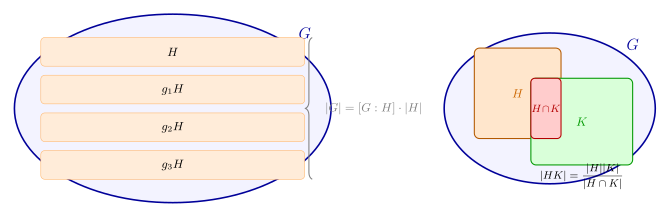
Lagrange’s theorem. If (finite group), then divides and .
Index multiplication. For : .
First Isomorphism Theorem. If is a homomorphism then . So divides . For a surjection, divides .
Product-set formula. For finite subgroups : These two combine to give .
Sylow III. The number of Sylow -subgroups satisfies and .
Question Archetypes
| Archetype | Recognition |
|---|---|
| sylow-counting | $ |
| order-counting-argument | $ |
| subgroup-existence | Every nonzero element of generates it; or subgroup of given order via element orders |
| onto-homomorphism | Does a surjection exist? — check divisibility $ |
sylow-counting (1 question(s); 2024)
Recognition Cues — with prime and ; asked for “at most one subgroup of order .”
Solution Template
- Subgroups of order are precisely the Sylow -subgroups.
- Sylow III: and (since ).
- Divisors of prime are . Rule out : that would need , i.e. ; impossible since .
- Conclude .
Worked Example
2024 Paper 2, 2024-P2-Q1a (10 marks)
has order , prime. Show has at most one subgroup of order .
Sylow III gives and . If , then ; impossible since . Hence .
order-counting-argument (1 question(s); 2025)
Recognition Cues — ; prove nontrivial intersection.
Worked Example
2025 Paper 2, 2025-P2-Q1a (10 marks)
, . Show .
Assume . Then . But — contradiction. Hence .
Proof of the product-set formula (needed to quote it): Map by . Each element has exactly preimages for . So , giving .
subgroup-existence (1 question(s); 2016)
Worked Example
2016 Paper 2, 2016-P2-Q2b (10 marks, coset part)
Every nonzero element of ( prime) generates .
Let in . By Lagrange, divides . Since is prime, . Since , , so , giving .
(Without Lagrange: , so the multiples are distinct mod , exhausting .)
onto-homomorphism (1 question(s); 2023)
Worked Example
2023 Paper 2, 2023-P2-Q1a (10 marks)
Does an onto homomorphism from to exist?
If exists, then by the First Isomorphism Theorem divides . But . No such homomorphism exists.
Common Traps
- Direction of divisibility. For a surjection, divides (not the other way). For an injection, divides .
- Sylow: two conditions, not one. Using only without checking the condition (or vice versa) leaves the argument incomplete.
- Product-set formula needs a proof or citation. In a 10-mark proof question, stating without justification loses 3–4 marks. Give the one-line preimage-counting proof.
- Primality is crucial. The result “every nonzero element generates” requires prime; for composite , elements with do not generate .
Marks-Aware Writing
All four questions are 10 marks. Each proof needs: (a) the theorem invoked (named), (b) its application to the specific numerical data, (c) the case analysis ruling out the unwanted value, and (d) a boxed conclusion with . Stating the theorem without applying it to the numbers earns ≤3 marks.
Practice Set
- 2019-P2-Q1a (10 m) — — Hint: index multiplication; use a bijection between cosets of in and cosets of in paired with cosets of in .