Euclidean domains
At a Glance
- Frequency: 5 sub-parts across 5 of 13 years (2013, 2016, 2017, 2019, 2025)
- Priority tier: T2
- Marks (count): 10 (2), 15 (2), 20 (1)
- Average solve time: ~11 min
- Difficulty mix: medium 4, easy 1
- Section: A | Dominant type: proof
Why This Chapter Matters
This atom has appeared in 5 of the last 13 years — always a proof, usually in Section A — and the questions cluster tightly around three ideas: the division algorithm (for or ), the implication chain Euclidean PID UFD, and the link between irreducibility and maximality of ideals. Once you understand why the norm is multiplicative and how rounding controls the remainder, every variant reduces to a two-page structural argument. The irreducibility-via-norm technique (2025 Q) is the same norm argument in miniature and takes under five minutes.
Minimum Theory
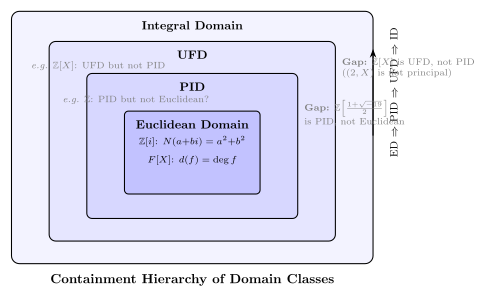
Euclidean domain. An integral domain is a Euclidean domain (ED) if there exists a function (the Euclidean norm or valuation) such that for every and , there exist with The key examples are: with ; (for a field ) with ; and the Gaussian integers with .
The implication chain. Every Euclidean domain is a PID, and every PID is a UFD: Each implication is strict. is a UFD but not a PID (the ideal is not principal). The ring is a PID but not Euclidean (Dedekind–Hasse counterexample). In a PID: irreducible prime the generated ideal is maximal.
in detail. The norm is multiplicative: . Units are elements of norm 1: . To divide by , write in , then round each of and to the nearest integer and . Set and . The rounding error on each component is at most , so This is the Euclidean property for .
Question Archetypes
| Archetype | Recognition |
|---|---|
| euclidean-domain | ”Show is a Euclidean domain / PID / UFD” |
| ideal-irreducible | ”Show maximal in iff irreducible” |
| division-algorithm | ”Prove the division algorithm in “ |
| quotient-field-irreducible | ”Show is a field for irreducible in a Euclidean ring” |
| irreducibility-via-norm | ”Show a specific element is irreducible in “ |
euclidean-domain (1 question; 2013)
Show is a Euclidean domain, hence a PID and a UFD
Recognition Cues
The question names (or a similar ring with a known norm) and asks you to verify one or more properties in the chain Euclidean PID UFD. All three may be asked together (as in 2013). The tell is that a specific norm function is either given or obviously available (sum of squares, polynomial degree).
Solution Template
- Define the norm. State and note it is a non-negative integer with iff .
- Establish multiplicativity (briefly): — this follows from .
- Prove division with remainder. For : write , round to , set . Bound , so . Conclude ED.
- PID from ED. Let be any ideal. If , then . Otherwise pick with minimal; for any write with — since , minimality forces , so . Hence .
- UFD from PID. In a PID every irreducible is prime (standard), and the ascending chain condition holds (bounded norm), so unique factorisation follows.
Worked Example
2013 Paper 2, 2013-P2-Q3a (15 marks)
State whether the Gaussian integers form a Euclidean domain, a principal ideal domain, and a unique factorisation domain. Justify your answer in each case.
Euclidean domain. Let , . Compute . Choose with and . Set and . Then: So with or . Since and , this makes a Euclidean domain with norm .
PID. Let be any ideal. If then . Otherwise choose with minimal (possible since takes non-negative integer values). For any , apply the Euclidean property: with . Since and , minimality forces , so . Thus and is a PID.
UFD. Every PID is a UFD by a standard theorem: in a PID every irreducible element is prime (since the ideal is maximal, hence prime), and the Noetherian property (which holds because ideals are generated by elements of finite norm) prevents infinite ascending chains. Unique factorisation into irreducibles then follows from the prime property plus Noetherian induction. Hence is a UFD.
Common Traps
- Forgetting to bound , not . The rounding argument gives , so . Write this as a product of norms — the step is one line but must appear explicitly.
- Claiming “PID therefore UFD” without justification. The UPSC mark scheme expects the intermediate fact: every irreducible in a PID is prime, and the ascending chain condition holds. A bare citation loses marks; one sentence of explanation suffices.
- Units. The units of are exactly (the elements with ). Confusing units with primes invalidates the UFD argument.
ideal-irreducible (1 question; 2016)
Show the principal ideal in is maximal if and only if is irreducible over the field
Recognition Cues
The question mentions the ideal generated by a polynomial in (where is a field) and asks for a maximality–irreducibility equivalence, or equivalently asks to show is a field iff is irreducible. The biconditional structure calls for two separate proofs ( and ).
Solution Template
- Setup. Note is a PID (proved by the division algorithm since is a field). The ideals containing are exactly the with .
- (Irreducible Maximal). Suppose is irreducible and for some ideal . Then . Since is irreducible, is either a unit or an associate of . If is a unit, . If , then . So is maximal.
- (Maximal Irreducible). Suppose is maximal. If with non-units, then , contradicting maximality. So is irreducible.
- Corollary (often asked): is a field is maximal is irreducible.
Worked Example
2016 Paper 2, 2016-P2-Q1a (10 marks)
Show that the ideal in is a maximal ideal if and only if is an irreducible polynomial over the field .
First note: is a PID because is a field and the division algorithm holds in (leading coefficient of is invertible in ). In a PID every ideal is principal, so every ideal containing has the form with .
() Suppose is irreducible. Let . Then . Since is irreducible, the only divisors of are units and associates. If is a unit then ; if is an associate of then . Hence there is no ideal strictly between and , so is maximal.
() Suppose is maximal. Assume for contradiction that with neither nor a unit. Then and , so is false, meaning . Also is a non-unit non-zero polynomial, so . This gives a proper chain , contradicting maximality. Hence is irreducible.
Consequence. maximal is a field (a standard ring-theory fact: is a field iff is maximal).
Common Traps
- Not excluding the trivial cases. The ideal is not maximal and is not irreducible; the ideal itself is not proper. Assume is a nonzero non-unit throughout.
- Strictness of the inclusion. To show in the () direction, you need to verify (since is not an associate of — is also a non-unit). A sentence confirming (i.e., is not a unit) is required.
- “Prime and maximal coincide” only in a PID. In a general commutative ring, irreducible prime. Here the PID hypothesis is essential; without establishing is a PID first, the argument fails.
division-algorithm (1 question; 2017)
Prove the division algorithm in for a field
Recognition Cues
The question asks you to prove that for with , there exist unique with and (with the convention ). This is an existence-plus-uniqueness proof; the key tool is induction on .
Solution Template
- Trivial case. If , set , ; the condition is satisfied.
- Inductive step. Let , with leading coefficients and . Define . Note is invertible in (field hypothesis). Then (the leading terms cancel). Apply the induction hypothesis to and : with . Set , .
- Uniqueness. Suppose . Then . If , then , but — contradiction. So and .
Worked Example
2017 Paper 2, 2017-P2-Q2c (20 marks)
Let be a field and with . Prove that there exist unique polynomials and in such that and either or .
Existence (by induction on ).
Base. If or , take , . Then and .
Step. Suppose existence holds for all polynomials of degree , and let . Write and . Since is a field, has an inverse . Define The coefficient of in is , so . By the induction hypothesis, with or . Then Setting gives with .
Uniqueness. Suppose with . Then . If then (using that is a domain, so degree is additive). But — contradiction. Hence and therefore .
Common Traps
- Field hypothesis is used exactly once. The invertibility of is the only step that requires to be a field. Make this explicit; examiners look for it.
- Degree convention for zero. When or arises during induction, use so the base case applies cleanly. Treating as creates a spurious edge case.
- Uniqueness needs the domain property. The step uses the fact that is an integral domain (no zero divisors). If you only assumed is a ring, this step fails.
quotient-field-irreducible (1 question; 2019)
Show is a field when is irreducible in a Euclidean ring
Recognition Cues
The question gives a Euclidean ring (or Euclidean domain), an irreducible element , and asks to show the quotient ring is a field. The Euclidean hypothesis is load-bearing: it guarantees a division algorithm and hence a gcd theory (Bézout’s identity).
Solution Template
- Show . Since is irreducible, it is a non-unit, so , meaning . Hence is a non-trivial ring.
- Show every nonzero coset is invertible. Take , so . Since is irreducible and , we have (an irreducible has only unit and associate divisors; is not a multiple of , so ).
- Bézout. In a Euclidean domain, means there exist with .
- Conclude. In : , and , so . Thus has inverse . Since was arbitrary, is a field.
Worked Example
2019 Paper 2, 2019-P2-Q3d (10 marks)
Let be a Euclidean ring and an irreducible element. Prove that is a field.
Step 1: is a proper ideal. Since is irreducible, is not a unit. Hence , so , and is a non-trivial quotient ring.
Step 2: Every non-zero element of is a unit. Let , so . Consider in (which exists since is Euclidean, hence a PID). Since and is irreducible, is either a unit or an associate of . If then , contradicting . So is a unit, i.e., (up to units).
Step 3: Bézout. Since is a Euclidean domain and , the ideal (in a PID, ). Hence there exist with
Step 4: Invertibility. Reduce modulo : , giving . So has multiplicative inverse in .
Since every nonzero element of is invertible, is a field.
Common Traps
- Not establishing first. The quotient ring is not a field; the argument requires , which follows from being a non-unit (i.e., irreducible). State this explicitly at the start.
- Euclidean hypothesis is essential. Bézout’s identity holds in any PID (and hence in any ED). If were only a UFD, exists but Bézout need not hold as a ring identity, so the proof breaks. The Euclidean/PID structure is precisely the hypothesis that makes possible.
- "" needs a sentence of justification. Don’t just assert ; show that with irreducible forces to be a unit (since is not a multiple of ).
irreducibility-via-norm (1 question; 2025)
Show that a specific element is irreducible in using the norm
Recognition Cues
The question names an element (a rational integer like , or a Gaussian integer like ) and asks to show it is irreducible. The method: compute and note that any factorisation gives ; then show the only factorisations of force one factor to have norm 1 (i.e., to be a unit).
Solution Template
- Compute . For , .
- Norm factorisation. If then ; list all ways to write as a product of two positive integers.
- Eliminate non-trivial splits. For each split of : if or , one factor is a unit — this is the irreducible conclusion. Otherwise, show no Gaussian integer of that norm exists (sum of two squares argument) or arrive at a contradiction.
- Conclude. Since every factorisation forces one factor to be a unit, is irreducible in .
Worked Example
2025 Paper 2, 2025-P2-Q2b (15 marks)
Show that is an irreducible element in the integral domain .
Setup. In , the norm is , and is multiplicative. The units are elements of norm 1: . Suppose for some . Then
Cases. The factorisation with has three forms: or or .
Case or . means is a unit, so is irreducible in this case.
Case . Suppose for some . Check: has no integer solution (since , and any sum of two squares satisfies — because squares are or , so sums of two squares are or ). Hence no Gaussian integer has norm , and this case is impossible.
Conclusion. In every factorisation , one factor has norm 1 and is therefore a unit. Hence is irreducible in .
Remark. Alternatively: since , the prime is inert in (by the two-squares characterisation), meaning it remains a Gaussian prime. But the norm argument above is self-contained and does not require this theorem.
Common Traps
- Not proving norm multiplicativity. If the question asks you to “show 3 is irreducible,” you must invoke and state this fact (one line of proof or a brief justification is expected). Simply writing "" without explanation of why norms multiply loses marks.
- Missing the modular arithmetic step. The conclusion that has no integer solution is not obvious by inspection. The clean proof is: squares are or , so or ; but . Examiners expect this argument.
- Confusing irreducible and prime. In , irreducible and prime coincide (because is a UFD). The question asks only for irreducibility; don’t conflate the two without stating the equivalence.
Marks-Aware Writing
For a 10-mark proof (ideal-irreducible or quotient-field): The mark scheme rewards structure. Write the two directions ( and ) as clearly labelled separate paragraphs. Each direction needs: one sentence of setup, the key chain of reasoning (3–5 lines), and a boxed or underlined conclusion. Avoid vague phrases like “by standard theory”; write the one or two lines that constitute the argument.
For a 15-mark proof (Z[i] Euclidean, or irreducibility-via-norm): The Euclidean proof must show the rounding bound explicitly — this is the only novel computation. The subsequent PID and UFD steps are brief (3–4 sentences each). For irreducibility-via-norm, the modular arithmetic argument for “no Gaussian integer of norm 3” is the key step and must be written out in full.
For a 20-mark proof (division algorithm): This is the most substantial proof; allocate roughly 8 marks to the existence induction and 4 marks to uniqueness. The inductive step must display the polynomial with its formula and confirm . The field hypothesis (invertibility of the leading coefficient) must be explicitly invoked.
General. Box every final conclusion. Number steps in inductions. If a direction is shorter (e.g., the “maximal irreducible” direction in 2016), still give it its own paragraph — do not bury it in the other direction.
Practice Set
- 2013-P2-Q3a (15 m) — — full ED-PID-UFD chain for ; practice stating the rounding bound explicitly
- 2016-P2-Q1a (10 m) — — maximality iff irreducibility; write both directions in separate paragraphs
- 2017-P2-Q2c (20 m) — — full induction proof of division algorithm; identify the single use of the field hypothesis
- 2019-P2-Q3d (10 m) — — quotient field; use Bézout; confirm as first step
- 2025-P2-Q2b (15 m) — — irreducibility of 3 in ; supply the mod-4 argument for no norm-3 Gaussian integer