Group homomorphisms: kernel, image
At a Glance
- Frequency: 4 sub-parts across 4 of 13 years (2019, 2020, 2023, 2024)
- Priority tier: T3
- Marks (count): 10 (3), 15 (1)
- Average solve time: ~6 min
- Difficulty mix: easy 4
- Section: A | Dominant type: proof
Why This Chapter Matters
Group homomorphism questions are the most frequent algebra topic, appearing in four separate years for a combined 45 marks. All three 10-mark variants follow the same two-line proof structure: show the image order divides both and , then use coprimality or the normal subgroup classification to rule out non-trivial images. The 15-mark question asks you to prove that properties like commutativity transfer to homomorphic images. Mastering the core lemma (image order divides domain order via the First Isomorphism Theorem) unlocks all four archetypes at once.
Minimum Theory
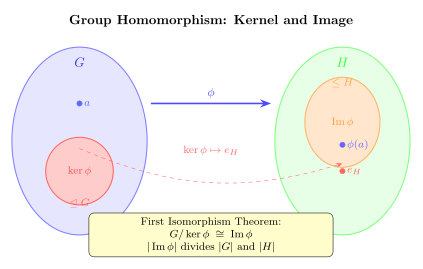
Group homomorphism. A map is a group homomorphism if for all . The kernel is and the image is .
Basic properties. (i) (normal subgroup); (ii) (subgroup); (iii) is injective iff .
First Isomorphism Theorem. . In particular, , so divides . Combined with Lagrange in : divides as well. Hence divides .
Question Archetypes
| Archetype | Recognition |
|---|---|
| homomorphism-existence | Given orders of , ; determine whether a (non-trivial or onto) homomorphism can exist |
| homomorphic-image-property | Prove a group property (commutativity, etc.) transfers to ; provide converse counterexample |
homomorphism-existence (3 question(s); 2019, 2020, 2023)
Recognition Cues — “prove the only homomorphism is trivial”; “show there is no homomorphism of onto ”; given concrete groups (, , groups of given orders).
Solution Template
- Let be any homomorphism.
- Use FIT: divides (via ) and divides (Lagrange in ).
- Hence divides .
- If : conclude , so is trivial.
- If asking about surjectivity: requires ; check whether this holds.
- For specific groups (e.g. ): use the abelianization argument — any map to an abelian group kills commutators, constraining the image order further.
Worked Example
2019 Paper 2, 2019-P2-Q2a (10 marks)
If and are finite groups whose orders are relatively prime, prove that there is only one homomorphism from to , the trivial one.
Let . By the First Isomorphism Theorem, , so divides . By Lagrange in , divides . Hence
So , meaning for all . Since was arbitrary, the trivial map is the only homomorphism .
(Element-order version: for any , divides both and . Coprimality forces , so .)
2020 Paper 2, 2020-P2-Q1a (10 marks)
Show that there is no homomorphism of into except the trivial homomorphism.
Let . Since is abelian, factors through the abelianization . So divides .
But also , so divides .
Since , , i.e. is trivial.
(Direct route via FIT: divides and , so . If , then — a normal subgroup of of order 2. But has no normal subgroup of order 2 (its only normal subgroups are , , ). Contradiction. So .)
2023 Paper 2, 2023-P2-Q1a (10 marks)
Let be a group of order 10 and be a group of order 6. Examine whether there exists a homomorphism of onto .
Suppose is surjective. By FIT, , so divides . But (since lacks the factor ). Contradiction.
Common Traps
- The image order divides (via FIT) as well as — forgetting the side and only using misses the coprimality argument.
- For surjectivity: the constraint is (not ). Confusing the direction loses the contradiction.
- The trivial homomorphism always exists; the question often asks whether a non-trivial or onto one exists.
- For the case: ruling out requires explicitly invoking the classification of normal subgroups of .
homomorphic-image-property (1 question(s); 2024)
Recognition Cues — “Show every homomorphic image of a [property] group is [property]”; “converse is not necessarily true”; needs a counterexample.
Solution Template
- Let be a homomorphism and let have property .
- Take arbitrary elements ; lift them to with .
- Use property on in , then apply to transfer the property to .
- For the converse: exhibit a non- group with a homomorphism where has property .
Worked Example
2024 Paper 2, 2024-P2-Q2b (15 marks)
Show that every homomorphic image of an abelian group is abelian, but the converse is not necessarily true.
Part 1. Let be a homomorphism and abelian. Take ; pick with . Then
So is abelian.
Part 2 — Converse fails. Take (non-abelian: ) and the sign homomorphism , . This is a homomorphism with image , which is abelian. But is not abelian.
Common Traps
- “Homomorphic image” is , not the entire codomain . The proof uses elements of only.
- The converse counterexample requires a non-abelian whose image under some is abelian — is the cleanest choice.
- In Part 1, the step uses commutativity in ; make this explicit.
Marks-Aware Writing
For 10-mark existence questions: a complete answer has (a) FIT cited by name, (b) the two-sided divisibility argument for , (c) the numerical conclusion ruling out non-trivial images, and (d) a boxed statement. Stating FIT without computing earns only 3–4 marks.
For the 15-mark property-transfer question: Part 1 needs the lifted-element argument written out symbol by symbol (4–5 marks), and Part 2 needs a specific, verified counterexample — naming without checking is non-abelian loses 2 marks.
Practice Set
- 2022-P2-Q2b (15 m) — — Hint: prove the First Isomorphism Theorem directly; check well-definedness of the induced map.
- 2022-P2-Q1a (10 m) — — Hint: apply FIT; compute divisibility constraints on the image order.