Integral domains; characteristic
At a Glance
- Frequency: 2 sub-parts across 2 of 13 years (2015, 2018)
- Priority tier: T3
- Marks (count): 10 (1), 15 (1)
- Average solve time: ~6 min
- Difficulty mix: easy 2
- Section: A | Dominant type: proof / verification
Why This Chapter Matters
Integral domain questions appear in two distinct flavours: testing whether a given set is an integral domain or field (2015, 15 marks — three sub-parts) and proving a structural theorem about polynomial rings over a domain (2018, 10 marks). The test question requires checking ring axioms one-by-one for each set, which is fast if you have a clear checklist. The polynomial-ring question hinges on the single fact that degree is additive over a domain, which reduces the entire proof to two lines of algebra. Together they cover ring structure from the axiomatic ground up through polynomial rings.
Minimum Theory
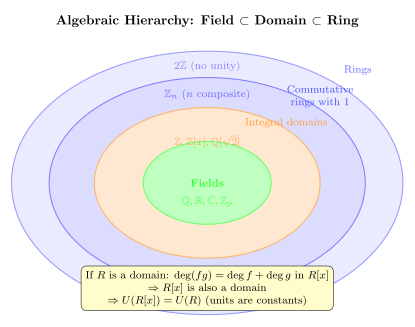
Integral domain. A commutative ring with unity is an integral domain if it has no zero divisors: or . A field is an integral domain in which every non-zero element has a multiplicative inverse. The chain of containments is: fields integral domains commutative rings.
Degree in a polynomial domain. If is an integral domain and are non-zero, then (the leading coefficients multiply to a non-zero element since has no zero divisors). In particular is also an integral domain.
Units in . A unit in is a polynomial with a multiplicative inverse in : . Degree additivity immediately forces , so and are constants; then means their constant terms multiply to in , i.e. and is a unit of .
Question Archetypes
| Archetype | Recognition |
|---|---|
| integral-domain-test | Given sets; check each ring axiom; determine domain/field status |
| units-in-polynomial-ring | ”Show units of are units of ”; use degree additivity over a domain |
integral-domain-test (1 question(s); 2015)
Recognition Cues — “Do the following sets form integral domains?”; “If so, state if they are fields”; three sets are given; must check ring axioms and zero-divisor property for each.
Solution Template
For each set :
- Check closure under addition and multiplication.
- Check additive identity (?) and additive inverses.
- Check multiplicative identity (?).
- Check commutativity (often inherited from or ).
- If all ring axioms pass: check zero-divisors (domain?) and inverses (field?).
- Conclude.
Worked Example
2015 Paper 2, 2015-P2-Q4a (15 marks)
Do the following sets form integral domains with respect to ordinary addition and multiplication? If so, state if they are fields: (i) ; (ii) the set of even integers; (iii) the set of positive integers.
Part (i) — .
Closure under addition: .
Closure under multiplication: . This is rational, not of the form unless . So is not closed under multiplication.
Conclusion (i): Not an integral domain (fails closure under multiplication; not even a ring).
Part (ii) — .
Closure under and : (sum and product of even integers are even). Additive identity . Additive inverses: for . No zero divisors (inherits from ).
But: no multiplicative identity — , and no even number satisfies (would need , which is odd).
Conclusion (ii): Not an integral domain (lacks multiplicative identity; is a rng, not a ring with unity).
Part (iii) — .
No additive identity: . No additive inverses: . So is not even a group.
Conclusion (iii): Not an integral domain (not a ring — fails additive identity and additive inverses).
Common Traps
- Part (i): the product is rational, not irrational. Students often assume “irrational times irrational is irrational” — this is false.
- Part (ii): even integers form a rng (ring without identity). UPSC convention requires a multiplicative identity for “ring” and “integral domain”; fails this.
- Part (iii): the most fundamental failure is no additive identity (0 is not a positive integer) and no additive inverses. This means is not even closed under the group structure of .
- If part (i) had been , that is a field. The restriction to elements of the form (no rational part) destroys closure under multiplication.
units-in-polynomial-ring (1 question(s); 2018)
Recognition Cues — “Let be an integral domain with unit; show any unit in is a unit in ”; key words: integral domain, unit, polynomial ring .
Solution Template
- State the degree additivity lemma: for a domain, (leading coefficients multiply to a non-zero element).
- Let be a unit; choose with .
- Apply degree: .
- Since both degrees are non-negative integers summing to 0, both are 0. So , are constants.
- in , so is a unit of .
Worked Example
2018 Paper 2, 2018-P2-Q1a (10 marks)
Let be an integral domain with unit element. Show that any unit in is a unit in .
Step 1 — Degree additivity. For non-zero with leading coefficients : the leading coefficient of is . Since has no zero divisors, , so .
Step 2 — Let be a unit. There exists with .
Step 3 — Degree equation. .
Step 4 — Both degrees are zero. Since and are non-negative integers summing to 0:
So and are constant polynomials.
Step 5 — is a unit of . From : in . Hence is a unit of .
(Converse: every unit of is trivially a unit of , so .)
(Why the domain hypothesis is necessary: in , , so is a unit of degree 1 — the argument breaks down because has zero divisors.)
Common Traps
- The single load-bearing fact is , which requires to be a domain (otherwise the leading coefficients might multiply to zero). State this explicitly and say why.
- After concluding , you must still extract from to conclude is a unit of — don’t stop at “constant polynomial.”
- Provide the counterexample or at least mention that without the domain hypothesis the result fails.
Marks-Aware Writing
For the 15-mark domain-test question: address each of the three sets separately with clear sub-headings. For each, identify the first axiom that fails — wasting time checking all axioms when the first fails loses time. State the conclusion explicitly for each set. The summary box and three clear conclusions account for the last 3 marks.
For the 10-mark units-in- proof: the argument has five steps (degree lemma, unit equation, degree equation, both degrees zero, unit of ). Skipping the degree lemma and just asserting "" earns at most 5 marks. Include the counterexample to show the domain hypothesis is essential — this is worth 1–2 marks of “completeness.”
Practice Set
- 2025-P2-Q4a (15 m) — — Hint: use the evaluation homomorphism and check is a domain but not a field.
- 2024-P2-Q4a (15 m) — — Hint: test the ring axioms and zero-divisor property for the specific ring given.