Isomorphism theorems (First, Second, Third)
At a Glance
- Frequency: 2 sub-parts across 2 of 13 years (2018, 2022)
- Priority tier: T3
- Marks (count): 15 (2)
- Average solve time: ~8 min
- Difficulty mix: easy 2
- Section: A | Dominant type: proof
Why This Chapter Matters
Both UPSC questions on the First Isomorphism Theorem are 15 marks, making this one of the highest-value single-theorem items in Paper 2 Algebra. The 2018 question applies the theorem to identify ; the 2022 question asks for the complete proof. Both reduce to the same four-step structure: define a surjective homomorphism, compute its kernel, invoke FIT, state the conclusion. Knowing the proof cold and being able to exhibit a concrete surjection on demand covers both archetypes with one preparation.
Minimum Theory
First Isomorphism Theorem. Let be a group homomorphism. Let . Then: (i) ; (ii) there is an isomorphism defined by . In particular, .
Well-definedness check (the crucial step). is well-defined because: if then , so , so .
Second and Third Isomorphism Theorems (stated for reference). Second: If and , then and . Third: If and with , then and .
Unit circle group. under multiplication. The map sends onto with kernel .
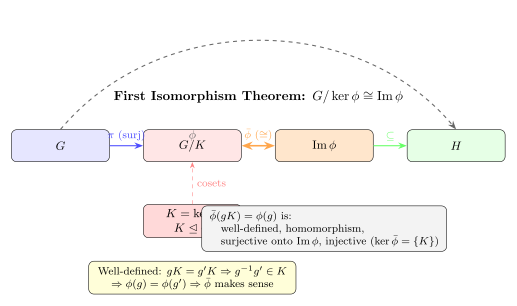
Question Archetypes
| Archetype | Recognition |
|---|---|
| first-isomorphism-application | Exhibit a surjective homomorphism with a specified kernel, then cite FIT to identify the quotient |
| first-isomorphism-proof | Prove every homomorphic image of is isomorphic to some quotient |
first-isomorphism-application (1 question(s); 2018)
Recognition Cues — “Show ” where is a known group; “quotient group is isomorphic to …”; find a natural surjective homomorphism with .
Solution Template
- Define and verify it is a homomorphism.
- Show is surjective.
- Compute and verify (the named subgroup).
- Apply FIT: .
Worked Example
2018 Paper 2, 2018-P2-Q2a (15 marks)
Show that the quotient group is isomorphic to the multiplicative group of complex numbers on the unit circle.
Let . Define by .
Step 1 — Homomorphism. .
Step 2 — Surjectivity. For any , set ; then .
Step 3 — Kernel. for some . So .
Step 4 — First Isomorphism Theorem. is a surjective homomorphism with kernel , so
(Well-definedness on cosets: if (), then , so the induced map is independent of the coset representative.)
Common Traps
- Use (period 1) so the kernel is exactly . Using gives kernel and quotient instead — same conclusion, but the kernel does not match .
- Verifying surjectivity (every point of is hit) and computing the kernel are both required for full marks.
- State the First Isomorphism Theorem explicitly by name; don’t just say “therefore the map descends.”
first-isomorphism-proof (1 question(s); 2022)
Recognition Cues — “Prove every homomorphic image of is isomorphic to some quotient group of ”; “State and prove the First Isomorphism Theorem.”
Solution Template
- State the theorem: a homomorphism, ; then and .
- Prove : identity, closure, inverses.
- Prove : for any , : , so .
- Define by .
- Check well-definedness, homomorphism, surjectivity, injectivity.
- Conclude is an isomorphism.
Worked Example
2022 Paper 2, 2022-P2-Q2b (15 marks)
Prove that every homomorphic image of a group is isomorphic to some quotient group of .
Let be a homomorphism. Set .
Step 1 — is a subgroup. (since ). If : , so . If : , so .
Step 2 — . For , : . So , i.e. .
Step 3 — Define by .
Well-defined: if , then , so , so .
Homomorphism: .
Surjective: for any , .
Injective: if , then , so , so (identity in ). Hence .
Conclusion. is a bijective homomorphism, i.e. an isomorphism.
Common Traps
- Well-definedness is the most commonly incomplete step. Write it out: ”.”
- Normality of must be proved, not assumed; injectivity of follows from .
- Both surjectivity (onto , not onto ) and injectivity must be checked for to be an isomorphism.
Marks-Aware Writing
Both questions are 15 marks. For the application question (2018): the four steps (define , verify homomorphism, verify surjectivity, compute kernel, cite FIT) together cover all marks — missing the surjectivity check or the kernel computation each costs 3 marks. For the proof question (2022): Steps 2 (normality) and 3 (well-definedness + four properties of ) are the load-bearing sections. A complete proof of normality plus a complete four-part check of earns 12–15 marks; a proof that omits well-definedness or injectivity earns at most 9.
Practice Set
- 2024-P2-Q2b (15 m) — — Hint: prove that commutativity transfers to the image via the homomorphism property; then exhibit as a counterexample for the converse.