Normal subgroups; quotient groups
At a Glance
- Frequency: 2 sub-parts across 2 of 13 years (2014, 2019)
- Priority tier: T3
- Marks (count): 10 (2)
- Average solve time: ~7 min
- Difficulty mix: medium 2
- Section: A | Dominant type: proof / enumeration
Why This Chapter Matters
Normal subgroup questions appear in two flavours: direct conjugation tests (2014, 10 marks) and listing all quotient groups of a finite abelian group (2019, 10 marks). The conjugation test requires explicit matrix calculation and a clean statement of the normality criterion . The quotient-listing question reduces to enumerating divisors and applying the bijection between subgroups of a cyclic group and divisors of its order. Both are reliable marks-earners that can be set up in 2 minutes if you know the normal subgroup equivalences.
Minimum Theory
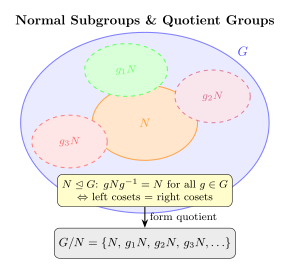
Normal subgroup. A subgroup is normal (written ) if any of the following equivalent conditions holds: (i) for all ; (ii) left and right cosets coincide, for all ; (iii) is the kernel of some group homomorphism from .
Quotient group. If , the set of cosets forms a group under , with by Lagrange.
Subgroups of . For each divisor there is exactly one subgroup of order , namely . Every subgroup is normal (abelian group). The quotient is cyclic of order : .
Question Archetypes
| Archetype | Recognition |
|---|---|
| normal-subgroup-test | Matrix/concrete group with a named subgroup; verify explicitly |
| list-quotients | ”Write all quotient groups of ”; enumerate by divisors, form cyclic quotients |
normal-subgroup-test (1 question(s); 2014)
Recognition Cues — a subgroup defined by a structural constraint (e.g., matrices with specified diagonal entries); asked to show it is normal, often after first verifying the ambient set is a group.
Solution Template
- (If needed) Verify is a group: check closure, note associativity is inherited, find identity, compute inverses.
- Write a general element and a general element .
- Compute explicitly.
- Show the result satisfies the defining property of — it lies in .
- Conclude for all ; hence .
Worked Example
2014 Paper 2, 2014-P2-Q1a (10 marks)
Let be the group of all real matrices with , under matrix multiplication. Let . Is a normal subgroup of ?
Part 1 — is a group. Write , .
Closure: . Upper-triangular; product of diagonal entries is .
Associativity: inherited from matrix multiplication.
Identity: has , so .
Inverses: since .
Hence is a group.
Part 2 — Normality. Take and general :
Since for every :
(Alternative: where maps — kernels are always normal.)
Common Traps
- Computing only for specific values of does not prove normality; the calculation must work for a general .
- The off-diagonal entry after conjugation is , not itself. The key is that is still real, so for every .
- In Part 1, the entry of is , not — write it correctly.
list-quotients (1 question(s); 2019)
Recognition Cues — “Write down all quotient groups of ”; any finite abelian cyclic group; asked for all (normal) subgroups and the corresponding quotients.
Solution Template
- Observe is abelian, so every subgroup is normal.
- List all divisors of .
- For each , the unique subgroup of order is .
- The quotient has order ; since a quotient of a cyclic group is cyclic, .
- Include the two improper quotients: gives ; gives .
Worked Example
2019 Paper 2, 2019-P2-Q2b (10 marks)
Write down all quotient groups of the group .
is abelian, so every subgroup is normal. Divisors of : .
| Subgroup | | Generator | | Quotient | |---|---|---|---|---| | | | — | | | | | | | | | | | | | | | | | | | | | | | | | | | | | | | | |
There are exactly 6 quotient groups, one for each of the 6 divisors of 12.
Common Traps
- “All quotient groups” includes the improper ones: and . Missing either loses marks.
- For a cyclic group all quotients are cyclic — there is no quotient of .
- A quick check: must equal in every row (Lagrange).
Marks-Aware Writing
Both questions are 10 marks. For the normal subgroup test: state the normality criterion explicitly, carry out the full computation for a general , and box the conclusion. Doing only specific examples scores at most 4 marks. For the quotient-group enumeration: present a complete table with subgroup, order, and quotient name; verify the count equals the number of divisors; state that all quotients are cyclic. Missing the two improper quotients loses 2–3 marks.
Practice Set
- 2018-P2-Q2a (15 m) — — Hint: define by , compute the kernel, apply the First Isomorphism Theorem.