Ring homomorphisms; quotient rings
At a Glance
- Frequency: 3 sub-parts across 3 of 13 years (2013, 2015, 2025)
- Priority tier: T3
- Marks (count): 15 (3)
- Average solve time: ~8 min
- Difficulty mix: medium 2, easy 1
- Section: A | Dominant type: proof
Why This Chapter Matters
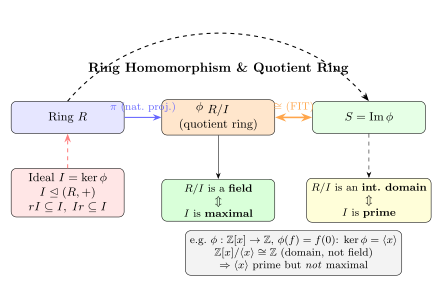
All three UPSC ring homomorphism questions are 15-mark proofs, making this the single highest-yield ring theory topic by total marks. They share a common engine: exhibit an evaluation homomorphism, identify its kernel as the target ideal, apply FIT to get the quotient ring, then classify it as a field (maximal ideal) or integral domain (prime ideal) or neither. Once you have this pipeline in muscle memory, all three archetypes — and any future variant — are solved with the same four-step argument.
Minimum Theory
Ring homomorphism. A map is a ring homomorphism if and for all . Many definitions also require (unital); UPSC questions sometimes ask you to prove this from surjectivity.
Ideal and quotient ring. A subset is an ideal if is a subgroup of and , for all . The quotient ring is a ring under and .
Key characterizations (commutative ring with unity). (i) is maximal is a field. (ii) is prime is an integral domain.
FIT for rings. If is a surjective ring homomorphism, then .
Question Archetypes
| Archetype | Recognition |
|---|---|
| ring-hom-property | Prove a structural property (e.g. ) using surjectivity + homomorphism law |
| maximal-ideal-quotient | Show an ideal is maximal by identifying a field via evaluation homomorphism |
| prime-maximal-via-hom | Use evaluation homomorphism to classify an ideal as prime but not maximal ( is a domain, not a field) |
ring-hom-property (1 question(s); 2015)
Recognition Cues — “Prove is the unit element of ”; or “prove a surjective ring homomorphism preserves [property]”; the word onto or surjective always appears — it is the load-bearing hypothesis.
Solution Template
- Let be arbitrary.
- By surjectivity, choose with .
- Compute .
- Compute .
- Since for all , .
Worked Example
2015 Paper 2, 2015-P2-Q2a (15 marks)
If is a ring with unit element and is a homomorphism of onto , prove that is the unit element of .
Let be arbitrary. By surjectivity, choose with . Then:
Since acts as a two-sided identity on every element of , and identities are unique, .
Why surjectivity is essential. Without it, is only an identity for the subring . Counterexample: , , is a non-surjective homomorphism with .
Common Traps
- Do not use as the definition of a ring homomorphism — the question asks you to prove it.
- Check both sides: and . For non-commutative , one side alone is not enough.
- Surjectivity is used exactly once: to find a preimage of the arbitrary .
maximal-ideal-quotient (1 question(s); 2013)
Recognition Cues — an ideal defined by a vanishing condition at a point, e.g. ; asked whether is a maximal ideal; the ring is typically a function ring.
Solution Template
- Define the evaluation homomorphism (or ) by .
- Show is a ring homomorphism (additive and multiplicative).
- Show is surjective.
- Show (elements vanishing at ).
- Apply FIT: . Since is a field, is a maximal ideal.
Worked Example
2013 Paper 2, 2013-P2-Q3b (15 marks)
Let be the ring of all real-valued continuous functions on under pointwise addition and multiplication. Let . Is a maximal ideal? Justify.
Step 1 — Evaluation homomorphism. Define by .
Additive: .
Multiplicative: .
Sends to : (constant function).
Step 2 — Surjectivity. For any , the constant function satisfies . So .
Step 3 — Kernel. .
Step 4 — FIT. .
Step 5 — Maximality. is a field. In a commutative ring with unity, is maximal is a field. Hence is maximal.
Common Traps
- Must verify all three parts of “homomorphism”: additivity, multiplicativity, and . Omitting multiplicativity loses marks.
- The characterisation used is: maximal a field (in a commutative ring with unity). State it explicitly.
- is also a prime ideal (since is also an integral domain), but the question asks for maximality — the field criterion suffices.
prime-maximal-via-hom (1 question(s); 2025)
Recognition Cues — evaluation homomorphism on a polynomial ring (, ); asked to prove a principal ideal is prime but not maximal; the quotient is a domain but not a field.
Solution Template
- Define the evaluation homomorphism by .
- Verify it is a (unital) ring homomorphism.
- Show is surjective.
- Identify (polynomials with root ).
- FIT: .
- If is an integral domain but not a field: is prime (but not maximal).
Worked Example
2025 Paper 2, 2025-P2-Q4a (15 marks)
Examine whether defined by is a homomorphism. Deduce that is a prime ideal in , but not a maximal ideal.
Step 1 — Homomorphism. For :
So is a (unital) ring homomorphism.
Step 2 — Surjectivity. For any , the constant polynomial gives . So .
Step 3 — Kernel. .
Step 4 — FIT. .
Step 5 — is prime. is an integral domain (no zero divisors). Hence is a prime ideal.
Step 6 — is not maximal. is not a field ( has no inverse in ). So a field, and is not maximal. (Witness: .)
Common Traps
- Identifying the kernel exactly as (polynomials with zero constant term = divisible by ) is the technical heart; state this clearly.
- Confusing the two characterisations: prime is an integral domain; maximal is a field. is a domain but not a field.
- For non-maximality, state a concrete witness: the ideal strictly contains and is strictly smaller than .
Marks-Aware Writing
All three questions are 15 marks. The common structure is: homomorphism verified (3 marks), surjectivity (2 marks), kernel identified (3 marks), FIT stated and applied (3 marks), ideal classified (4 marks). For prime/maximal classification, you must state the relevant theorem (“prime domain, maximal field”) and apply it — a bare assertion without the theorem earns at most half marks.
Practice Set
- 2023-P2-Q3a (15 m) — — Hint: use an evaluation or natural projection homomorphism; identify kernel and quotient.
- 2016-P2-Q1a (10 m) — — Hint: verify ring axioms; check whether the ideal is maximal via the quotient.