Subrings and ideals
At a Glance
- Frequency: 4 sub-parts across 4 of 13 years (2015, 2022, 2023, 2024)
- Priority tier: T3
- Marks (count): 10 (2), 15 (2)
- Average solve time: ~8 min
- Difficulty mix: easy 2, medium 2
- Section: A | Dominant type: proof
Why This Chapter Matters
Ideal questions in Section A reward knowledge of three templates: (a) give an example of a ring with a subring having a different identity; (b) show a set is an ideal, identify it as a principal ideal, and analyse the quotient ring; (c) use the First Isomorphism Theorem for rings to prove an ideal is prime (quotient is an integral domain) but not maximal (quotient is not a field). All three appear in the 10–15 mark range and are algorithmic once you know which template applies.
Minimum Theory
Ideal. A non-empty subset of a ring is a (two-sided) ideal if: (1) for all ; (2) for all , .
Principal ideal. The ideal generated by a single element : (in a commutative ring).
Quotient ring. If is an ideal of , the quotient is a ring with cosets as elements.
Prime vs maximal ideal.
- is prime is an integral domain.
- is maximal is a field.
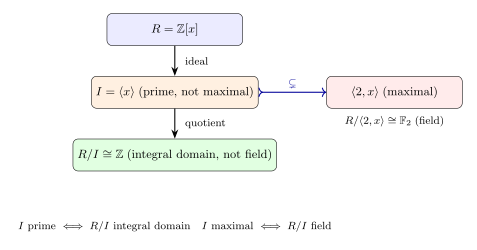
- Every maximal ideal is prime; the converse fails (e.g. in ).
First Isomorphism Theorem (rings). If is a surjective ring homomorphism with , then .
Idempotent subring trick. In , an element with (idempotent, ) generates a subring with identity . This gives the standard example of a subring with a different identity.
Question Archetypes
| Archetype | Recognition |
|---|---|
| ring-example | ”Give an example of a ring with subring having a different identity” |
| ideal-quotient | Show a set is an ideal; identify it as principal; classify |
| prime-maximal-ideal | Prove via First Isomorphism Theorem that is prime but not maximal |
ring-example (1 question(s); 2015)
Worked Example
2015 Paper 2, 2015-P2-Q1b (10 marks)
Give an example of a ring having identity but a subring of this having a different identity.
Take (identity ) and .
is a subring: ; ; , etc. Closure under and holds.
Identity of : , , — so acts as the multiplicative identity of .
Since , and have different identities.
Recognition pattern for other examples: in for composite , any idempotent (satisfying ) generates a subring with identity . In : ✓ and ✓ (so also works with identity ).
Common Traps
- Don’t confuse “subring” conventions. Some authors require a subring to contain the parent ring’s identity; UPSC uses the broader definition (closed under , with its own identity that may differ).
- Check idempotent: . Without this, need not act as an identity on the generated subring.
ideal-quotient (1 question(s); 2022)
Worked Example
2022 Paper 2, 2022-P2-Q4a (15 marks)
Let . Prove is an ideal of . Is an integral domain?
is an ideal: ; if then , so ; if and , then and , so . ✓
Identify : iff both and divide . Since , this means . So .
is NOT an integral domain: the generator is reducible, so the quotient has zero divisors: but and . ( by CRT.)
Common Traps
- Closure under right-multiplication by . An ideal requires for all , not just for . Write the proof for an arbitrary .
- Identifying the generator. Both and must divide because the conditions are AND simultaneously. Don’t stop at ”.“
prime-maximal-ideal (1 question(s); 2025)
Worked Example
2025 Paper 2, 2025-P2-Q4a (15 marks)
Show , , is a homomorphism. Deduce is prime but not maximal in .
Homomorphism: and , and . ✓
Surjectivity: the constant polynomial maps to .
Kernel: .
First Isomorphism Theorem: .
- is an integral domain is prime.
- is not a field ( has no inverse) is not maximal.
(Concrete witness of non-maximality: , where .)
Common Traps
- Surjectivity must be verified. Without confirming is onto, the First Isomorphism Theorem only gives , not .
- “Not maximal” needs a witness or the field criterion. Saying ” is not a field” is the clean argument; alternatively, exhibit the chain .
- Prime maximal in general. In (a PID), every nonzero prime is maximal. In (not a PID by Krull dimension 2), there are prime ideals that are not maximal — is the canonical example.
Marks-Aware Writing
For a 10-mark example question: give the ring, identify the subring, construct the multiplication table of the subring (or verify closure by explicit computation), and identify the identity. Three lines of explicit arithmetic plus the conclusion.
For a 15-mark ideal+quotient proof: three parts — (a) ideal axioms verified explicitly, (b) the ideal identified as principal with the generator named, (c) the quotient analysis with zero divisors exhibited or the CRT structure stated. Skipping any of the three parts costs 4–5 marks.
Practice Set
- 2023-P2-Q1b (10 m) — — Hint: Bezout’s theorem; , so in .