Cauchy-Riemann equations (necessary and sufficient)
At a Glance
- Frequency: 5 sub-parts across 5 of 13 years (2014, 2019, 2020, 2023, 2024)
- Priority tier: T2
- Marks (count): 10 (4), 15 (1)
- Average solve time: ~8 min
- Difficulty mix: easy 3, medium 2
- Section: A | Dominant type: proof
Why This Chapter Matters
The Cauchy-Riemann equations are the single most-tested idea in complex analysis at this level: every year from 2019 to 2024 carried a CR question. They appear in four flavours — showing CR hold but the derivative fails, proving an analytic function must be constant, recovering an analytic function from one harmonic part, and verifying analyticity using CR directly — and a candidate who can execute all four is essentially guaranteed full marks on any Section A complex-analysis part. The polar form of the CR equations, often overlooked, is indispensable for the recovery archetype and for .
Minimum Theory
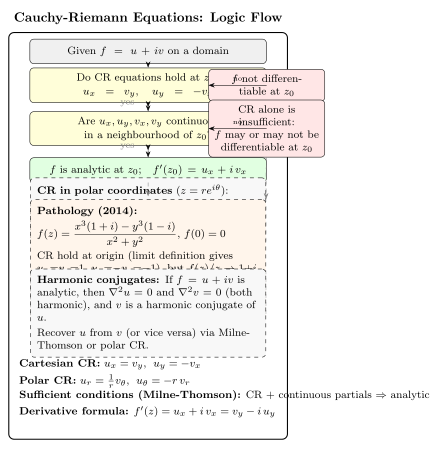
CR equations (Cartesian). If is differentiable at then the partial derivatives satisfy These are necessary for differentiability. Alone they are not sufficient: the classic pathology (2014) shows CR can hold at a point while fails to exist.
Sufficient conditions (Milne-Thomson theorem). If and have continuous first-order partial derivatives on an open neighbourhood of and the CR equations hold at , then is analytic at and The continuity of partials in a neighbourhood (not just at the point) is the extra ingredient that converts CR into analyticity.
CR equations (Polar). With , , : Use these when the given harmonic part is expressed in — the recovery archetype always arrives in polar form.
Harmonic conjugates. If is analytic on a domain, then and ; is called a harmonic conjugate of . Conversely, given a harmonic function (or ), a conjugate can be recovered by integrating the CR relations.
Question Archetypes
| Archetype | Recognition cue |
|---|---|
| cr-pathology | ”Show CR hold at a point but does not exist” |
| analytic-constant | ”Prove analytic with (or similar constraint) is constant” |
| recover-analytic-polar | ”Given or , find analytic “ |
| analyticity-conditions | ”State sufficient conditions; show is analytic; find “ |
| verify-cr | ”Verify CR / show analyticity for built from harmonic “ |
cr-pathology (1 question; 2014)
Show the Cauchy-Riemann equations hold at a point yet the derivative fails to exist.
Recognition Cues
The question gives a piecewise-defined (often with a rational formula elsewhere) and asks to verify CR at the origin and show that does not exist. The key signal is that two limits of along different paths disagree.
Solution Template
- Write and read off and from the formula.
- Compute and using the limit definition: Do the same for and . Confirm and .
- Test along two different paths (e.g., real axis and diagonal ). Obtain two different limits.
- Conclude: CR necessary conditions hold, but the limit is path-dependent, so does not exist. State that the partials are not continuous in any neighbourhood of .
Worked Example
2014 Paper 2, 2014-P2-Q1c (10 marks)
Let for and . Show CR equations are satisfied at but does not exist.
Separate real and imaginary parts:
CR at the origin (limit definition):
Check: \checkmark, \checkmark. CR hold at the origin.
Derivative fails to exist:
Along the real axis ():
Along the diagonal (, ):
Since , the limit of as is path-dependent. Therefore does not exist.
Common Traps
- Do not compute partials by the quotient rule at . The formula is not differentiable at the origin by inspection; you must use the limit definition, otherwise you are dividing by zero.
- One path is not enough. Showing along the real axis only says the limit exists along that path; you need a second path that gives a different value to prove non-existence.
- “CR at a single point” is the entire point of this archetype. The partials are discontinuous in every punctured neighbourhood of , which is why the Milne-Thomson sufficient condition fails.
analytic-constant (1 question; 2019)
Show that an analytic function satisfying a relation between and must be constant.
Recognition Cues
The question states ” is analytic on a domain ” and imposes a constraint such as , , , or . The instruction is “show is constant.” The method is always: differentiate the constraint, substitute CR, factor into a product , conclude the partials are zero, hence is constant on the connected domain.
Solution Template
- Write the constraint explicitly: e.g. .
- Differentiate in and to get in terms of .
- Substitute CR (, ) to obtain a system purely in .
- Eliminate one variable: substitute the first equation into the second to obtain where everywhere.
- Conclude , back-substitute to get .
- State: all partials vanish on connected constant constant.
Worked Example
2019 Paper 2, 2019-P2-Q1d (10 marks)
Let be analytic on a domain and throughout . Prove is constant.
Differentiate :
Apply CR (, ):
Substitute the first equation into the second:
Since for all real , we must have .
Then , and from , .
All four partial derivatives vanish on the connected domain , so and are individually constant, hence
Common Traps
- Do not divide by . If somewhere the division is invalid; instead factor out to get and use the positivity of .
- Connectedness is essential. All-zero partials imply constancy only on a connected domain. If is disconnected, is only piecewise constant. State “connected domain” in the conclusion.
- Check both CR equations are used. The proof uses and ; skipping one leaves the system underdetermined and the examiner will deduct marks.
recover-analytic-polar (1 question; 2020)
Given one harmonic part in polar coordinates, recover the full analytic function .
Recognition Cues
The question gives (or ) in polar form and asks to find . The signal words are “find an analytic function” or “determine .” Since the given part contains and , the polar CR equations are the correct tool; using Cartesian CR leads to messy algebra.
Solution Template
- Compute and from the given .
- Use polar CR: and .
- Integrate with respect to , holding fixed: .
- Differentiate w.r.t. and match with from step 2 to find , then (usually a constant ).
- Write and recognise the combination as a known function of (often , , etc.), absorbing .
Worked Example
2020 Paper 2, 2020-P2-Q4a (15 marks)
If , find the analytic function .
Compute and :
Apply polar CR to find :
Integrate with respect to :
Find via : Polar CR also gives .
Matching: , so (constant).
Assemble :
Recognise using :
Common Traps
- Use polar CR, not Cartesian. Converting to Cartesian and then applying is algebraically correct but extremely messy; polar CR is the designed tool.
- Do not forget . Integrating in leaves an arbitrary function of that must be determined. Omitting this is the most common error.
- Recognise the closed form. After assembling , factor out and to write the answer as an elementary function of ; leaving it in form loses the elegance and may cost presentation marks.
analyticity-conditions (1 question; 2023)
State the sufficient conditions for analyticity, verify them for , and compute the derivative.
Recognition Cues
The question explicitly asks to “state sufficient conditions” before the application, signalling that a theorem statement is required. The application is typically , , or a rational function, and always involves identifying a branch cut (the standard principal branch of has a cut along ).
Solution Template
- State the theorem: If , have continuous first-order partial derivatives in an open neighbourhood of , and if the CR equations , hold at , then is analytic at and .
- Write the given function in form; specify the domain (eliminate the branch cut).
- Compute all four partials .
- Verify CR hold identically on the domain.
- Check continuity (usually obvious for rational expressions in ).
- Apply the formula and simplify to a function of .
Worked Example
2023 Paper 2, 2023-P2-Q1d (10 marks)
State sufficient conditions for a function to be analytic. Show that is analytic for with a suitable branch cut, and find .
Theorem statement. If exist and are continuous in an open neighbourhood of , and the CR equations , hold at , then is analytic at with .
Apply to . Take the principal branch: on .
Partial derivatives:
Verify CR:
All four partials are continuous on away from the branch cut. By the theorem, is analytic on .
Derivative:
Common Traps
- CR alone is not sufficient. A common exam error is stating only “CR hold analytic.” The theorem requires both CR and continuity of the partials in a neighbourhood. State both conditions.
- Specify the branch cut. is multivalued; without specifying the principal branch cut along , the argument that is a well-defined real function is incomplete. Examiners expect the domain to be stated.
- Use the formula directly. Computing from scratch (e.g., using ) is longer than just evaluating and simplifying to .
verify-cr (1 question; 2024)
Verify the CR equations for where and are defined in terms of two harmonic functions.
Recognition Cues
The question defines and explicitly as linear combinations of partial derivatives of given harmonic functions and , and asks to show is analytic. The harmonic condition (, ) is what makes the two CR equations close.
Solution Template
- Write out , , , by differentiating the given expressions for and .
- Form and ; group terms to isolate and .
- Use and to conclude both expressions equal zero.
- State: and (CR), partials continuous (since are harmonic hence smooth), therefore is analytic.
Worked Example
2024 Paper 2, 2024-P2-Q1d (10 marks)
If and are harmonic functions of , show that is analytic where and .
Compute partial derivatives of and :
First CR equation (): since is harmonic. Hence \checkmark.
Second CR equation (): since is harmonic. Hence \checkmark.
Since and are harmonic (and hence ), all partial derivatives of and are continuous. By the Milne-Thomson sufficient conditions:
Common Traps
- Equality of mixed partials is assumed. The calculation uses and ; these hold because harmonic functions are , but state it explicitly if the examiner is strict.
- Each harmonic condition closes exactly one CR equation. harmonic closes ; harmonic closes . If you mix them up, the terms will not cancel — this is a useful self-check.
- Explicitly invoke the sufficient conditions at the end. State “CR hold and partials are continuous (harmonic functions are smooth), so by the Milne-Thomson theorem is analytic.” A proof that only shows CR hold without citing continuity of partials is technically incomplete.
Marks-Aware Writing
For a 10-mark CR question: UPSC expects (i) explicit computation of all four partials or limit-definition values, (ii) a clear check of both CR equations with tick marks or “hence CR satisfied”, and (iii) either a path-dependence argument (pathology) or an invocation of the sufficient conditions theorem (analyticity). Showing only one of the two CR equations earns at most half credit.
For the 15-mark recovery question (2020): Show all intermediate steps — both and , the integration constant argument, and the assembly into a closed form of . The final boxed answer is worth 3–4 marks; the working leading to it is worth 10–11. Do not skip the determination step.
Theorem statement questions (2023 style): Examiners expect the exact statement of the Milne-Thomson theorem with all three hypotheses: (a) existence of partials, (b) continuity of partials in a neighbourhood, (c) CR equations hold. Omitting (b) is the single most penalised error in this atom.
Practice Set
- 2023-P2-Q3b (15 m) — — analytic function recovery via Milne-Thomson; closely related to the 2020 polar recovery
- 2015-P2-Q1d (10 m) — — verify CR and find for an explicit function; good warm-up for the verify-cr archetype
- 2022-P2-Q1b (10 m) — — analytic-constant variant with a different constraint on
- 2018-P2-Q1c (10 m) — — CR pathology variant; practise the limit-definition method
- 2017-P2-Q3b (15 m) — — polar recovery with a different harmonic part; longer algebra
- 2016-P2-Q1d (10 m) — — standard analyticity-conditions question; practise theorem statement + log-z application