Frequency: 5 sub-parts across 5 of 13 years (2013, 2015, 2016, 2021, 2022)
Priority tier: T2
Marks (count): 10 (2), 15 (3)
Average solve time: ~8 min
Difficulty mix: easy 3, medium 1, hard 1
Section: A | Dominant type: computation
Why This Chapter Matters
Cauchy’s residue theorem converts a contour integral — which would otherwise require parametrisation and real calculus — into pure algebra: locate poles, compute residues, sum them, multiply by 2πi. UPSC has set this exactly five times in the window 2013–2022 with very little variation: four questions ask you to evaluate a specific contour integral, and one asks you to count zeros via Rouché’s theorem. Mastering the residue formula for simple and double poles covers four of those five questions; Rouché adds the fifth at the cost of a single short argument. This is one of the most mark-efficient atoms in Paper 2 Complex Analysis.
Minimum Theory
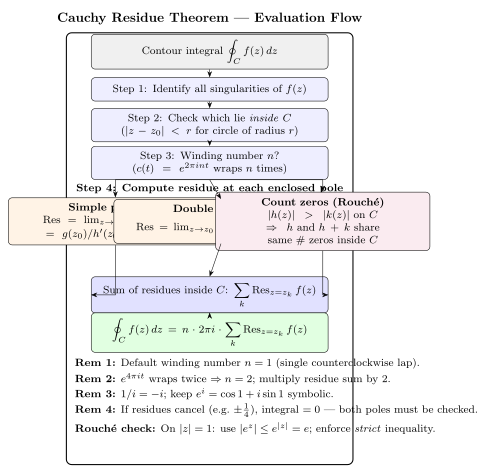
Cauchy’s Residue Theorem. Let f be analytic on and inside a simple closed positively-oriented contour C, except at finitely many isolated singularities z1,z2,…,zn inside C. Then
∮Cf(z)dz=2πi∑k=1nResz=zkf(z).
If the curve winds n times around the region (winding number n), multiply the right-hand side by n.
Residue formulas.
Simple pole at z0:Resz=z0f(z)=limz→z0(z−z0)f(z).
If f(z)=g(z)/h(z) with h(z0)=0, h′(z0)=0, this simplifies to g(z0)/h′(z0).
Double pole at z0:Resz=z0f(z)=limz→z0dzd[(z−z0)2f(z)].
Rouché’s Theorem. If h and k are analytic on and inside a simple closed contour C, and ∣h(z)∣>∣k(z)∣ for all z on C, then h(z) and h(z)+k(z) have the same number of zeros (counting multiplicity) inside C. The key step is always to find the “dominant” term h and verify the strict inequality on the boundary.
Question Archetypes
Archetype
Recognition
residue-theorem-evaluation
”Evaluate ∮C…dz” — function with poles, contour given explicitly
rouche-theorem
”Prove that [expression] has n zeros inside [contour]“
Evaluate a closed-contour integral via the Cauchy residue theorem
Recognition Cues
The question gives a rational or meromorphic function of z and a specific contour — either a circle ∣z−a∣=r or a parametric curve c(t)=e2πint. The instruction is “evaluate” or “using Cauchy’s residue theorem, find.” The answer is always a complex number (often a multiple of πi).
Solution Template
State the theorem (required when the question says “state and use”).
Find all poles of f(z) by solving the denominator = 0 (or factoring).
Test each pole: check whether ∣zk−a∣<r for the given circle, or whether ∣zk∣<1 for the unit circle. Mark each as inside/outside C.
Compute the residue at each pole inside C:
Simple pole: use g(z0)/h′(z0) where f=g/h.
Double pole: differentiate (z−z0)2f(z) and evaluate at z0.
Check the winding numbern (from the parametrisation c(t)=e2πint; most circles have n=1).
Assemble:∮Cfdz=n⋅2πi⋅∑Res.
Worked Example 1
2015 Paper 2, 2015-P2-Q3a (15 marks)
State Cauchy’s residue theorem and use it to evaluate ∫Cz(z+1)(z−i)2ez+1dz where C:∣z∣=2.
Step 1 — State the theorem. Cauchy’s Residue Theorem: if f is analytic inside and on simple closed contour C except at isolated singularities z1,…,zn inside C, then
∮Cf(z)dz=2πi∑k=1nResz=zkf(z).
Step 2 — Locate poles. Denominator zeros: z=0 (simple), z=−1 (simple), z=i (double). All satisfy ∣z∣<2, so all three lie inside C.
Step 3 — Residues.
At z=0 (simple):Resz=0=(0+1)(0−i)2e0+1=(1)(−1)2=−2.
At z=−1 (simple):Resz=−1=(−1)(−1−i)2e−1+1=(−1)(2i)1+e−1=2i(1+e−1).
At z=i (double): Write ϕ(z)=(ez+1)/[z(z+1)]; then f(z)=ϕ(z)/(z−i)2 and
Resz=i=ϕ′(i).
Let ψ(z)=z2+z. Then
ϕ′(z)=ψ(z)2ezψ(z)−(ez+1)ψ′(z),ψ′(z)=2z+1.
At z=i: ψ(i)=i2+i=−1+i, so ψ(i)2=(−1+i)2=−2i.
Double pole derivative. For z=i in the 2015 question the residue requires differentiating ϕ(z)=(ez+1)/(z2+z) — not just evaluating it. Forgetting the product rule here is the most common source of error on that question.
Both poles are inside in the 2016 question.z=21 and z=−21 both have modulus 21<1. A common mistake is to enclose only one. Since their residues are +41 and −41 respectively, the sum is zero and the integral is exactly 0.
Winding number from parametrisation.c(t)=e4πit gives n=2, not n=1. The extra factor of 2 turns −32πi into −34πi.
1/i=−i. When simplifying residues involving i in the denominator, use i1=−i (since i⋅(−i)=1). Writing i1=i is a frequent arithmetic error.
Centre-to-pole distance. In the 2022 question the circle is not centred at the origin. Compute ∣zk−centre∣, not ∣zk∣.
rouche-theorem (1 question(s); 2013)
Count zeros inside a contour via Rouché’s theorem
Recognition Cues
The question asks you to prove that a given expression has exactly n zeros inside a specified contour, or to show that two functions have the same number of zeros. It will always provide a condition like bea+1<1 that you will need to translate into the strict inequality ∣h∣>∣k∣ on the boundary.
Solution Template
Split the expression into two parts: identify a “dominant” function h(z) (whose zeros you know) and a “perturbation” k(z).
Bound ∣k(z)∣ on the contour C using ∣ez∣=eRe(z)≤e∣z∣ or similar.
Verify∣h(z)∣>∣k(z)∣ strictly on C using the given condition.
Conclude by Rouché: h+k has the same number of zeros inside C as h.
Count zeros of h inside C (often a power zn with n zeros at the origin).
Worked Example
2013 Paper 2, 2013-P2-Q1d (10 marks)
Using Rouché’s theorem, prove that zne−a−bez has n zeros inside the unit circle ∣z∣=1, given that bea+1<1.
Step 1 — Choose the split. Write the expression as h(z)+k(z) where
h(z)=zne−a,k(z)=−bez.
Step 2 — Bound on ∣z∣=1.
On ∣z∣=1: ∣h(z)∣=∣z∣ne−a=e−a.
For ∣k(z)∣: using ∣ez∣=eRe(z)≤e∣z∣=e1=e,
∣k(z)∣=b∣ez∣≤be.
Step 3 — Apply the condition. The given hypothesis bea+1<1 is equivalent to be⋅ea<1, i.e. be<e−a. Therefore
∣k(z)∣≤be<e−a=∣h(z)∣for all z on ∣z∣=1.
Step 4 — Rouché’s conclusion. Since ∣h(z)∣>∣k(z)∣ on ∣z∣=1, Rouché’s theorem guarantees that h(z)+k(z)=zne−a−bez has the same number of zeros inside ∣z∣=1 as h(z)=zne−a.
Step 5 — Count zeros of h.h(z)=e−azn has exactly n zeros at z=0 (multiplicity n) inside ∣z∣=1. ■
Common Traps
Strict inequality is essential. Rouché requires ∣h∣>∣k∣ (strict) on the boundary, not ∣h∣≥∣k∣. Always verify the inequality is strict; here it follows from bea+1<1 (strict).
∣ez∣=eRe(z), not e∣z∣. On ∣z∣=1 we need Re(z)≤∣z∣=1, so ∣ez∣≤e. Writing ∣ez∣=e∣z∣ as an equality is imprecise; it is only an upper bound.
Choosing the right dominant term.h should be the term whose zeros you want to count. Here h=zne−a has n zeros at the origin — exactly the desired conclusion.
Marks-Aware Writing
For a 10-mark residue question (e.g., 2021-P2-Q1d): state the winding number explicitly, identify which poles lie inside, compute each residue showing at least one line of working, and box the final answer. Skipping “step 2 — check which poles are inside” loses 2–3 marks even if the final number is correct.
For a 15-mark residue question (e.g., 2015-P2-Q3a): if the question says “state and use,” write out the theorem statement in full before any computation — this is worth 3–4 marks by itself. For the double pole at z=i, show the derivative calculation explicitly; the examiner will check the quotient-rule step.
For a 10-mark Rouché question (e.g., 2013-P2-Q1d): write out h and k explicitly, show the bound on ∣k∣ using the given numerical condition, state the conclusion of Rouché’s theorem in words (”h+k has the same number of zeros as h inside C”), and then count the zeros of h. Four steps, one mark each is the typical allocation.
Practice Set
2013-P2-Q4b (15 m) — — residue evaluation with multiple poles; practice locating and computing each residue methodically
2017-P2-Q2b (15 m) — — standard residue evaluation; good drill for the simple-pole formula
2018-P2-Q3b (15 m) — — residue evaluation; check for pole order carefully
2020-P2-Q2c (20 m) — — higher-mark question; may involve more poles or a harder contour
2021-P2-Q4b (20 m) — — extended evaluation; practice assembling several residues into the final integral
2022-P2-Q2c (20 m) — — verify centre-to-pole distance arithmetic under time pressure
2022-P2-Q8c (20 m) — — complex arithmetic drill; keep ei symbolic throughout
2025-P2-Q2c (20 m) — — recent question; establishes current exam style
2025-P2-Q3a (15 m) — — recent question; confirms the theorem-state-then-use format persists
We've mapped all 13 years of this exam. Get new chapters, tools, and solutions as we release them — free.