Cauchy’s theorem (Cauchy-Goursat)
At a Glance
- Frequency: 2 sub-parts across 2 of 13 years (2019, 2020)
- Priority tier: T3
- Marks (count): 10 (2)
- Average solve time: ~8 min
- Difficulty mix: easy 1, medium 1
- Section: A | Dominant type: computation
Why This Chapter Matters
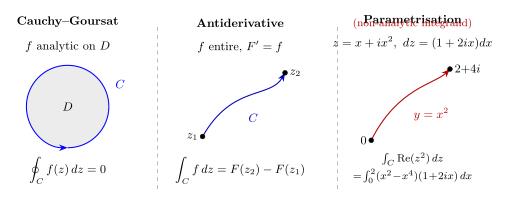
Two distinct question types appear under this atom, and mixing them up is the most dangerous error. When the integrand is analytic (entire), the integral depends only on endpoints and you use a complex antiderivative — the contour itself is irrelevant. When the integrand is non-analytic (e.g. ), the integral is path-dependent and must be evaluated by explicit parametrisation. The 2020 question is the path-independent type (5 minutes of work); the 2019 question is the parametrisation type (9 minutes). Both are worth 10 marks in Section A.
Minimum Theory
Cauchy-Goursat theorem. If is analytic on and inside a simple closed contour , then .
Fundamental theorem for contour integrals. If is analytic on a domain and is an antiderivative of on (i.e. ), then for any contour in from to : In particular the value is independent of the path. Entire functions (analytic on all of ) always have global antiderivatives.
Parametrisation. If is not analytic, there is no antiderivative and the integral must be computed by choosing a parametrisation , , and reducing to Split into real and imaginary parts and integrate each separately.
Question Archetypes
| Archetype | Recognition |
|---|---|
| antiderivative-integral | integrand is a polynomial or entire function; endpoints given; contour irrelevant |
| contour-parametrize | integrand contains , , , or $ |
antiderivative-integral (1 question(s); 2020)
Recognition Cues — The integrand is a polynomial such as , or any entire function. The problem specifies a start and end point and mentions a curve, but because the function is entire and has a global antiderivative, the curve description is a red herring for the value of the integral. You only need the two endpoints.
Solution Template
- Confirm the integrand is entire (polynomial, , , etc.).
- Find an antiderivative such that .
- Identify the endpoints (start) and (end) from the geometric description.
- Compute , carefully evaluating powers of .
Worked Example
2020 Paper 2, 2020-P2-Q1d (10 marks)
Evaluate the integral counterclockwise from to along the curve , where is the circle .
Step 1 — The integrand is entire. is a polynomial, hence analytic on all of . Its antiderivative is
Step 2 — Identify endpoints. The point corresponds to and corresponds to .
Step 3 — Evaluate the antiderivative at each endpoint.
Step 4 — Subtract.
Common Traps
- The phrase “along the circle ” tempts you to parametrize — do not. When the integrand is entire, the contour description only determines the endpoints.
- and ; sign errors here are the most common arithmetic mistake.
- The endpoints are and , not and mislabeled as unit multiples.
contour-parametrize (1 question(s); 2019)
Recognition Cues — The integrand is a real part or modulus: , , , . These are not analytic, so there is no antiderivative and the value is path-dependent. The problem specifies the exact curve (parabola, line segment, semicircle) because the curve must be parametrized explicitly.
Solution Template
- Write the parametrisation , , consistent with the given curve and direction.
- Compute and express the integrand in terms of .
- Split into real and imaginary parts: .
- Evaluate each integral using standard calculus.
Worked Example
2019 Paper 2, 2019-P2-Q3c (10 marks)
Evaluate the integral from to along the curve where is the parabola .
Step 1 — Parametrize the curve. On , write for . Then
Endpoints check: ; . Correct.
Step 2 — Compute the integrand. Since with :
Step 3 — Assemble and split.
Step 4 — Evaluate each integral.
Common Traps
- , a real scalar — not itself. The integrand is non-analytic; do not look for an antiderivative.
- is complex. The factor produces the imaginary part of the answer via the odd-power integrals; omitting it gives zero imaginary part, which is wrong.
- Arithmetic check: and .
Marks-Aware Writing
For a 10-mark answer on this atom, the examiner expects: (a) a one-sentence justification of the method (entire use antiderivative; non-analytic must parametrize), (b) all intermediate algebra shown, and (c) a clearly boxed numerical answer. Omitting the justification step typically costs 2–3 marks. For the parametrisation type, also show explicitly — leaving it implicit is penalised.
Practice Set
- 2024-P2-Q2c (20 m) — — Hint: identify whether the integrand is analytic; if not, set up a parametrisation and split into real and imaginary integrals.